
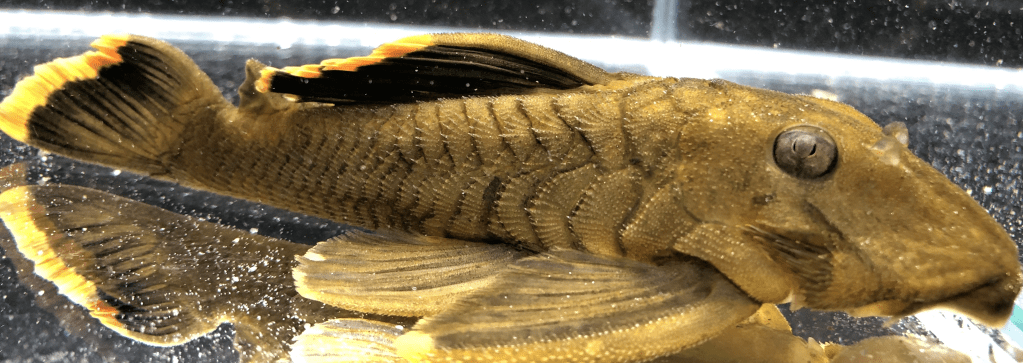
Now this is only an introduction to my favourite dietary niche, I think. When algae eating is mentioned most will think about Loricariids, a 1,040 species strong family of Siluriformes (catfishes) according to Catalog of Fishes as of 2023 but many many more are to be described and discovered. It might be the small Otocinclus or the reasonably sized Pterygoplichthys and Hypostomus, if in the aquarium hobby even just a short time a wider diversity of this family becomes obvious with almost everyone having kept the common bristlenose, Ancistrus aff. cirrhosus or one of the ‘L numbers’ as they are called regardless if they have a number or not.
It’s also pretty well known that there are other fishes who do not rasp, maybe in the same way and feed on algaes, the diversity of Rift Valley cichlids who are a model taxa for adaptive radiation (McGee et al., 2020) has many species that frequently feed on algaes (McKaye & Marsh, 2020). The extent of their specialisation is certainly interesting given they are more then capable of generalisation where possible as explained in the Liems paradox (Liem, 1980). There is definitely the Gastromyzontidae, these are the hillstream loaches and looking at their mouth parts they don’t rasp in the same way to Loricariids.
So if not Loricariids what am I talking about? And ignoring those other groups? When looking at the mouth of any Loricariid you can’t help but notice those big rasping plates, part of the reason these are the suckermouth fishes. But are there others?
Loricariids obviously dominate South America, yet elsewhere that clade is not found. Africa, a vast but underrated continent when looking beyond the Rift Valley, we need to look no further then the secretly well known but diverse family, Mochokididae. I cannot even just express how fascinating this family is for algae raspers.

Synodontis, the genus anyone with Rift Valley will be aware of. But there is a lot more to this genus, they are found further then the Rift Valley and across the vast nature of Synodontis. There is also a wide diversity of diets within this genus (Yongo et al., 2019). Synodontis brichardi, S. shoutedeni and S. victoriae (Elison et al., 2018) are well known algae raspers, sometimes based on that very specialised rasping morphology. There has been little studies to whether they are able to generalise but in my personal experience I have seen Synodontis brichardi at least be able and willing to feed on live earthworms over algae, Liems paradox maybe?

There is one other Mochokidae you might not have heard of regarding algae rasping, Chiloglanis although others I shall not have the time to mention (Gerrinckx & Kegal, 2014) . A good sized genus, Chiloglanis (Van Wassenbergh et al., 2009) these feed on algaes and other Periplankton. They are not common in the trade but maybe they should be? As riverine fishes adapted to low flow maybe they should be?
Looking towards Asia Sisoridae (Mousavi-Sabet et al., 2021) could contain many algae raspers but maybe just adapted to that high velocity water?
The answer might be partially is there other taxa that might rasp on the algae or how much do we know about fish diets? Most understanding seems reasonably limited.
While I say all of this it doesn’t mean they are eating exclusively algae but maybe other periplankton or aufwuch by a specific feeding motion. The jaws outside of Loricariid seem to be a lot less diverse and more specialised competing I assume with other species and genera whereas Loricariidae dominate so much.
References:
Elison, M. V., Mlaponi, E., Musiba, M. J., NGUPULA, G. W., Kashindye, B. B., & Kayanda, R. J. (2018). Changes in the Diet of Synodontis victoriae and Synodontis afrofischeri in Lake Victoria, Tanzanian waters. African Journal of Tropical Hydrobiology and Fisheries, 16(1), 10-15.
Geerinckx, T., & De Kegel, B. (2014). Functional and evolutionary anatomy of the African suckermouth catfishes (Siluriformes: Mochokidae): convergent evolution in Afrotropical and Neotropical faunas. Journal of Anatomy, 225(2), 197-208.
Liem, K. F. (1980). Adaptive significance of intraspecific and interspecific differences in thefeeding repertoires of cichlid fishes. American Zoologist20,295 – 314.
McGee, M. D., Borstein, S. R., Meier, J. I., Marques, D. A., Mwaiko, S., Taabu, A., Kiche, M. A., O’Meara, B., Bruggmann, R., Excoffier, L. & Seehausen, O. (2020). The ecological and genomic basis of explosive adaptive radiation. Nature, 586(7827), 75-79.
McKaye, K. R., & Marsh, A. (1983). Food switching by two specialized algae-scraping cichlid fishes in Lake Malawi, Africa. Oecologia, 56, 245-248.
Mousavi-Sabet, H., Eagderi, S., Vatandoust, S. A. B. E. R., & Freyhof, J. Ö. R. G. (2021). Five new species of the sisorid catfish genus Glyptothorax from Iran (Teleostei: Sisoridae). Zootaxa, 5067(4), 451-484.
Van Wassenbergh, S., Lieben, T., Herrel, A., Huysentruyt, F., Geerinckx, T., Adriaens, D., & Aerts, P. (2009). Kinematics of benthic suction feeding in Callichthyidae and Mochokidae, with functional implications for the evolution of food scraping in catfishes. Journal of Experimental Biology, 212(1), 116-125.
Yongo, E., Iteba, J., & Agembe, S. (2019). Review of food and feeding habits of some Synodontis fishes in African freshwaters. OFOAJ, 10, 27-31.
 The Scientific Fishkeeper