
This touches on a very controversial topic, what should you feed your discus fish? Strangely this fish has been described as a carnivore, an invertivore or an insectivore sometimes these myths are impossible to track down the origins. As a result traditionally for many years the answer has been beefheart, there is a lot to unpack about beefheart but equally as much about dry diets. No doubt that beefheart does result in weight gain (Reis et al., 2022; Wen et al., 2018) but it would not be fair entirely to compare it to dry diets given the diversity of dry diets out there. But this is half the story, these fishes are not carnivores in the wild.
Interestingly wild fish show a higher muscle protein content and crude fat was lower then domestic fishes (Wang et al., 2016) although I cannot identify the diet of those domestic fishes. So there is definitely a difference between these fishes, it could also be due to activity levels between the wild and domestic fishes.
There is only one paper specifically covering what these fishes eat in the wild, Crampton (2008). In this study the diet of Symphysodon “haraldi” was identified using gut analysis, as this species name is no longer valid (Amado et al., 2011) and the locality of these fishes being from the Rio Tefe these are probably Symphysodon tarzoo, the green discus identified by spots on the anal fin. This matters because there are other species of discus, Symphysodon aequifasciatus (Blue discus) and S. discus (Heckels) along with one undescribed species known as the blue discus and the undescribed Rio Xingu discus (Amado et al., 2011). Domestics result from a hybridisation of a variety of these species.
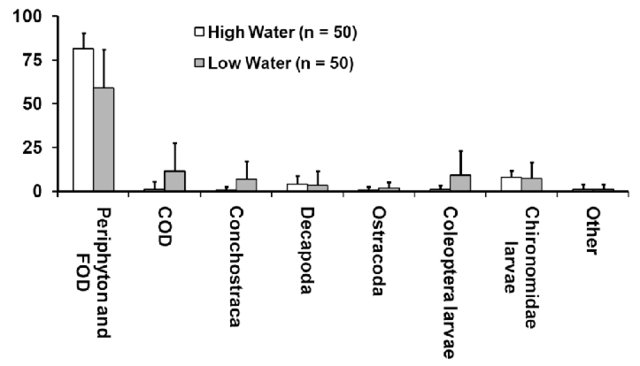
Figure 1: The diet of Symphysodon tarzoo (haraldi) in Crampton, W. G. (2008). Ecology and life history of an Amazon floodplain cichlid: the discus fish Symphysodon (Perciformes: Cichlidae). Neotropical Ichthyology, 6, 599-612. FOD: Fine Organic Detritus, COD: Course Organic detritus. Periplankton is referred to as algae.
One can clearly see the seasonal variation in diets with a slightly higher contribution from invertebrates but still minimal. What is most clear though is the amount of detritus and periplankton these fishes are feeding on (Fig 1).
It is not just scientific research that has reported this, Bleher’s (2009) article on discus care also suggests this diet of mostly detritus. Detritus is a difficult term as a lot of it cannot be identified without a microscope, usually it seems in many fishes any loose or soft detritus generally is a microbial matrix, from my observations of research into Loricariids.
If we look at discus we can really think more about their diet.

Figure 2: Symphysodon tarzoo from the Rio Nanay, Peru.
These fishes are not the best built for prey capture beyond body shape lets focus on the anatomy that is most important for feeding. The jaws, and I don’t just mean upper and lower jaws. First looking at the mouth, they have a small mouth that cannot extend far, this means they are extremely limited on the size of item they can eat, this is known as gape limitation as many fishes including discus cannot chew with the oral jaws. They have strong lips great at removing food items from surfaces much like many other fishes who have a similar niche (Cohen et al., 2023). These are all factors connected with that first set of jaws, the oral jaws that really have a limited ability to expand outwards.
There is a second set of jaws, the pharyngeal jaws which are not immediately obvious as at the back of the mouth. Unlike the oral jaws that are about prey/food capture these pharyngeal jaws are about food processing. In discus these are thinner and more elongate (Roberts-Hugghis et al., 2023), not great at processing particularly solid food like large amount of invertebrates, also lacking the stronger villiforme or molariform teeth. Very similar to other detritivores or fishes feeding largely on algaes and detritus (Burress et al., 2020).
So, not just from their gut analysis but their morphology, Symphysodon are best classified along the lines of algivores and detritivores. You could say omnivores but if the mere addition no matter how small of any animal to any species diet makes them an omnivore then all organisms are omnivores.
From knowing this how should we see what we are feeding our fishes? Should we look to the inclusion of more algaes? And what algaes? What is the current long term effects of captive diets on discus?
There are brands such as Nature Kind by CE Fish Essentials who have started to look at wild diets and the inclusion of replicating that into their captive diet. https://cefishessentials.com/product/naturekind-fish-food-100g/ is the link for anyone who is curious.
Beefheart shouldn’t be the scapegoat for captive diets. Most commercial feeds as well differ massively from wild fish diets and there is a lot of questions to be asked about their use. Beefheart has proven itself as an effective captive diet though and many fishes live full lives on it.
So the story here is, read both what the fish eat in the wild and the ingredients of the food you are feeding.
References:
Amado, M. V., Farias, I. P., & Hrbek, T. (2011). A molecular perspective on systematics, taxonomy and classification Amazonian discus fishes of the genus Symphysodon. International Journal of Evolutionary Biology, 2011.
Bleher, H. (2009). Definitive Guide to Discus: Part 2. Practical Fishkeeping. https://www.practicalfishkeeping.co.uk/features/definitive-guide-to-discus-part-two/
Burress, E. D., Martinez, C. M., & Wainwright, P. C. (2020). Decoupled jaws promote trophic diversity in cichlid fishes. Evolution, 74(5), 950-961.
Cohen, K. E., Lucanus, O., Summers, A. P., & Kolmann, M. A. (2023). Lip service: Histological phenotypes correlate with diet and feeding ecology in herbivorous pacus. The Anatomical Record, 306(2), 326-342.
Crampton, W. G. (2008). Ecology and life history of an Amazon floodplain cichlid: the discus fish Symphysodon (Perciformes: Cichlidae). Neotropical Ichthyology, 6, 599-612.
Reis, G. A., Siqueira, M. S., & Momo, H. (2022). Evaluation of commercial and experimental grower diets for use in intensive culture of Symphysodon aequifasciatus. Pan-American Journal of Aquatic Sciences, 17(3), 190-200.
Roberts-Hugghis, A. S., Burress, E. D., Lam, B., & Wainwright, P. C. (2023). The cichlid pharyngeal jaw novelty enhances evolutionary integration in the feeding apparatus. Evolution, qpad109.
Wang, L., Chen, Z., Leng, X., Gao, J., Sun, P., Qu, H., … & Song, X. (2016). Comparison of muscle composition of wild and cultured discus fishes Symphysodon spp. Journal of Shanghai Ocean University, 25(5), 719-725.
Wen, B., Chen, Z., Qu, H., & Gao, J. (2018). Growth and fatty acid composition of discus fish Symphysodon haraldi given varying feed ratios of beef heart, duck heart, and shrimp meat. Aquaculture and fisheries, 3(2), 84-89.
 The Scientific Fishkeeper