
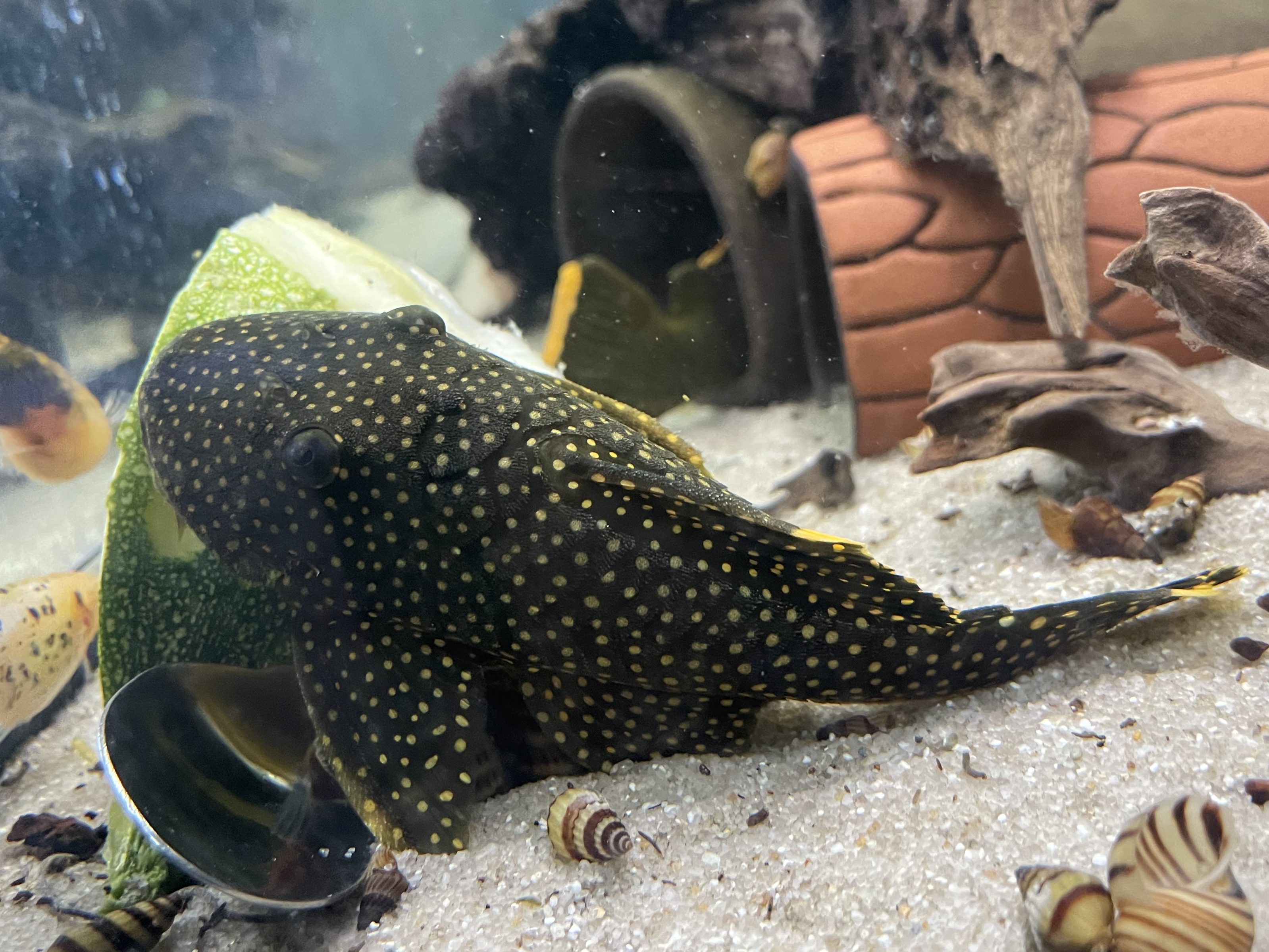
The gold nugget, Baryancistrus xanthellus one of the most well known and popular Loricariids, plecos within the aquarium trade and maybe one of the most misunderstood. They are often challenging to keep and are rarely grown to maturity and even less frequently bred.

Baryancistrus xanthellus is a member of the genus Baryancistrus with a the type species being Baryancistrus niveatus, a species we do not see in the aquarium trade frequently. A type species is basically the species that defines the genus, in a way. There are 12 described species within this genus although phylogenetically/evolutionarly two of these do not belong in this genus, Baryancistrus demantoides and Baryancistrus beginni of which both are more closely related to the ‘Hemiancistrus’ clade (Lujan et al., 2015; Fig 1).

Because of this I wont be discussing either of those two species who are morphologically very different and their care is additionally different.
Additional to these described species are several undescribed species within the L number system, as many do not reach the aquarium trade the only undescribed species I’ll discuss here is Baryancistrus sp. ‘L142’
Like all Loricariids, Baryancistrus is exclusive to South America, the majority of this genus particularly is located in Brazil. They are a large bulky fish with a deeper head, not so much a defining feature because it is not present in all species and found also outside of the genus is a membrane between the dorsal and adipose fin. Their heads are not particularly wide but they are a strong appearing fishes. All species have spots to one degree or another, in Baryancistrus chrysolomus, the mango/magnum pleco these are rarely visible.
Like the undescribed species only two of the described species tend to occur in the aquarium trade so it would not be worth discussing the others.
So what are the three species:
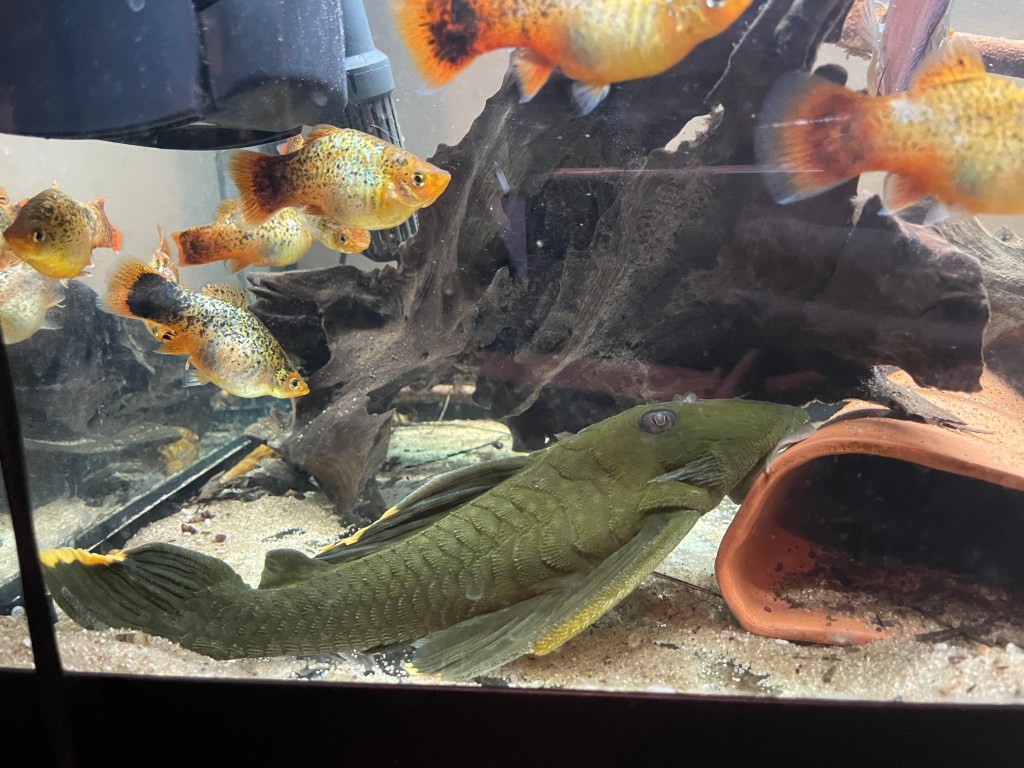
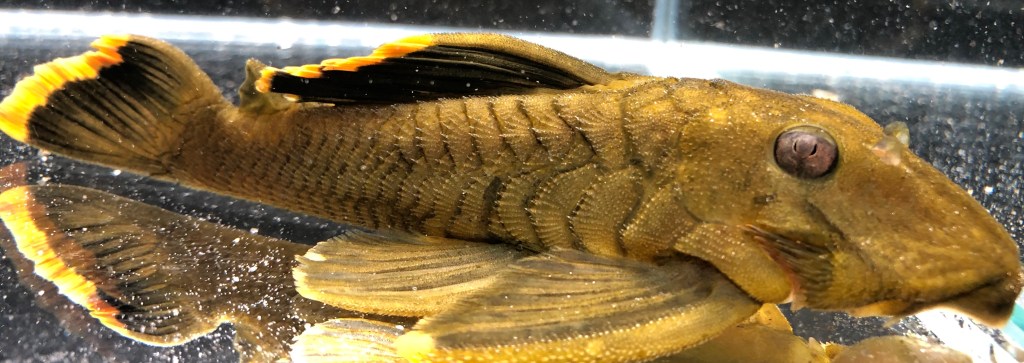
Scientific name: Baryancistrus chrysolomus
Common names: Mango pleco, magnum pleco, L047
Adult size: 22cm SL (Py-Daniel et al., 2011), likely larger.
Origin: Rio Xingu
Temperature: 28c or higher (Rofrigues-Filho et al., 2015).
Water type: Clear water.
Habitat: Largely rocky with a strong current. Plenty of periplankton and sponges.
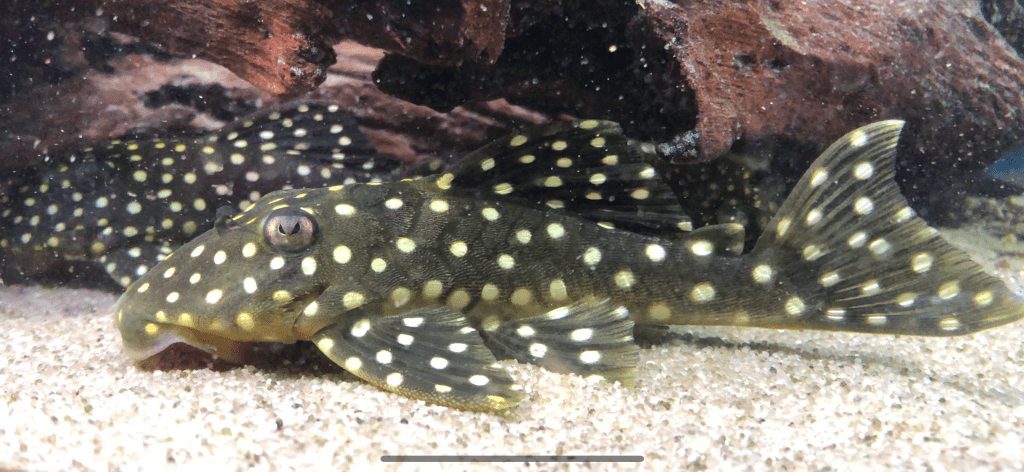
Scientific name: Baryancistrus sp. ‘L142’
Common name: Snowball pleco, L142, LDA033.
Adult size: 25cm SL
Origin: Rio Tapajos

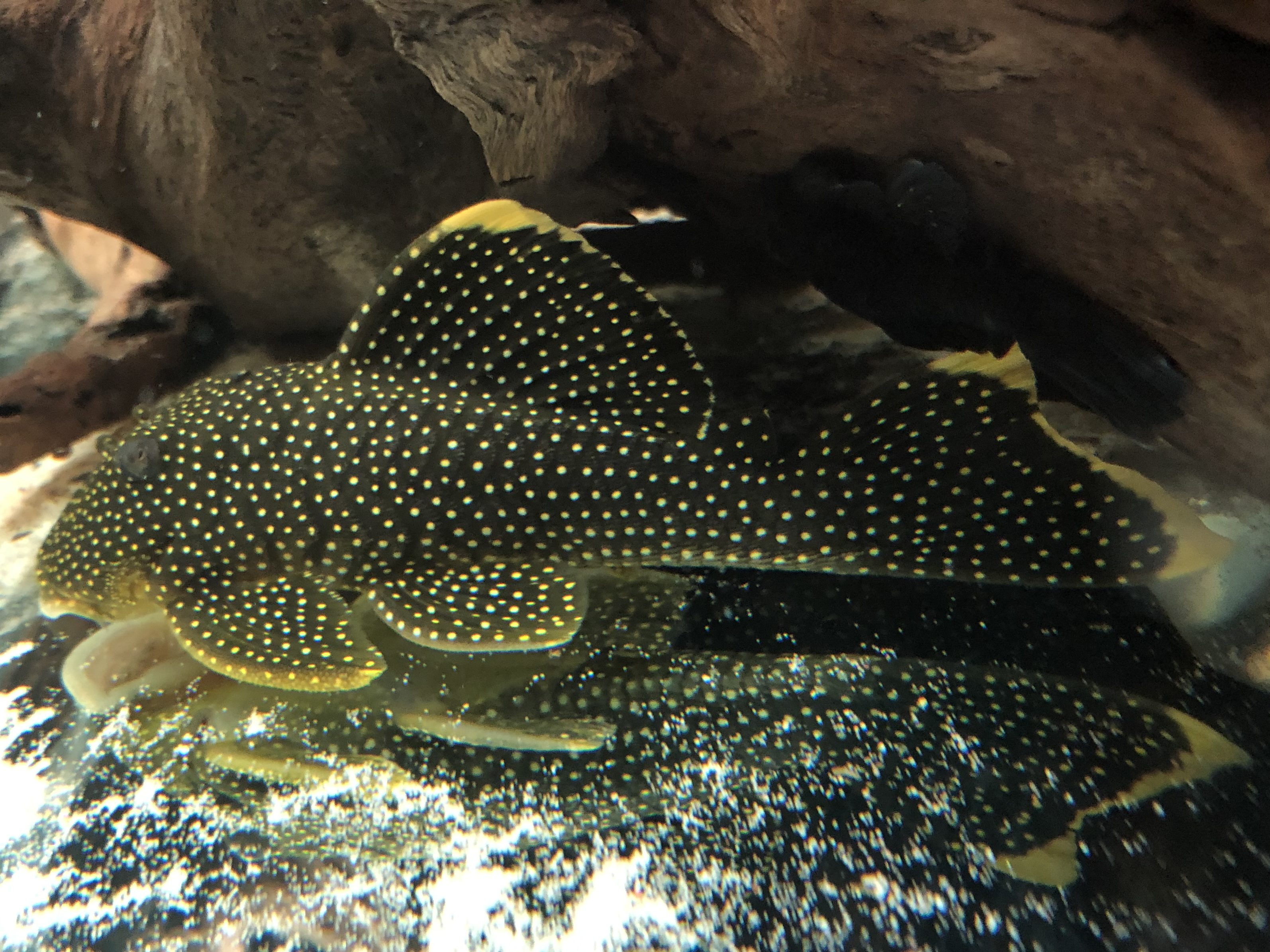
Scientific name: Baryancistrus xanthellus
Common name: Gold nugget pleco, queen gold nugget pleco, L081, L018, L085, L177, LDA060, LDA116, LDA117.
Adult size: 21.5cm SL but reports of individuals over 30cm SL (Py-Daniel et al., 2011).
Origin: Rio Xingu
Temperature: 28c or higher (Rofrigues-Filho et al., 2015).
Water type: Clear water.
Habitat: Largely rocky with a strong current. Plenty of periplankton and sponges.
Temperature
I can’t emphasise enough the importance of the higher temperatures with these species, particularly the two found in the Rio Xingu are not frequently exposed below 28c. More then often the water seems to be above 30c although oxygen saturation does decrease as the temperature increases so this needs to be thought of.
In my experience these fishes just don’t thrive lower. Temperature is known to be important in many biological processes not just gut biota function best at an optimum temperature but enzymes within the gut do too.
Water current
The habitat of these fishes has strong currents while rocks might act as refuge (Py-Daniel et al., 2011). The importance of a strong flow of water around the aquarium isn’t just for replicating their natural environment but also to maintain a higher oxygen saturation within the water as possible. The flow provides surface movement increasing gaseous exchange and circulates that oxygen around the aquarium.
Powerheads and wavemakers are probably the best at this, although they can be loud an expensive. If you have the DIY ability a river manifold system would be amazing such as seen here: https://www.loaches.com/articles/river-tank-manifold-design but also https://www.practicalfishkeeping.co.uk/features/the-secret-to-setting-up-a-better-river-aquarium/ . Recently floating bases have been appearing on the market but require a little more money.
Air powered alternatives could easily work but turnover and amount of water movement is very difficult to work out.
While a filter will never provide enough circulation I definitely recommend adding a device to it that sucks air through e.g. Eheim Venturi.

Setup
For understanding the natural environment of these fishes this article displays so many photos of their habitat: https://amazonas.dk/index.php/articles/brasilien-rio-xingu
Rocks or wood I don’t think it makes the difference, the main thing is about these fishes is plenty of caves and crevices. They really benefit from their own territory and spaces to hide. I always have plenty of caves for them as well but I recognise these are not available everywhere. For caves to try then Nature2Aqua has a brilliant range of caves and tunnels in a range of shapes and sizes and PlecoCeramics has some really nice designs.
There is no harm though in PVC caves as it’s about breaking up their enclosure and having ceramic caves is not important.
As you could maybe see of their habitat it does lack many plants with the exception of Podostemaceae, it’s a particularly challenging habitat for them. I would argue there is no harm in adding plants as long as the fishes needs are met. But these fishes will dig up any plants in the substrate and much of the fishes requirements conflict with that of plants.
Diet
This is the most interesting aspect of Baryancistrus. For some reason people see a colourful pleco/Loricariid and assume carnivore or omnivore. In no mean is Baryancistrus an omnivore. These fishes are quite strict algivores feeding almost entirely on algaes with the occasional invertebrate particularly bryozoans (Py-Daniel et al., 2011). Bryozoans are strange animals, like sponges they are filter feeding clonal organisms. It is additionally likely they are feeding on a wide range of other microbes. This is reflected in their jaw morphology, long with many numerous teeth is particularly noted in algivorous species (Lujan et al., 2012), one of the most extreme examples might be the hillstream Chaetostoma and Ancistrus. I can’t yet comment on their pharyngeal jaws, yes Loricariids have two sets of jaws.

This doesn’t sound like a specialist diet but it is, the algaes that grow in the aquarium do not grow enough and are more then often the wrong species. If aquarium algaes were enough then we wouldn’t see the failure rate we do. The other aspect is the amount of algaes in traditional captive diets, or just the majority is so very low usually being higher in cereals and fish/krill meal. I do recommend reading the ingredients of any fish food first!
So what should you feed them? This is a difficult question to answer and it is partially why I do not recommend this species. So what brands to consider:
- Repashy: Great range of ingredients and wide range of algaes so a wider diversity of nutrition. For this species soilent or super green would be required. I have used this diet frequently to acclimatise fishes from the wild with great success. A gel diet but replicates their natural mode of feeding.
- In the Bag, Tropical Fish UK Pleco Pops: Really high amount of algal ingredients and designed with Loricariids in mind. Again another gel diet.
- Naturekind: While not designed for Loricariids it does provide a larger amount of algaes and is much more herbivorous then commercial brands.
- Make your own: The one I least recommend, buying all the algaes is difficult and can get expensive. Gelling agents might not hold long enough and it is luck of the draw if the fishes even eat it. The biggest risk is getting that range of nutrition for the fishes.
It is really difficult in some countries and there becomes a kind of balance in regards to feeding for this genus and even most Loricariids.
Frequency of feeding Loricariids is almost always understated. These fishes are almost like underwater cows constantly grazing or eating with long digestive tracts. The algivores particularly this is no doubt the case. So for juveniles once a day would not be harmful but as the fish gets older more frequent feeding events would be beneficial. I would definitely leave courgette or mushrooms in between main feeding times but certainly not as a main diet.
Feeding at night is very important as it limits other fishes outcompeting for the food and these fishes are less likely to come out and feed with lights on.
These fishes are seriously slow feeders and will not compete with anything even slightly fast to feed. I have seen many issues when they are kept with fishes such as Geophagus, barbs or large Poecilidae (livebearer) groups. Definitely for many reasons why they should not be housed with very boisterous cichlids such as many of the popular Rift Valley cichlids.
Behaviour
Baryancistrus are very territorial, I have two/three adults and even before maturity disputes were not a rare occurrence. They are large and bulky and will through their weight around and for this reason large size disparities between individuals could result in issues. Plenty of caves and cover really does help here to break up the outline and prevent them frequently meeting each other but with time they will develop their own spaces they will keep to.
The aggression like other Loricariids is not just exclusive to other Baryancistrus. Slow moving tankmates who can’t move out the way are best avoided. But equally as much nothing very fast moving that can outcompete them for food.
Maintenance
I can definitely recommend a minimum of weekly water changes, these fishes want next to no nitrates or as little as possible, the same for any Loricariid.. They do seem to really thrive and survive on good water quality, not to say this shouldn’t be provided for any fish. I just feel it needs saying because of the popularity of certain aquarium methods.

Colouration
No doubt Baryancistrus are only popular for their striking and contrasting colouration. The seams found in two of them are half of that popularity and of all the colouration the seams will fade with age particularly the Baryancistrus xanthellus. Any spotting will reduce in size and these fishes tend to become a lot duller with age. But Baryancistrus xanthellus it is most obvious where the three L numbers people buy them for look the same as adults with minimal pin prick spots and little to no seams.
I have not described the different L numbers of Baryancistrus xanthellus and because of their adult colouration I don’t think it should matter. I also feel the L numbers are not reflective of the wild diversity nor of localities.
You might have noticed I have not mentioned sexing, that is a discussion for another article into sexing Loricariids. These members of the Hemiancistrus clade are a challenge and so few have mature enough fishes.
Baryancistrus are beautiful fishes but take considerable thought into their care with their adult size. They are not forgiving fishes and there are many smaller or easier to keep alternatives who also hold their colouration.
References:
Fred Furrer (2013). Successful Breeding of Baryancistrus xanthellus. IG-BSSW. https://www.ig-bssw.org/successful-breeding-of-baryancistrus-xanthellus/?lang=en
Lujan, N. K., Armbruster, J. W., Lovejoy, N. R., & López-Fernández, H. (2015). Multilocus molecular phylogeny of the suckermouth armored catfishes (Siluriformes: Loricariidae) with a focus on subfamily Hypostominae. Molecular phylogenetics and evolution, 82, 269-288.
Lujan, N. K., Winemiller, K. O., & Armbruster, J. W. (2012). Trophic diversity in the evolution and community assembly of loricariid catfishes. BMC Evolutionary Biology, 12(1), 1-13.
Magalhães, K. X., da Silva, R. D. F., Sawakuchi, A. O., Gonçalves, A. P., Gomes, G. F. E., Muriel-Cunha, J., … & de Sousa, L. M. (2021). Phylogeography of Baryancistrus xanthellus (Siluriformes: Loricariidae), a rheophilic catfish endemic to the Xingu River basin in eastern Amazonia. Plos one, 16(8), e0256677.
Py-Daniel, L. R., Zuanon, J., & Oliveira, R. R. D. (2011). Two new ornamental loricariid catfishes of Baryancistrus from rio Xingu drainage (Siluriformes: Hypostominae). Neotropical Ichthyology, 9, 241-252.
Rios-Villamizar, E. A., Piedade, M. T. F., Da Costa, J. G., Adeney, J. M. and Junk, W. J. (2013). Chemistry of different Amazonian water types for river classification: A preliminary review. Water and Society 2013, 178.
Rodrigues-Filho, J. L., Abe, D. S., Gatti-Junior, P., Medeiros, G. R., Degani, R. M., Blanco, F. P., Faria, C. R. L., Campanelli, L., Soares, F. S., Sidagis-Galli, C. V., Teixeira-Silva, V., Tundisi, J. E. M., Matsmura-Tundisi, T. and Tundisi, J. G. (2015). Spatial patterns of water quality in Xingu River Basin (Amazonia) prior to the Belo Monte dam impoundment. Brazilian Journal of Biology, 75(3).
 The Scientific Fishkeeper
Pingback: What to feed your pleco when they wont eat. | The Scientific Fishkeeper
Pingback: Pleco’s and Whiptail Catfishes, the Beginners Guide to Loricariid catfishes. | The Scientific Fishkeeper