
You might have heard the statement before, a fishes stomach is only the size of their eye. As a statement it comes from so many sides of truths, half truths and misunderstanding of fish biology.
I would argue the controversial, the majority of fishes we feed too little.
Largely the reason we don’t overfeed is to avoid overwhelming an aquarium with additional nutrients in the form of uneaten fish food that will decay, the results of that decay are handled by the microbes within the filter. The problem is where there is too much nutrients for those microbes in the filter to handle exposing the fish to it. Ammonia would be the main type of nutrients I am referring to but as we are talking about decay there is a lot more to it. This is the truth, it’s also quite logical but it means when we think about feeding we also need to think in terms of the microbes in the filter.
The stomach of fishes is hugely diverse (Pirhonen et al., 2019; Gosch et al., 2009) and in some species e.g. goldfish, Carassius auratus it is debated on it’s presence but largely the literature leads to the lack of it (McVay & Kaan, 1940; Kodzahinchex et al., 2018). The stomach size can be heavily linked to diet and the ability to specialise (Gosch et al., 2009). In the argument for eye size being related to stomach size, goldfish must lack eyes and imagine the eyes on the gulper catfish, Asterophysus batrachus if this was the case.
How much and how frequently should you feed your fish?
This has to be very species not just that but will have seasonal and allometric variations. There is no hard answer or even a formula, it’s an educated guess that can be narrowed down.

There is a multitude of studies suggesting that more frequent feedings to a point increase the growth of fishes (Fava et al., 2022; Cadorin et al., 2022). Anyone who has seen the two citations will see that farmed for the food industry feature heavily here. While research will always be focused on the highest investor, there is research into ornamental fishes. It’ll also be important to understand frequency and amount are different things, that one day frequency of food might be larger then what you’d feed 5 times a day or less then that.
In a study focusing on angelfish, Pterophyllum scalare by Ribeiro et al. (2012) 15 individual fish per a day were either 30, 60 or 90 grams per a kilogram of body weight, growth plateaued at 60g but 30g can sustain a fish without growth. In the Siamese fighting fish, Betta splendens weight only increased up to three times a day while in the guppy, Poecilia reticulata increased over four times a day, neither mentioned any amounts of food (Norazmi-Lokman et al., 2020). For the Rift Valley cichlid, Melanochromis aureatus growth rate was highest fed twice a day (Karadal et al., 2018).
Of course growth though is only one measure but to go into many others would complicate things and make the article maybe too long. Growth rate is a good all round measure as it can easily indicate how one factor, in our case amount/frequency of feeding influences many factors. Growth is heavily reliant on so many things from temperature, to specifical nutritional values, stress etc. but it does have it’s flaws as a measure.

So what could effect feeding frequency:
- Age, younger fishes need to devote a lot more to that growth period as they mature.
- Breeding, individuals who are rearing young or maturing eggs need to devote more energy into those aspects of reproduction.
- Temperature, the higher the temperature the more energy will be used and produced. This is more about the fishes optimal temperatures and range of tolerance.
- Nutrition, a diet with a lower nutritional value will need to be fed a lot more frequently to reach the vital amount of nutrition required by the fish.
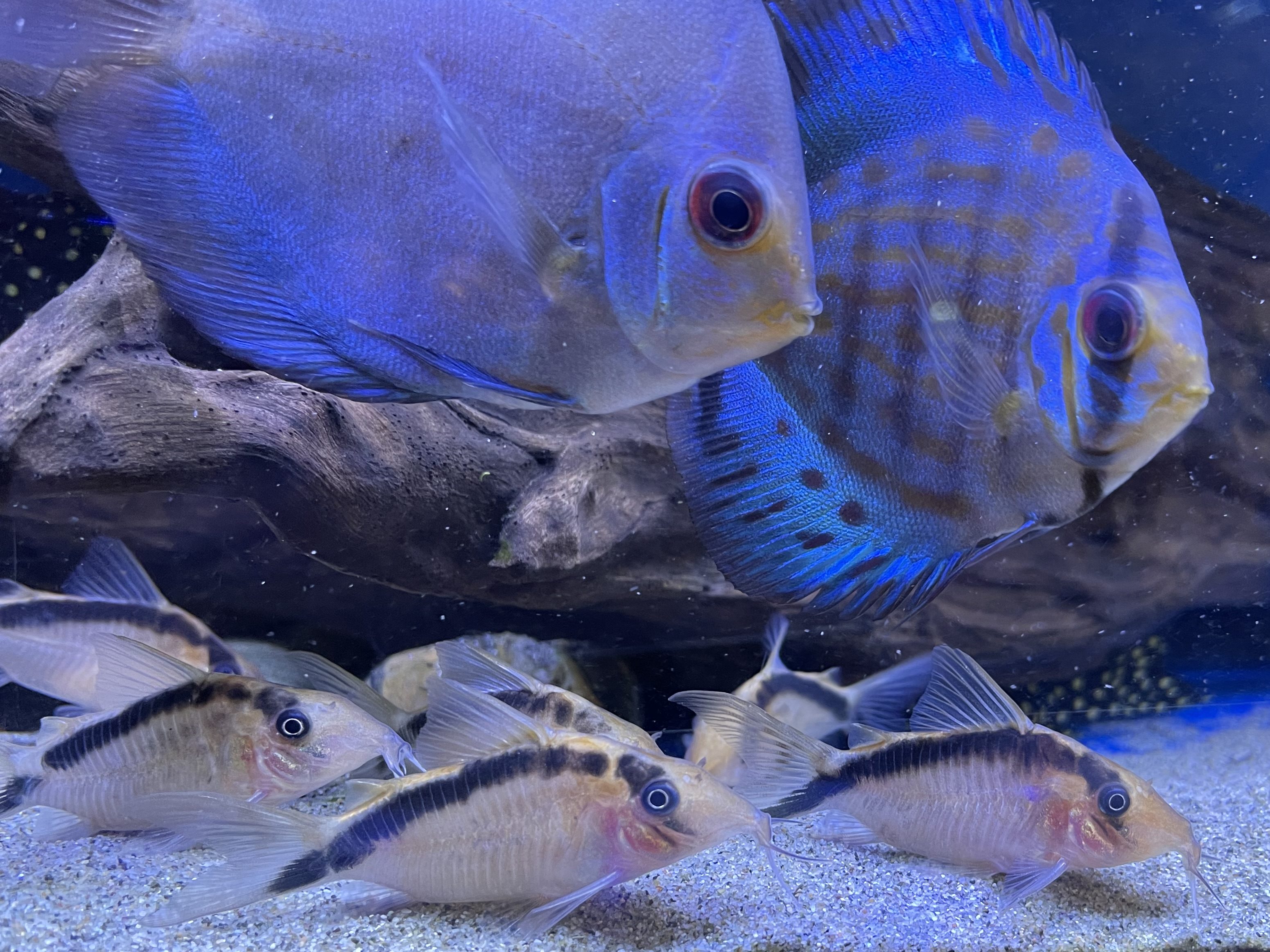
There is a misconception that animals generally have one meal every so often, particularly with fishes. This logically cannot be true, take grazing fishes such as discus (Symphysodon spp.), most Loricariids or even many ‘herbivorous’/algivorous/detritivores Rift Valley cichlids who devote large amounts of their time to obtaining food in smaller but frequent volumes (Crampton, 2008; Lujan et al., 2012; Hata et al., 2014). This is just by the nature of feeding on periplankton, algaes or detritus they are almost feeding like cows or rabbits. Although there is aspects of the Liems paradox where certain fishes can generalise and obtain a lot more nutrition in one sitting as seen in two species of grazing Tanganyikan cichlids (Golcher-Benavides & Wagner, 2019). Liems paradox likely has it’s limits though and doesn’t always play well in captivity where food items even if can be eaten can cause nutritional imbalances or issues with health.
Even within carnivores feeding frequency in the wild is going to vary. You can only watch Gymnotiformes, knifefishes and Mormyrids to see as many are micropredators but often at a larger size how often they are feeding. It reminds me of owls who need multiple food items in a day or shrews. They are constantly searching for food.
Feeding frequency does add in questions of nutrition, higher nutritional items might not be need to be fed as frequently but another aspect of that is the rate of digestion which will be a limiting factor. So even if feeding a higher nutrition item, if a fish has a very rapid processing time how much of it will be digested? This is only amplified by food items that contain ingredients that cannot be digested or easy to digest. Such as the difficulty extracting phosphorus and calcium from fish as an ingredient by non-piscivores (Žák et al., 2022).
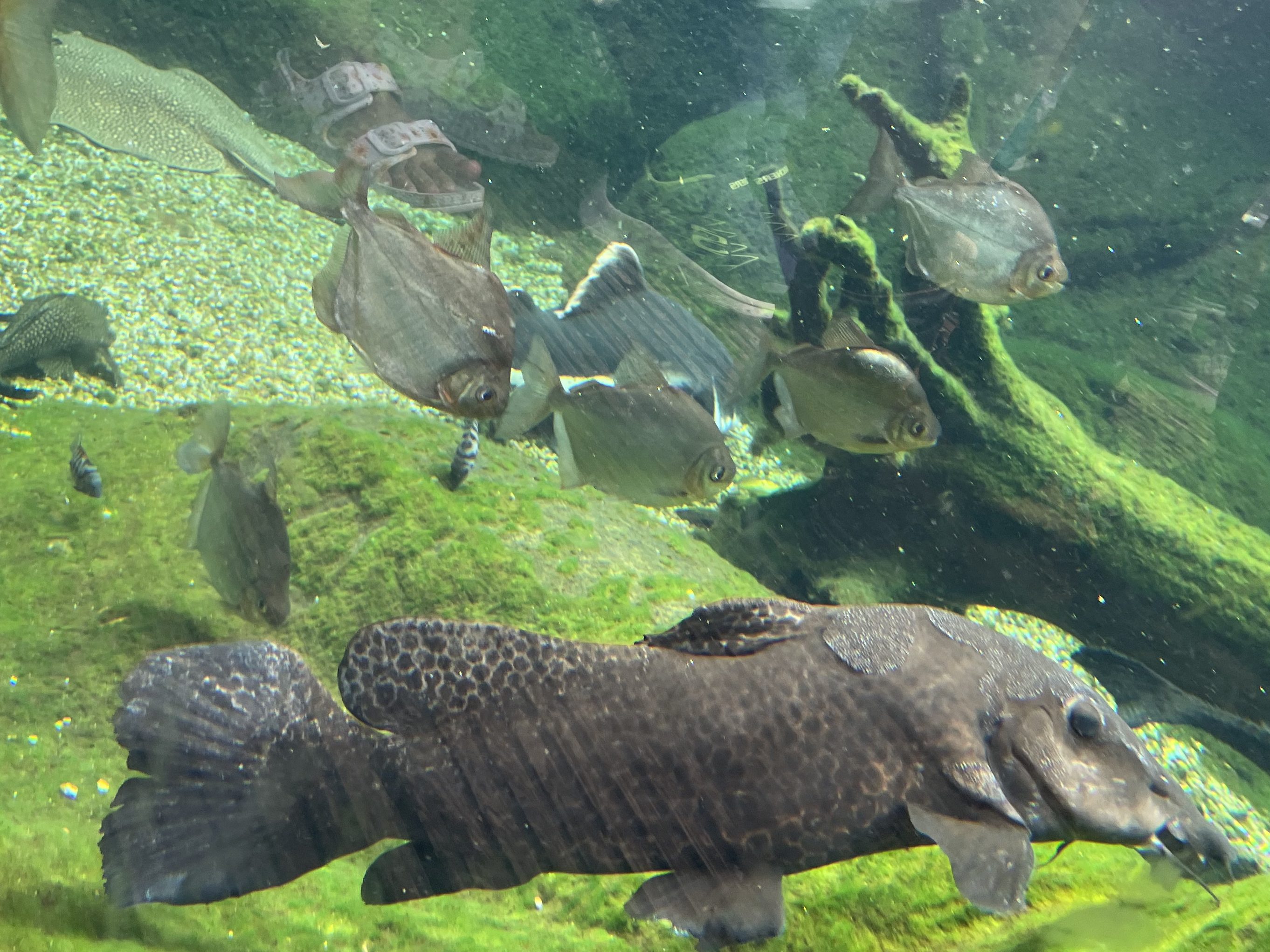
I personally feel that feeding frequency is behind the stunting of so many fishes particularly Loricariids. And catfishes maybe have lost out the most because there is the idea that they need feeding maybe once or twice a week but Loricariids, these cows of South America really do particularly at night show constant grazing. There was research into this grazing behaviour in Ancistrus sp. and given how much area they can clear and their ecological influence (Power, 1984), they are not once in a day feeders. Someone will argue but artificial captive diets are higher in nutrition, Ancistrus feed largely on algaes and a wide diversity (Lujan et al., 2012) but there is research on a few other species but very few diets (only 2) contain a noticeable amount of algaes. In a study 2017 study by Vucko et al. even just one species of algae replaced the entire commercial feed which if the ingredient list used by most brands. Not just are we not feeding Loricariids enough, we aren’t often feeding them what would be more then enough. Now why is there a claim that these fishes have a slow growth rate in captivity. I would definitely say Royal plecos, gold nugget plecos etc. do not have a slow wild growth rate.
The other aspect of these small feeding amounts is only feeding enough as x fish can eat in x amount of time usually a few minutes. Just watching how some fishes feed proves this wrong. There are many fishes I have kept and worked with who might take hours to reach their food and this will definitely cause harm with. Many are nocturnal or just don’t compete with other fishes.
How to avoid overfeeding?
I’m not sure what to really call overfeeding as there is no overfeeding unless resulting in obesity of the fish. But as it is more about overloading the bacteria with more fish waste or decaying material then they can handle, any increases in feeding should be handle. And if nitrates are peaking then more frequent and/or larger water changes. Sudden changes in feeding is more where issues arise and where water changes aren’t keeping up with the amount of food. Another thing to consider is the amount of waste produced and if the mechanical filtration can keep up or siphoning. I have not though mentioned how different food items and ingredients can heavily influence the amount of waste a fish is eating due to how much might not be digested, another story for another day.
How often you feed and the amount depends on the fish and understanding it’s biology and ecology. So again research is more then key here.
References:
Cadorin, D. I., da Silva, M. F., Masagounder, K., & Fracalossi, D. M. (2022). Interaction of feeding frequency and feeding rate on growth, nutrient utilization, and plasma metabolites of juvenile genetically improved farmed Nile tilapia, Oreochromis niloticus. Journal of the World Aquaculture Society, 53(2), 500-515.
Crampton, W. G. (2008). Ecology and life history of an Amazon floodplain cichlid: the discus fish Symphysodon (Perciformes: Cichlidae). Neotropical Ichthyology, 6, 599-612.
Fava, A. F., de Souza Bezerra, G., Neu, D. H., Bittencourt, F., Signor, A., Carvalho, K. V., … & Boscolo, W. R. (2022). Effects of Feeding Frequency for Nile Tilapia Fingerlings (Oreochromis niloticus). Aquaculture Nutrition, 2022.
Golcher-Benavides, J., & Wagner, C. E. (2019). Playing out Liem’s paradox: Opportunistic piscivory across Lake Tanganyikan cichlids. The American Naturalist, 194(2), 260-267.
Gosch, N. J., Pope, K. L., & Michaletz, P. H. (2009). Stomach capacities of six freshwater fishes. Journal of Freshwater Ecology, 24(4), 645-649.
Hata, H., Tanabe, A. S., Yamamoto, S., Toju, H., Kohda, M., & Hori, M. (2014). Diet disparity among sympatric herbivorous cichlids in the same ecomorphs in Lake Tanganyika: amplicon pyrosequences on algal farms and stomach contents. Bmc Biology, 12, 1-14.
Karadal, O., Güroy, D., & Türkmen, G. (2018). Effects of feed type and feeding frequency on growth performance, reproductive efficiency and skin coloration of auratus cichlids (Melanochromis auratus). Aquaculture Studies, 18(2), 135-144.
Kodzhahinchev, V., Biancolin, A., & Bucking, C. (2018). Quantification of Mg2+, Ca2+ and H+ transport by the gastrointestinal tract of the goldfish, Carassius auratus, using the Scanning Ion-selective Electrode Technique (SIET). Plos one, 13(12), e0207782.
Lujan, N. K., Winemiller, K. O., & Armbruster, J. W. (2012). Trophic diversity in the evolution and community assembly of loricariid catfishes. BMC Evolutionary Biology, 12(1), 1-13.
McVay, J. A., & Kaan, H. W. (1940). The digestive tract of Carassius auratus. The Biological Bulletin, 78(1), 53-67.
Norazmi-Lokman, N. H., Baderi, A. A., Zabidi, Z. M., & Diana, A. W. (2020). Effects of different feeding frequency on Siamese fighting fish (Betta splenden) and Guppy (Poecilia reticulata) Juveniles: Data on growth performance and survival rate. Data in brief, 32, 106046.
Pirhonen, J., Muuri, L., Kalliokoski, S. M., Puranen, M. M., & Marjomäki, T. J. (2019). Seasonal and ontogenetic variability in stomach size of Eurasian perch (Perca fluviatilis L.). Aquaculture International, 27, 1125-1135.
Power, M. E. (1984). Habitat quality and the distribution of algae-grazing catfish in a Panamanian stream. The Journal of Animal Ecology, 357-374.
Ribeiro, F. D. A. S., Vasquez, L. A., Fernandes, J. B. K., & Sakomura, N. K. (2012). Feeding level and frequency for freshwater angelfish. Revista Brasileira de Zootecnia, 41, 1550-1554.
Vucko, M. J., Cole, A. J., Moorhead, J. A., Pit, J., & de Nys, R. (2017). The freshwater macroalga Oedogonium intermedium can meet the nutritional requirements of the herbivorous fish Ancistrus cirrhosus. Algal research, 27, 21-31.
Žák, J., Roy, K., Dyková, I., Mráz, J., & Reichard, M. (2022). Starter feed for carnivorous species as a practical replacement of bloodworms for a vertebrate model organism in ageing, the turquoise killifish Nothobranchius furzeri. Journal of Fish Biology, 100(4), 894-908.
 The Scientific Fishkeeper