
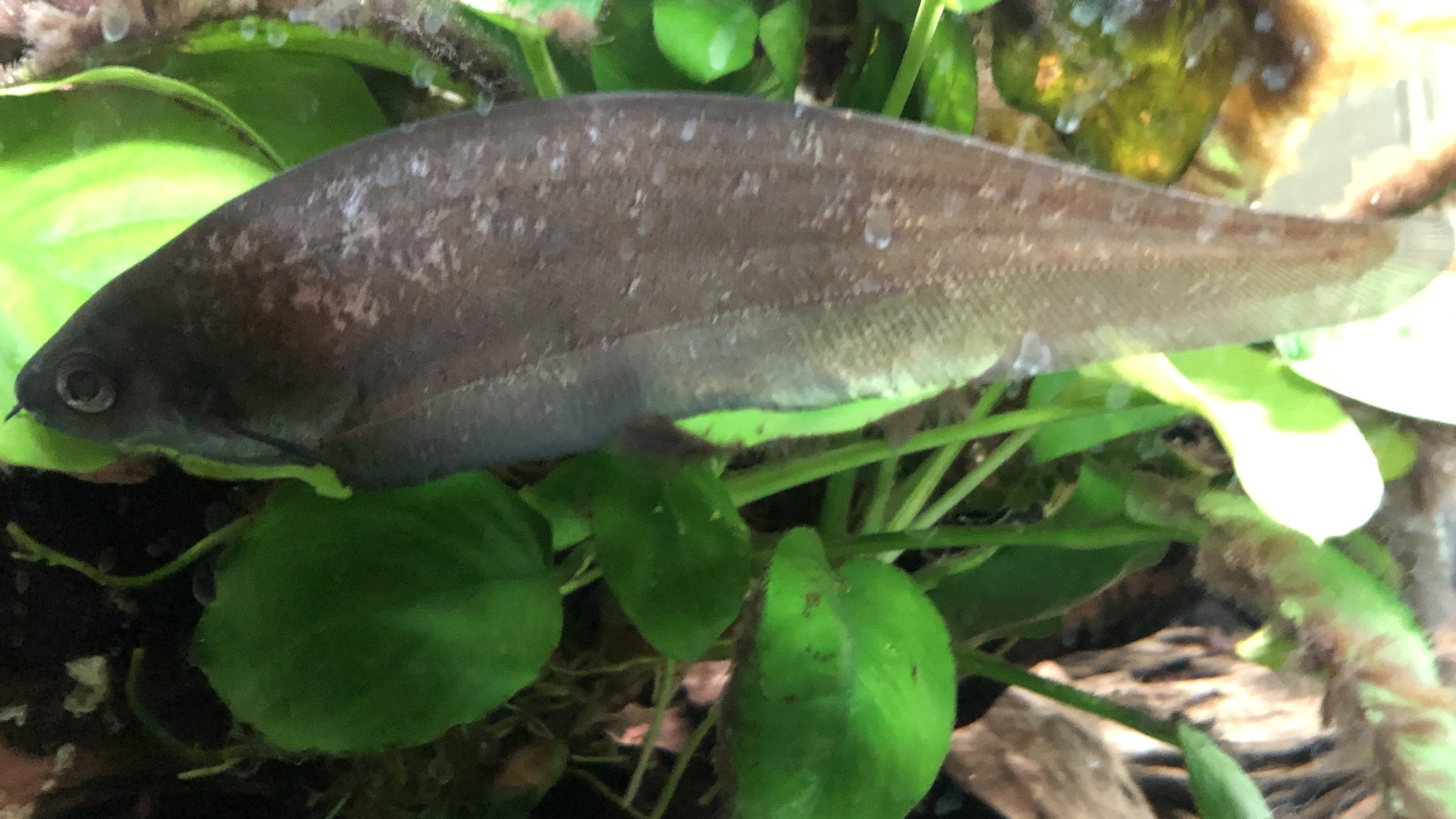
This is certainly an example of a problem with common names, X. nigri is actually more closely related to Mormyrids and as Osteoglossiformes are very closely related to arowana. While mormyrids are electrosensitive not all members of this group are, the clown knifefish Chitala spp. lacks this ability. The name knifefish is given to a few members of Osteoglossiformes but that is a story of convergent evolution of shared morphology for a solution to a common problem particularly with those electrosensitive species. They are not at all related to true knifefishes, Gymnotiformes which are exclusive to South America and are distantly placed in the tree of life on the same branch as the catfishes (Siluriformes) and tetra (Characiformes; Hughes et al., 2018; Fig 1).
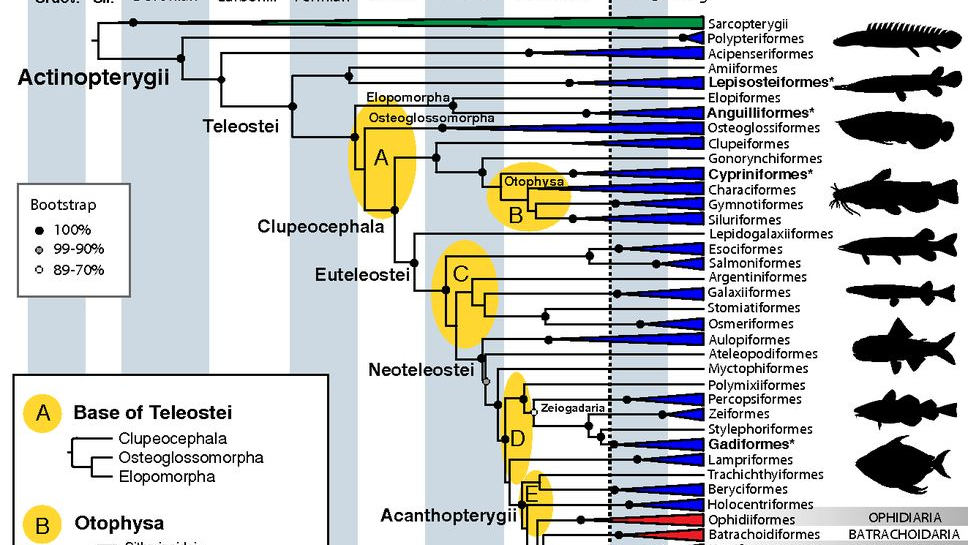
These Asian and African species known as knifefishes are very different in care as a result from Gymnotiformes. Many Gymnotiformes with very few exceptions are challenging to feed due to specialist morphology (Evans et al., 2019) and/or grow to exceptional sizes. While this is entirely also the case for Mormyrids. Regarding size the majority of these knife shaped Osteoglossiformes it leaves one Xenomystus nigri.
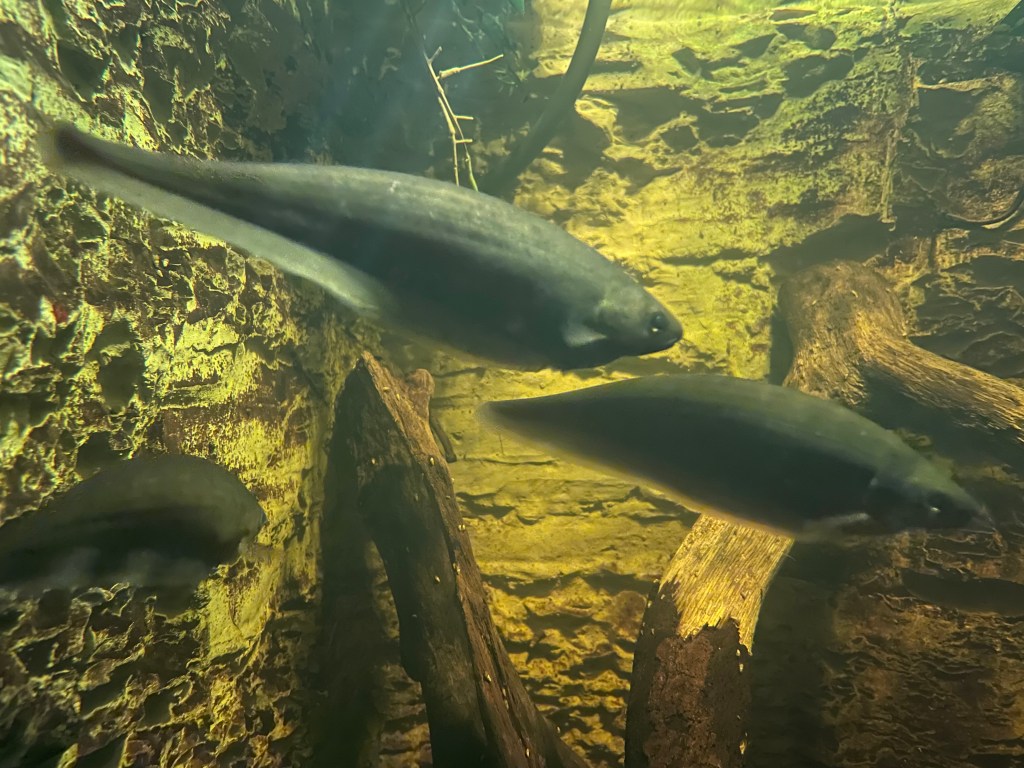
Common name: African Knifefish, Brown knifefish, African Brown Knifefish.
Scientific name: Xenomystus nigri Günther, 1868.
Origin: Wide spread from West Africa to Ethiopian, type locality is the Niger river. (Golubtsov & Darkov et al., 2008; Günther, 1868).
Size: 15.24cm SL (Günther, 1868) but there is a bit of variability around that, measurement converted from inches.
But why are these the best knifefishes for most people?
Size as I have already stated, 15cm SL as an adult is not a bad maximum size and a lot better then the 50cm SL black ghost knifefish, Apteronotus albifrons or any much larger species commonly available. They are easy to identify with the only similar species being the bronze featherback, Notopterus notopterus but thankfully X. nigri lacks a dorsal fin. So not easily confused with larger species unlike Gymnotus spp. who all are very similar in appearance. Many knives, true and not are territorial and do not tolerate each other particularly well, X. nigri is social and a shoaling species who is just fascinating to watch interact with each other but do keep in groups of more then 3.
To emphasise more, what makes Xenomystus nigri better then any other knife is how easy they are to feed. I brought my first individual before I really saw them around with bags of live food, little did I realise just after introducing the fish it was feeding on dry food. Many true knifefish, Gymnotiformes are a nightmare to feed, often with extreme gape limitation meaning the smallest of foods for a reasonable sized fish and even then they can be fussy. Due to the nature of how electrosensitive fishes feed by locating prey using electromagnetism (Waddell & Caputi, 2020), they might not even notice any food that is not live.
Habitat
It seems although a reasonably easy to locate fish there is no specifics on the habitat of these fishes. I’ve kept a few and can definitely say they need a lot of decor and hiding places. This makes them great fishes to watch as they move between everything in the aquarium.
I would provide a mixture of wood, rocks, branches and just many different places for them to retreat to. They do prefer dimmer lighting or even better would be areas of brighter and darker lighting so they have choice.
Water parameters
Unfussy, I can’t say much more given how widespread they are but given largely from West Africa softer more acidic and low conductivity water might be more ideal. They certainly do not suffer in higher conductivity water. It’d also be wrong to be specific or entirely certain as it’s generalising entire countries and water ways.
Sociality
As said previously these are extremely social fishes and do need to be in groups, by watching them you can see how much they interact closely with each other. In very small numbers such as a pair they can cause a lot of harm to each other.
Regarding tankmates avoid anything that can easily fit in their reasonable large mouth so small tetra but otherwise they are not aggressive.
Feeding
There is no doubt that electosensitive fishes are carnivores, plants do not produce such signals they can pick up. Realistically we can understand what these fishes feed on based on the mouth size, these are likely invertivores which might be more insect larvae but probably a small amount of smaller fishes. It’s very difficult without seeing any research into the diets of these fishes.
In captivity they have no problems being fed on a dry diet. Unlike feeding even a large range of live and frozen foods it is difficult to know how much nutrition the fish is really getting.
References:
Bullock, T. H., & Northcutt, R. G. (1982). A new electroreceptive teleost: Xenomystus nigri (Osteoglossiformes: Notopteridae). Journal of comparative physiology, 148, 345-352.
Evans, K. M., Kim, L. Y., Schubert, B. A., & Albert, J. S. (2019). Ecomorphology of neotropical electric fishes: an integrative approach to testing the relationships between form, function, and trophic ecology. Integrative Organismal Biology, 1(1), obz015.
Golubtsov, A. S., & Darkov, A. A. (2008). A review of fish diversity in the main drainage systems of Ethiopia based on the data obtained by 2008. In Ecological and faunistic studies in Ethiopia, Proceedings of jubilee meeting “Joint Ethio-Russian Biological Expedition (Vol. 20, pp. 69-102). Moscow: KMK Scientific Press.
Günther, A. C. (1868). Catalogue of the Fishes in the British Museum: VII (Vol. 7). order of the Trustees.
Hughes, L. C., Ortí, G., Huang, Y., Sun, Y., Baldwin, C. C., Thompson, A. W., … & Shi, Q. (2018). Comprehensive phylogeny of ray-finned fishes (Actinopterygii) based on transcriptomic and genomic data. Proceedings of the National Academy of Sciences, 115(24), 6249-6254.
Waddell, J. C., & Caputi, A. A. (2020). Electrocommunication in pulse Gymnotiformes: the role of electric organ discharge (EOD) time course in species identification. Journal of Experimental Biology, 223(16), jeb226340.
 The Scientific Fishkeeper