
So often we don’t really think about what we are feeding our fishes but when we do, do we consider what the food is being fed? This isn’t much of a consideration when it comes to prepared feeds because the companies and manufactures will cater for that. Regarding live foods then what they are fed is up to you. Nutrition doesn’t come out of thin air and unlike plants they cannot manufacture a lot of the sugars.
Here I think we can exclude anything that is not carnivorous as their food requires very different nutrition or more correct fertilising which is a whole other topic.
The term relevant here is known as gut loading and largely refers to the feeding of invertebrate prey to increase nutrition.
Why gut load prey?
As previously mentioned gut loading increases the nutritional value of the prey provided, when initially bought from the store the food item might be low in nutrition particularly calcium and many vitamins (Boykin et al., 2021). While calcium is taken up from the environment in fishes there is still a dietary requirement which varies depending on the species and the environmental calcium values (Baldisserotto et al., 2019) explained a little bit more in my article on mineral content and fish biology.
Considerations
Just feeding anything to the invertebrate feeders wont provide the nutrition required. Whatever going into the prey should be going into the fish so it needs to be a complete diet and there is no benefit from reduced quality. The easiest way to do this would be feeding a complete fish food whether it be dry or a gel diet, alternatively there are many products based on gut loading insects. The issue with exact nutrients required for using feeders depends on the prey item (Finke et al., 2003) and the fish you are feeding of which most will not have complete nutritional studies (Teles et al., 2022; Velasco-Santamaría & Corredor-Santamaría, 2011).

Time after gut loading is also important likely due to that nutrition being used for metabolism and other physiological processes, for dubia roaches and snails after around 1 hour calories decreased but fat content did continue increase up to 12 hours. Mealworms on the other hand nutrition only increases till the 6 hour mark where that creased (Gorst et al., 2015).
What should I gut load?
This really depends on the food items you are using as stated before and what it is possible to feed them. Excluding earthworms fish food would be a logical choice for most, I would not actually say it’d be a bad idea to use generic fish foods to at least meet all of those basic nutritional requirements. Generally a great rule for vegetables in addition to these fish foods is anything but the onion/garlic family so unlike herbivorous rodents even mushrooms. For snails definitely supplement the calcium with cuttlefish shells.
Bran is popular for feeding many feeders particularly insects, it’s not entirely clear the nutritional value of bran as a diet and at least compared to carrots it does seem to have benefits that carrots don’t have and vice versa (Fasce et al., 2022). I wouldn’t be opposed to it’s use with other items included in the insects diet.
Now there are things I would definitely consider avoiding, iceburg lettuce due to low nutrient value and for providing moisture there are many other alternatives.
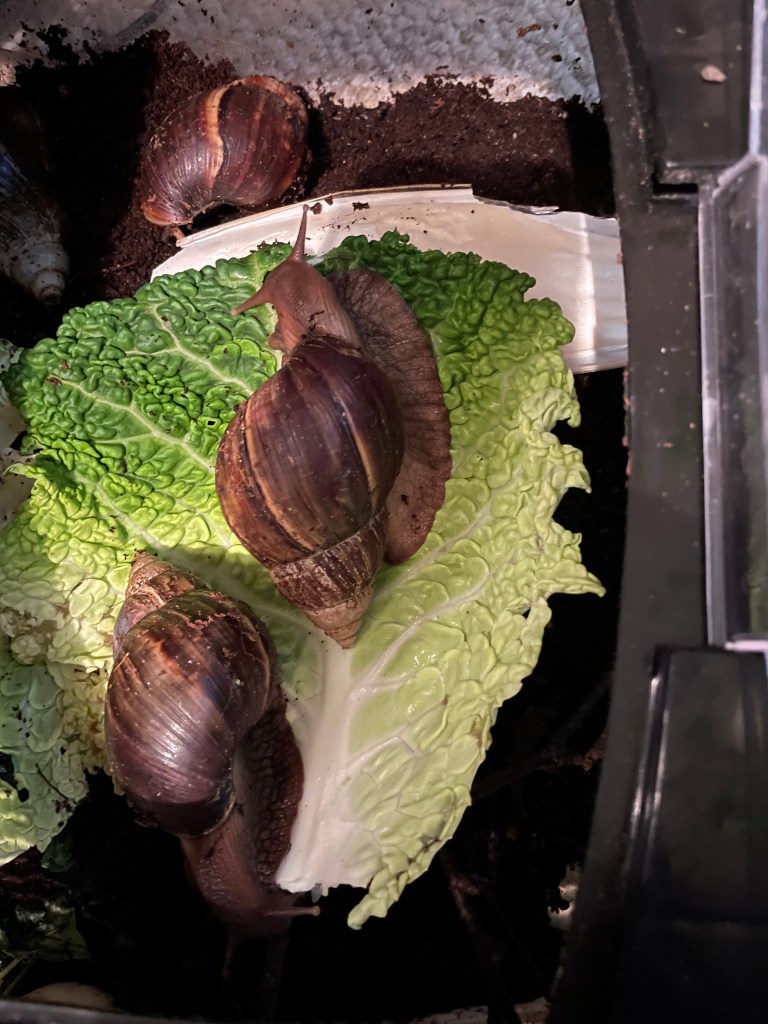
For feeding snails there are many resources on how to feed them, many snail specialist diets even if maybe not needed around. I give my land snails, A. fulica a variety of vegetables along with frequent fish food that has been mixed in with warm water, not that I use them to feed fishes. Herbs can be really great to add to this mixture of fish food. The fish food is to provide protein as definitely these snails are detritivores, omnivores who can be fed pinkie mice, mealworms and I’ve fed mine dubia roaches obviously those who are not alive though!
This does seem a very understudied topic when it comes to fishes and maybe because when it comes to food that needs to be gut loaded it is largely in the realm of ornamental fishes. I personally think citizen science could easily provide some answers such as whether fish condition improves depending on what the feeder is fed, the issue with calcium might be harder to answer though.
The Ethics
This is the final maybe most important statement. Live feeding obviously comes with ethics. In the UK invertebrates are not included under the Animal Welfare Act 2006 and are therefore not protected by law in terms of their welfare, this is largely why I do not mention fishes here. Fishes as a vertebrate are included in the Animal Welfare Act 2006, section 4 clearly stating they are protected from unnecessary harm. There are no fishes in wide distribution or distribution at all in the UK which are obligatory piscivores requiring a live feeder. Live feeding using vertebrates carries a higher parasite and even damage risk to the fish. Many of these fishes are not piscivores or would feed on vertebrates in the wild.
That is the legislation, the personal ethics and sentience of invertebrates is a long debate. I personally believe all animals should be treated with respect so when feeding invertebrates they shouldn’t be exposed to any suffering where possible. Certain Crustaceans and Cephalopods are protected by law in the UK, particularly the octopus and decapods under the Animal Welfare (Sentience) Act, 2022. It doesn’t seem clear to what extent these animals are protected. This legislation was introduced to recognise the intelligence of such animals. So the live feeding of these should be avoided.
The use of unprotected invertebrates in live feeding is not always a necessity and that should be recognised. This method of feeding is a lot more challenging to meet a fishes nutritional needs so if possible I’d recommend against. Of course some fishes need help after acclimating from the wild or even import. Some species are of particular challenges due to their specialised feeding morphology and behaviour. I would argue if creative enough most fishes can be pushed onto frozen, gel or dry, if not should we question their place in the hobby like many Gymnotiformes and Mormyrids? Or even leave them with those who can cater for them.
References:
Baldisserotto, B., Urbinati, E. C., & Cyrino, J. E. P. (Eds.). (2019). Biology and physiology of freshwater neotropical fish. Academic Press.
Boykin, K., Bitter, A., & Mitchell, M. A. (2021). Using a Commercial Gut Loading Diet to Create a Positive Calcium to Phosphorus Ratio in Mealworms (Tenebrio molitor). Journal of Herpetological Medicine and Surgery, 31(4), 302-306.
Fasce, B., Ródenas, L., López, M. C., Moya, V. J., Pascual, J. J., & Cambra-López, M. (2022). Nutritive value of wheat bran diets supplemented with fresh carrots and wet brewers’ grains in yellow mealworm. Journal of Insect Science, 22(3), 7.
Finke, M. D. (2003). Gut loading to enhance the nutrient content of insects as food for reptiles: a mathematical approach. Zoo Biology: Published in affiliation with the American Zoo and Aquarium Association, 22(2), 147-162.
Gorst, V. M., Mitchell, K., & Whitehouse-Tedd, K. M. (2015). Effect of post-gut loading time on the macro-nutrient content of three feeder invertebrate species. Journal of Zoo and Aquarium Research, 3(3), 87-93.
Teles, A. O., Couto, A., Enes, P., & Peres, H. (2020). Dietary protein requirements of fish–a meta‐analysis. Reviews in Aquaculture, 12(3), 1445-1477.
Velasco-Santamaría, Y., & Corredor-Santamaría, W. (2011). Nutritional requirements of freshwater ornamental fish: a review. Revista MVZ Córdoba, 16(2), 2458-2469.
 The Scientific Fishkeeper