
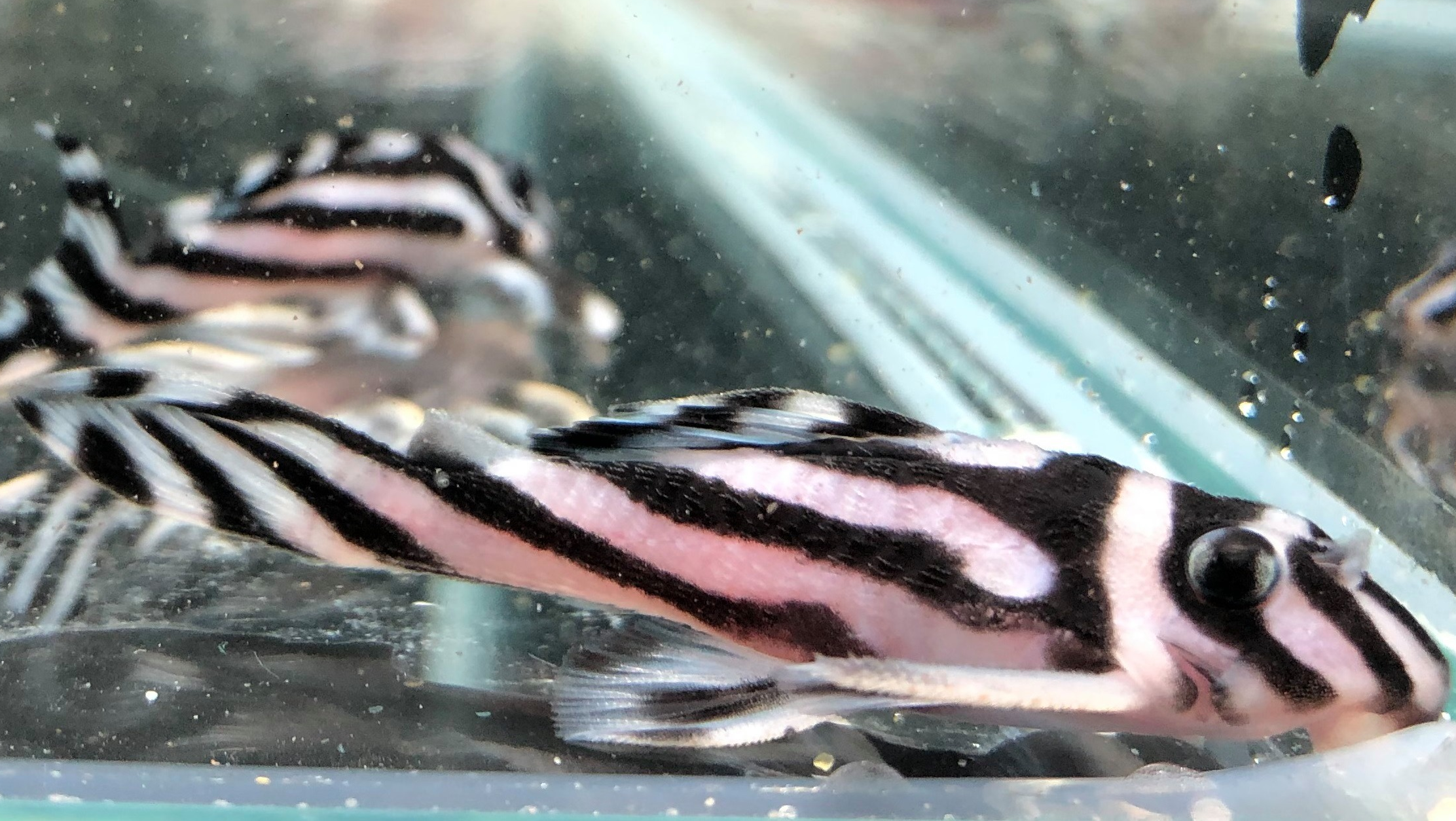
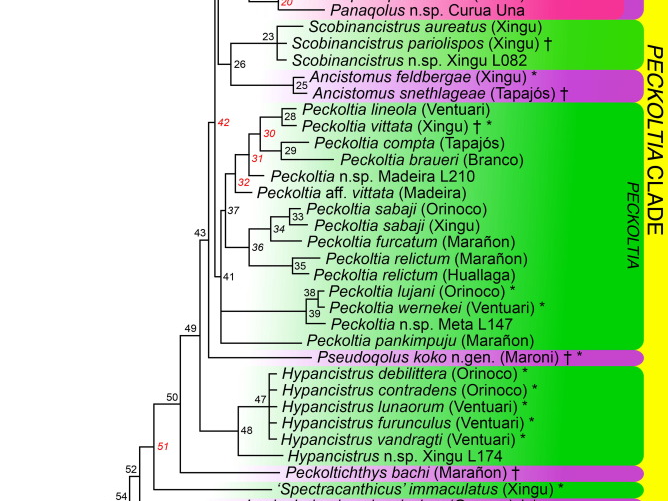
Hypancistrus is a relatively medium sized genera with a type species of Hypancistrus zebra (Fig 1). The genus is nested within the Peckoltia clade in the subfamily Hypostominae (Fig 2) and displays similar morphology to many members of this group.
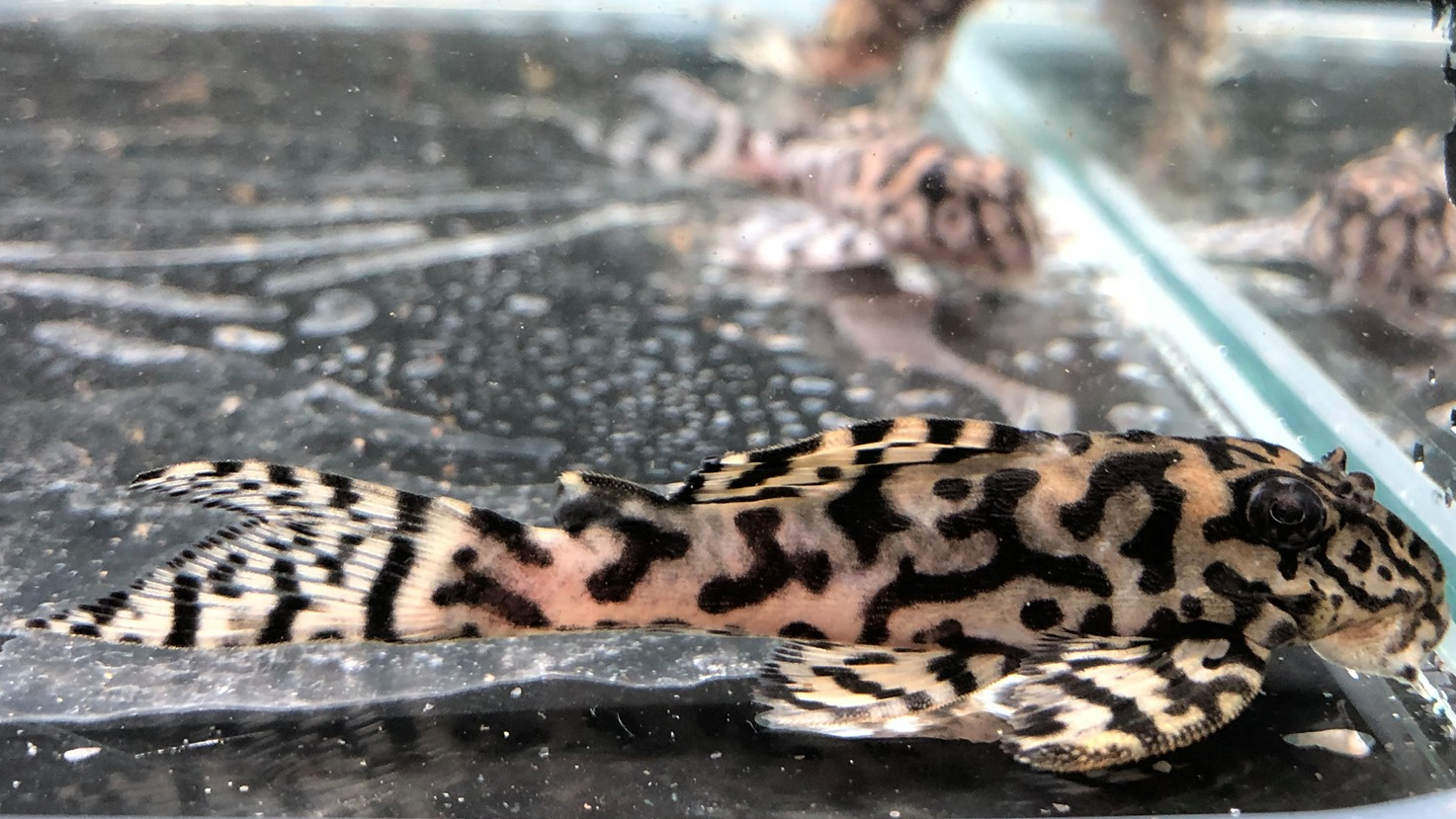
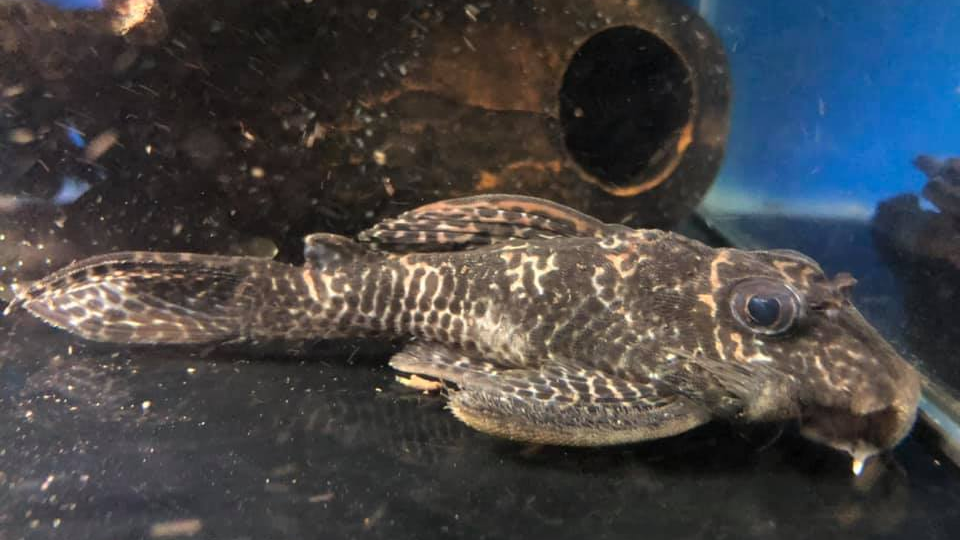
The body shape of Hypancistrus is generally quite characteristic of many typical Hypostominae plecos. They tend to have a shorter head and larger eyes compared to Panaqolus and Peckoltia. Markings are spotted or striped but vermiculations are present, these might reduce with age or change shape. Colouration similarly becomes less distinctive with age but the majority of members are white/yellow and grey/black.
Like the majority of the Peckoltia group Hypancistrus displays hypertrophied (large) odontodes (external teeth, not used for feeding) on the caudal peduncle, pectoral fin spines and at the gill opercula. These odontodes are sexually dimorphic being hypertrophied in the caudal peduncle and pectoral fin spines within males while females also absent. In mature males the odontodes that cover the body tend to become larger giving a more blurred appearance to the fish (Reis et al., 2022).
Regardless of the popularity of the genus Hypancistrus, there are only 9 described species (Fricke et al., 2023) but almost four times that are undescribed with and without L numbers. This doesn’t define if these undescribed individuals are species as L066 and L333 has been suggested to be the same species (Cardoso et al., 2016).
Hypancistrus is generally located within areas of high velocity water residing between the cracks and crevices. Water temperatures are a minimum of 28c and this is why flow within captivity is important to keep oxygen levels high (de Sousa et al., 2021).
The Ecomorphology of Hypancistrus
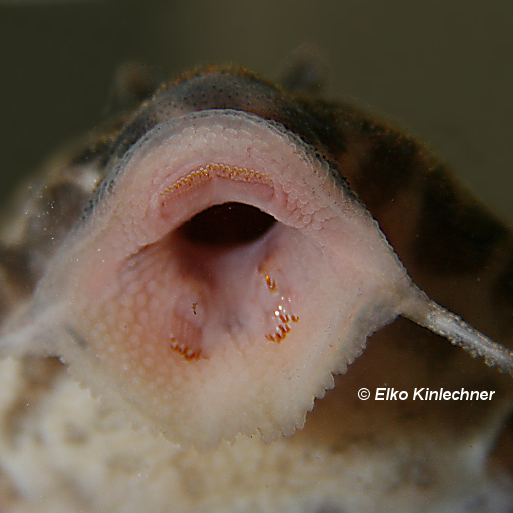
Ecomorphology are anatomical traits that are involved in functional behaviour such as feeding. This oral morphology (Fig 4) is very similar to particularly Peckoltia itself. There are a reasonable amount of teeth particularly on the maxaillae, upper jaw and less on the dentary, lower jaw. While there are a few it is a lot more then the closely related, carnivorous Scobinancistrus. The jaws of Hypancistrus are strong and robust, very similar again to Peckoltia but not quite the same as the other closely related genus, Panaqolus.
Dietary Ecology
Hypancistrus is often recorded as being a carnivore, I don’t entirely know where the assumption comes from but it must stem from this common idea that any of the colourful Loricariids are, I have seen this stated quite frequently. Additionally maybe the doctorial thesis of Dr. Jansen Zuanon where the species Hypancistrus zebra is suggested to feed on reasonable amounts of Bryozoa along with algaes (Zuanon, 1999). As many things do with time information is lost, some older information generalises the genus as omnivores and later others have suggested carnivores.
When reading the scientific literature including Zuanon (1999) there is limited references to the diet of Hypancistrus. There is gut analysis attached to the description of four species. While various algae and detritus made up the majority of the gut contents of these four species: numerous processed seeds were located in the gut of Hypancistrus inspector (Armbruster, 2002), bryophytes (mosses) within Hypancistrus lunaorum and; in Hypancistrus contradens in addition to mostly algae and detritus, some aquatic invertebrates were located (Armbruster et al., 2007). This infers that Hypancistrus is some what of a generalist but likely more on the herbivorous side.
So what should you feed Hypancistrus in captivity?
Don’t forget those algae’s, a diet with a range and high amounts of these algae’s will be beneficial. Always check ingredient lists, algae’s unlike many macrophyte plants are high in protein and various vitamins and minerals. As the fish are evolved to feed on these it’ll be much more easy for them to digest and less waste produced as a result. In addition a little bit of variation, the odd frozen food such as brine shrimp, tubifex etc. would not be bad but many diets that contain algaes also contain this. Mosses would be an interesting addition to trial, aquarium mosses can be quite expensive but perhaps terrestrial mosses from areas without pesticides?
Of all the things to trial seeds, as mentioned by Armbruster (2002), at least Hypancistrus inspector feeds on seeds. This is certainly worth exploring with many more Loricariids and a variety of seeds as bare in mind the number of plants that produce seeds is immense, fruits that contain seeds such as blueberries and pomegranate could be worth trying. They might not jump to them but it’s worth sitting back and watching, in discussion with other fishkeepers seeds have been worth the trial. As seeds are almost a storage body for many plants they will contain a lot of nutrition and could explain why Hypancistrus and maybe Peckoltia have such strong jaws. A selective advantage at a seasonal or occasional food item? Selective advantages towards awkward to reach food items are not rare in Loricariidae.
Conclusion
Hypancistrus might be popular for their colours, their patterning but ecologically they offer quite a lot that has yet to be explored. The focus on breeding them has maybe moved the husbandry of the genus away from a curiosity of just keeping them and understanding them.
References:
Armbruster, J. W. (2002). Hypancistrus inspector: a new species of suckermouth armored catfish (Loricariidae: Ancistrinae). Copeia, 2002(1), 86-92.
Armbruster, J. W., Lujan, N. K., & Taphorn, D. C. (2007). Four new Hypancistrus (Siluriformes: Loricariidae) from Amazonas, Venezuela. Copeia, 2007(1), 62-79.
Cardoso, A. L., Carvalho, H. L. S., Benathar, T. C. M., Serrao, S. M. G., Nagamachi, C. Y., Pieczarka, J. C., … & Noronha, R. C. R. (2016). Integrated cytogenetic and mitochondrial DNA analyses indicate that two different phenotypes of Hypancistrus (L066 and L333) belong to the same species. Zebrafish, 13(3), 209-216.
Fricke, R., Eschmeyer, W. N. & Van der Laan, R. (eds) 2023. ESCHMEYER’S CATALOG OF FISHES: GENERA, SPECIES, REFERENCES. (http://researcharchive.calacademy.org/research/ichthyology/catalog/fishcatmain.asp)
Lujan, N. K., Cramer, C. A., Covain, R., Fisch-Muller, S., & López-Fernández, H. (2017). Multilocus molecular phylogeny of the ornamental wood-eating catfishes (Siluriformes, Loricariidae, Panaqolus and Panaque) reveals undescribed diversity and parapatric clades. Molecular phylogenetics and evolution, 109, 321-336.
Reis, R. G. A., Oliveira, R. S. D., da Silva Viana, I. K., Abe, H. A., Takata, R., de Sousa, L. M., & da Rocha, R. M. (2022). Evidence of secondary sexual dimorphism in King Tiger Plecos Hypancistrus sp, Loricariidae, of the Amazon River basin. Aquaculture Research, 53(10), 3718-3725.
de Sousa, L. M., Lucanus, O., Arroyo-Mora, J. P., & Kalacska, M. (2021). Conservation and trade of the endangered Hypancistrus zebra (Siluriformes, Loricariidae), one of the most trafficked Brazilian fish. Global Ecology and Conservation, 27, e01570.
Zuanon, J. A. S. (1999). História natural da ictiofauna de corredeiras do rio Xingu, na região de Altamira, Pará.
 The Scientific Fishkeeper
Pingback: Premixed foods for plecos (Loricariids) and other rasping fishes. | The Scientific Fishkeeper
Pingback: What to feed your pleco when they wont eat. | The Scientific Fishkeeper
Pingback: Pleco’s and Whiptail Catfishes, the Beginners Guide to Loricariid catfishes. | The Scientific Fishkeeper