
Little seems known about the diet of Corydoradinae, it might be due to a generalization of the genus but also a lack of understanding of their ecology. For scientists it is a relatively small genus from a small family, Callichthyidae which also contains genera such as Megalechis, Hoplosternum and Aspidoras.
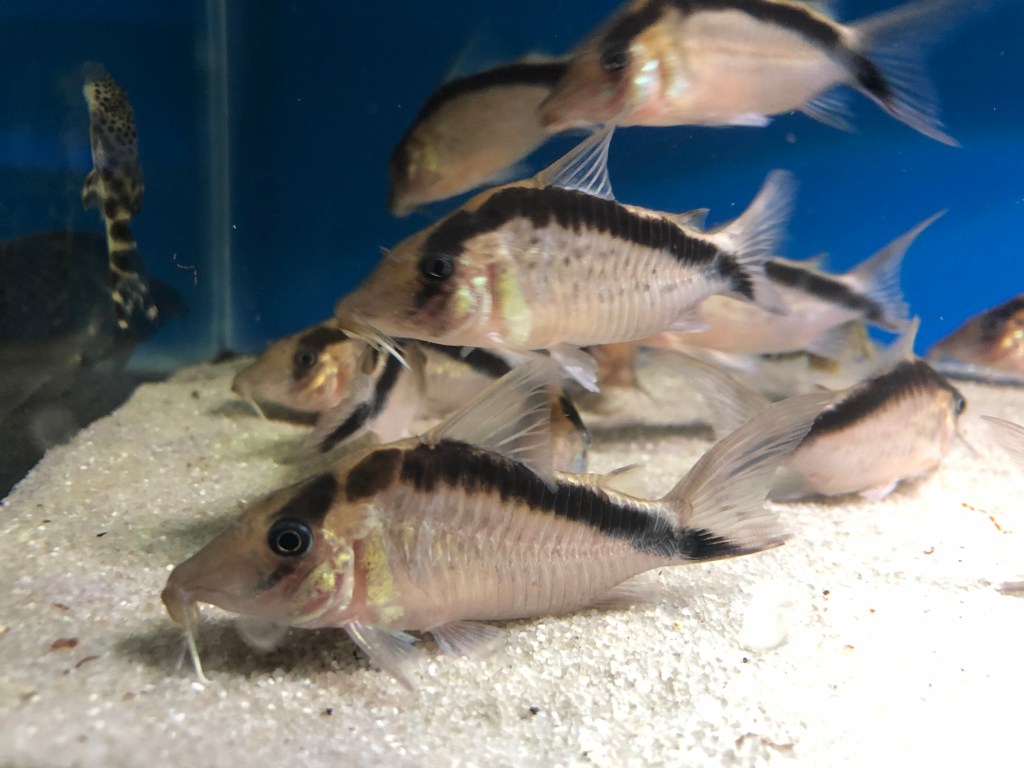
There is no doubt that Corydoras feeds largely as a carnivore but as a term that is very vague. These fishes are hardly hunting down capybara that enter the water or swarming round the carcasses of fishes. Carnivory purely just refers to the fact an animal eats an animal, and what is defined as an animal is just Animalia which is a gigantic category of organisms. Animalia covers from the simple sponges and corals all the way to molluscs, mammals and fishes, it includes some strange organisms as well like bryozoa and jellyfish. Each of these animals will have different nutritional compositions, some toxins but also accessibility. It is well known that insectivores (carnivores that specialize on insects) are not able to access nutrition from fishes, mammals etc. efficiently (Žák et al., 2022), this also increases nitrogenous waste. There might be other aspects of nutrition commonly missed such as perhaps the importance of chitin? It’s very difficult to digest, too much and the food item wont be processed, too little might result in blockages. It reminds me very much of the bloodworm used in the aquarium trade having a strong chitin casing compared to the chromatid larvae the fishes are likely eating in the wild. I have seen bloodworm pass out the fish as if it hadn’t been eaten at all, even carnivorous fishes. Not just does carnivory cover a wide range of different nutritional profiles and species but also modes of feeding. It is very different to catch and feed on a whole fish as it is to maybe feed on scales (lepidophagy), break down snails (durophagy), maybe extract a snail from it’s shell etc. Carnivory is so obviously diverse compared to herbivory but it still is best visualized like a field of grass, all grass specialists but put sheep, cattle and horses out and they will all feed on very different parts of the grass.
What I am emphasizing is not to generalize any dietary category and just fall to the general diets for fishes. Carnivory is just a man made category regardless and doesn’t reflect realistically aquatic dietary niches.
The Wild Corydoras Diet
Corydoradinae has previously been identified as an omnivore by Nijssen (1970) although only used aquarium fishes as evidence. This paper records them feeding on fallen leaves of which I find particularly strange. Although a particular fondness for invertebrates is noted, particularly tubifex and daphina, identifying the worms using their highly evolved sense of smell/taste. This record is later referenced in Alexandrou et al. (2011) but also noted that they feed on algae, insects, zooplankton and annelids. Algae I would not be surprised that is consumed but I do not believe they are targeting it, much like invertebrates are found in small numbers the guts of grazing Loricariids.
Isotope analysis was used to compare different lineages of Corydoras and identify any partitioning in where and what they feed on. Different lineages display divergent nutritional profiles between different genera of Corydoradinae based on head shape, eye placement and body depth. There is a clear difference between the diet of the longer snouted and shorter snouted Hoplisoma and Gastrodermus, I can assume due to the depths of substrate that can be exploited by either. These longer snouted, Corydoras are referenced as feeding on a lower trophic level (Alexandrou et al., 2011). This could infer on feeding on more algaes but maybe those lower trophic level invertebrates such as worms who would be lower down in the substrate then predatory invertebrates.
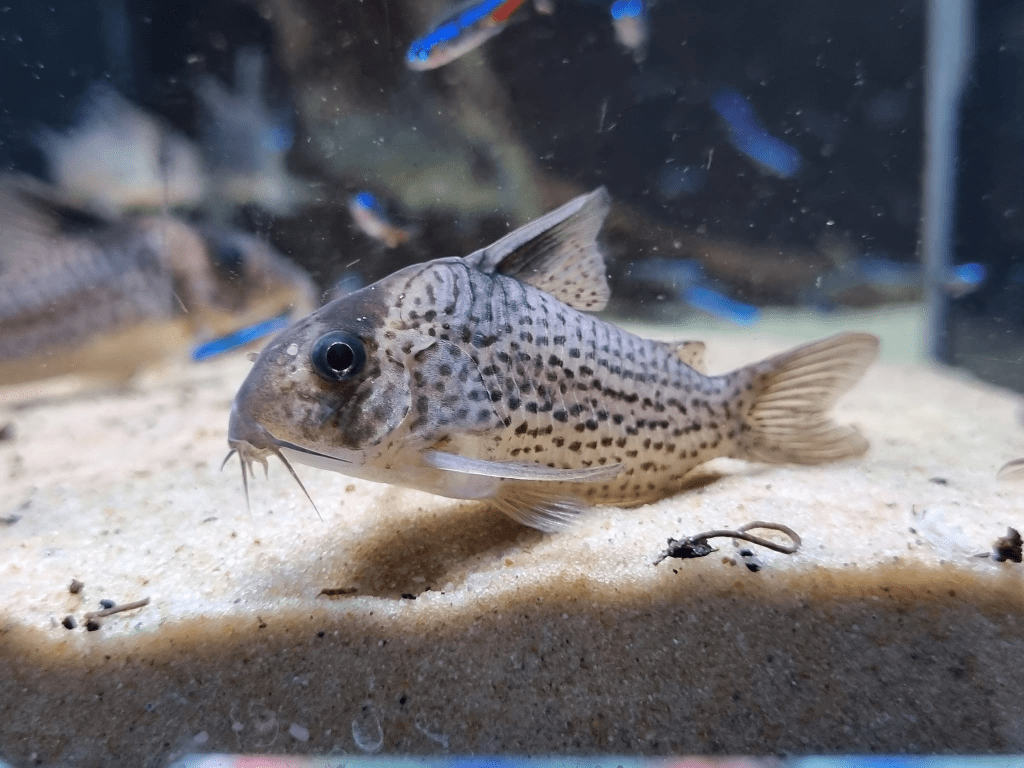
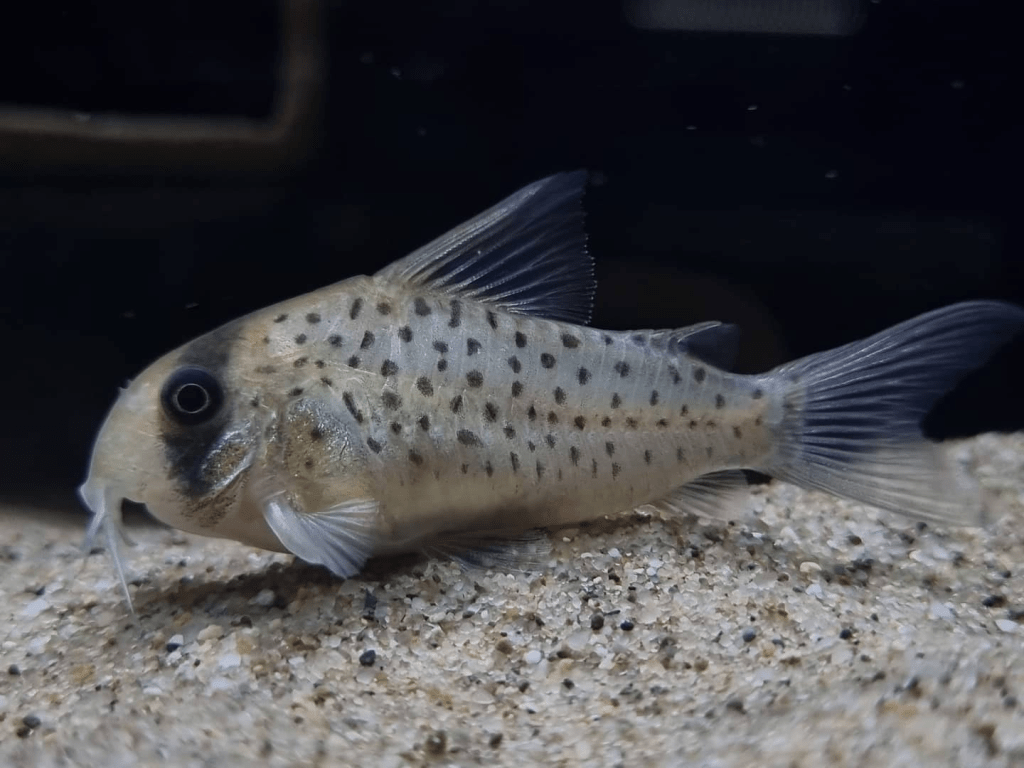
The shorter to medium snouted Hoplisoma paleatum, the peppered ‘Corydoras‘ is recorded as feeding largely on fly larvae such as chromatid’s with a small addition of nematode’s. Algae and plant fragments are recorded in the gut but near minimal volumes, less then substrate ingested (Bertora et al., 2021).
So the picture of what Corydoradinae eat in the wild is unclear.
The Dietary Morphology of Corydoras
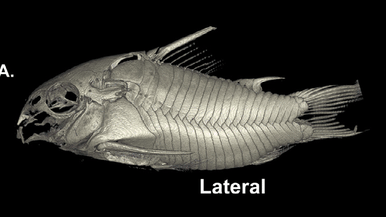
Again, an unclear topic. We know Corydoradinae have oral jaws (Fig 1) at the front of the head humongous with our the general vertebrate jaw. These oral jaws contain teeth (Huysentruyt et al., 2011) but there seems to have been no exploration of the diversity of these teeth. These oral jaws are very similar to other invertivores (feeds on invertebrates), being elongate to extract food items out of crevices or the substrate.
What is not researched is the secondary pair of jaws found in most fishes, the pharyngeal jaws. While the oral jaws in fishes are often involved in prey capture, the pharyngeal jaws are involved in prey processing, so the grinding and breaking down. These are at the back of the mouth so aren’t obvious but when you see a fishes head move after feeding it’s likely those jaws are moving. Corydoradinae do have pharyngeal jaws, they contain teeth (Huysentruyt et al., 2011) but we have no idea how this morphology differs across Corydoradinae. In Osteogaster aenea Huysentruyt et al. (2011) identified elongate pharyngeal teeth which would confirm that at least O. aeneus is not evolved to feed on snails but the jaws do seem some what robust. It contrasts from those species that feed on algae to any extent who seem to have much more simplistic and often bladed pharyngeal anatomy. Most research into pharyngeal anatomy focuses on cichlids of which might not be the best reference given differential feeding behaviour.
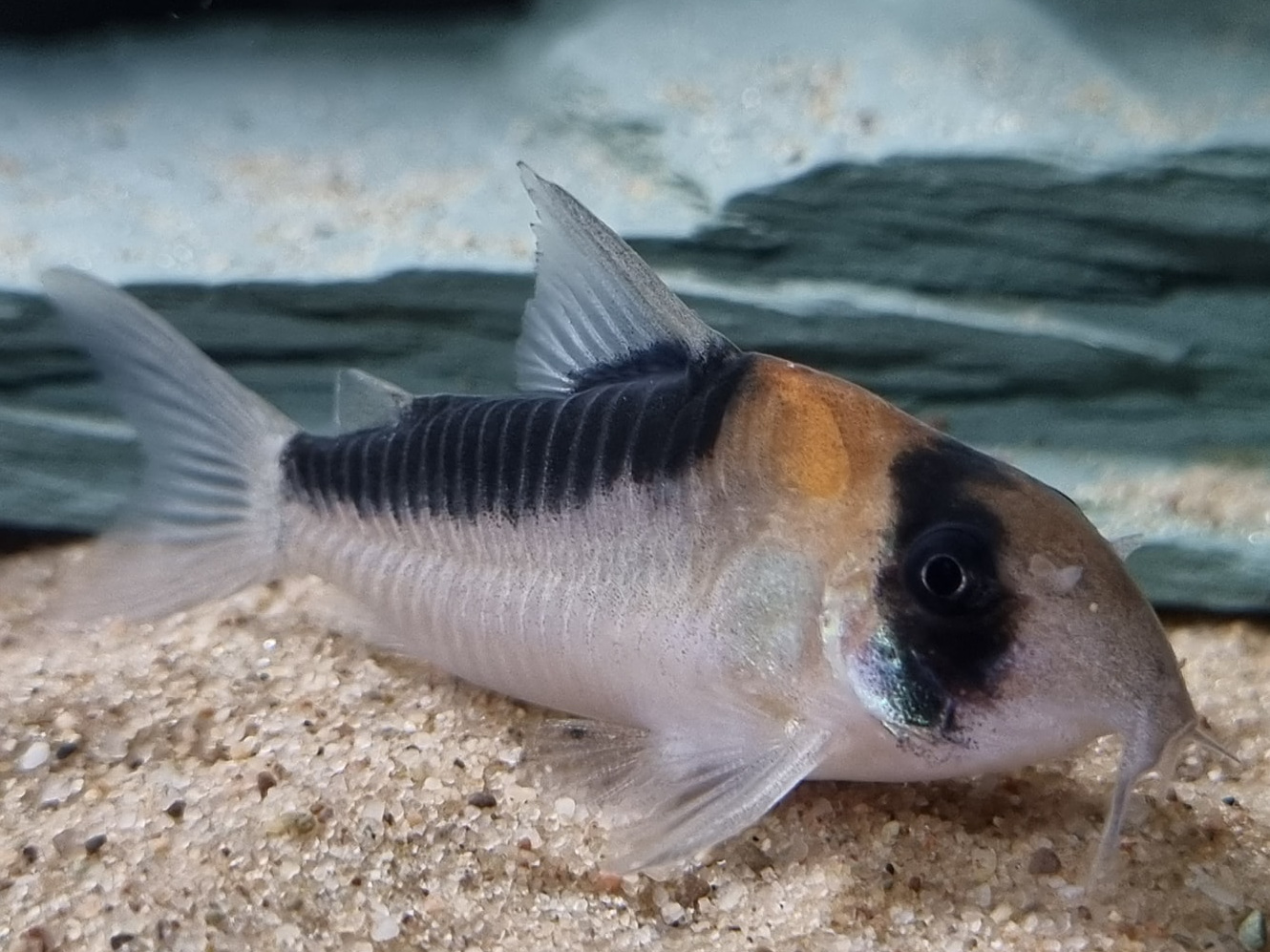
Head shape can tell a lot about the fish, these fishes have such inferiorly facing mouths will be feeding around the substrate. What is more interesting is the shape of the snout mentioned earlier but we know so little about it. Those elongate snouts certainly allow the fish to dig deeper for food but how it effects them we only have clues.
What should I feed my Corydoras?
These are certainly not feeding on fishes, there is also the misconception that because fishes die that all fishes have access to them. Generally weaker individuals would be picked up by predators before they die and any dead fish would be more quickly exploited by species evolved to detect and quickly feed on carcasses. So fish meal is logically best avoided. These fishes also do not feed on plants so cereals are certainly of little use. This means those general diets are not great for them, most containing fish meal, cereals, vegetables etc. usually in that order.
Luckily for carnivores there is a few options for insect based foods. Fish Science is generally good and they offer some diversity. Fluval bug bites can be okay but still has quite a lot of fish meal and cereals in it. Repashy bottom scratcher is certainly worth looking at, being a gel diet you can add additional ingredients to it. I wouldn’t be afraid to use either Fish Science or Repashy bottom scratcher as the basis of the diet then frozen and freeze dried foods to build on it creating a more well rounded diet. Certainly live foods are worth looking at and would offer a lot of enrichment.
Corydoradinae are very forgiving regarding diets so experimenting is certainly possible.
What about frozen foods?
Frozen foods are great but often will not contain all of the nutrition a species might require. In the wild most fishes will feed on hundreds of species and the narrow range of frozen foods available likely doesn’t compare nutritionally. These are great as enrichment or an addition to a fishes diet but not as a complete diet.
Protein Blisters
This is something that will always need mentioning regarding diets. I am not convinced it is caused by too much protein, even protein that isn’t absorbed/taken up by the fish e.g. excreted as nitrogenous waste. There is no evidence either way, it is clear bacteria can cause blisters and cysts but it can’t be said every cyst is caused by them without exploring further. Some frozen/live foods such as bloodworm can harbor Aeromonas (Senderovich et al., 2008) so it is difficult to make assumptions but there is little research on that.
A suggestion has been a form of gas bubble disease, true gas bubble disease as I call it though is caused from supersaturation of gases in the water, or some change in pressure resulting in bubbles forming in tissues very rapidly like the bends. It kills extremely rapidly as those bubbles form and burst blood vessels. There are other similar diseases like I have seen extreme algae growth associated, not proven though, to cause bubbles in some fishes but doesn’t kill and they are very localized.
We see similar in Loricariids, also armored and personally I would associate it with an infection of some kind. Blisters are tricky though as it’s such a general pathological symptom it could mean anything.
References:
Alexandrou, M. A., Oliveira, C., Maillard, M., McGill, R. A., Newton, J., Creer, S., & Taylor, M. I. (2011). Competition and phylogeny determine community structure in Müllerian co-mimics. Nature, 469(7328), 84-88.
Bertora, A., Fontanarrosa, M. S., Grosman, F., Sanzano, P., & Rosso, J. J. (2021). Trophic ecology of the Neotropical tolerant fish Corydoras paleatus under the influence of contrasting environmental conditions in a prairie stream. Anais da Academia Brasileira de Ciências, 93, e20200981.
Huysentruyt, F., Geerinckx, T., Brunain, M., & Adriaens, D. (2011). Development of the osteocranium in Corydoras aeneus (Gill, 1858) Callichthyidae, Siluriformes. Journal of Morphology, 272(5), 573-582.
Lowe, A., Summers, A. P., Walter, R. P., Walker, S., & Paig-Tran, E. M. (2021). Scale performance and composition in a small Amazonian armored catfish, Corydoras trilineatus. Acta Biomaterialia, 121, 359-370.
Nijssen, H. (1970). Revision of the Surinam catfishes of the genus Corydoras Lacépède, 1803 (Pisces, Siluriformes, Callichthyidae). Beaufortia, 18(230), 1-75.
Senderovich, Y., Gershtein, Y., Halewa, E., & Halpern, M. (2008). Vibrio cholerae and Aeromonas: do they share a mutual host?. The ISME journal, 2(3), 276-283.
Žák, J., Roy, K., Dyková, I., Mráz, J., & Reichard, M. (2022). Starter feed for carnivorous species as a practical replacement of bloodworms for a vertebrate model organism in ageing, the turquoise killifish Nothobranchius furzeri. Journal of Fish Biology, 100(4), 894-908.
 The Scientific Fishkeeper