
Corydoras has been revised splitting up the genus and resurrecting previously synonymized genera. But what does this all mean?
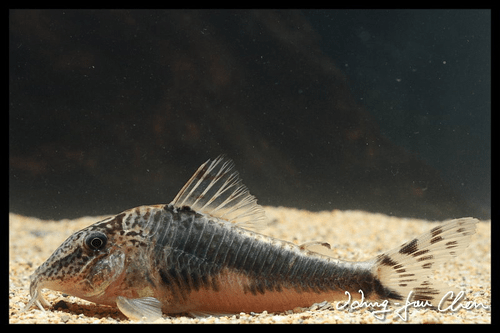
Corydoras is a genus of Catfishes in the family Callichthyidae. Callichthyidae includes: Callichthyinae (Callichthys, Lepthoplosternum, Hoplosternum, Megalechis and Dianema); Corydoralinae which is the focus of this article and revision. Figure 1 explains the topography (family tree format) of this group but bare in mind it doesn’t reflect the current knowledge for Corydoralinae.

Shimabukuro-Dias, C. K., Oliveira, C., Reis, R. E., & Foresti, F. (2004). Molecular phylogeny of the armored catfish family Callichthyidae (Ostariophysi, Siluriformes). Molecular Phylogenetics and Evolution, 32(1), 152-163.
Previously many genera were inferred for members of what was known for a long time as Corydoras but over time these were synonymized finalizing with Britto (2003) which resulted in Brochis no longer being valid. To put it simply as there were many reasons behind but also to have Corydoras as the genus it was then Brochis would have to be Corydoras.
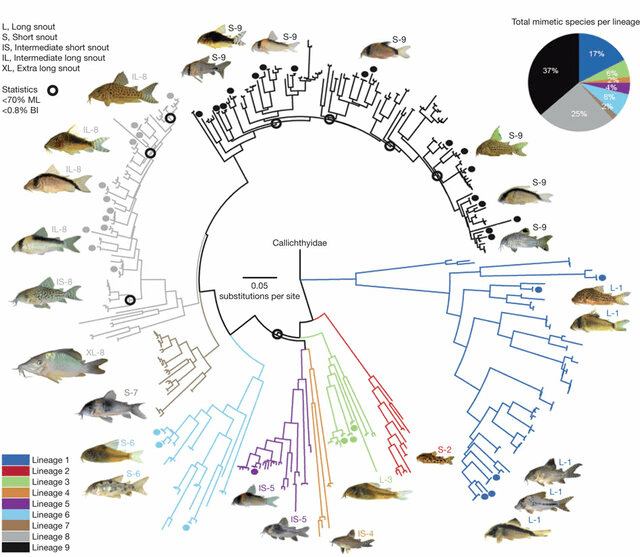
The history is a bit messy. We have known for a long time Corydoras has had a lineage system, this was explained clearly in Alexandrou et al (2011). This phylogeny shows how embedded Brochis is inside of Corydoras and therefore would not easily be valid as a genus.
The issue of type species
So while many of the ‘Corydoras‘ kept in the aquarium trade are not Corydoras, the type, C. geoffroy places in lineage 1. These would be the only true Corydoras, basically this is the reference species in a way.
Some might note what was known as Aspidoradini, a tribe separate to what was Corydoras branches out in the middle of Corydoras, more problems. It’s really messy.
What are the new genera?
- Corydoras: Used to represent lineage 1 of Corydoras. These have a but curved block shaped head, most distinctively is a filament behind the barbel’s which can look like an additional barbel.
- Aspidoras: Always known as Aspidoras but excludes Gastrodermis pauciradiatus.
- Scleromystax: Sometimes known as bearded Corydoras, the only to show really clear sexual dimorphism through odontodes.
- Gastrodermus: Originally the C. elegans group, lineage 5 and the microcorydoras such as G. pygmeaus and G. hastatus. Much shorter and rounder in the head but still slightly trinagular unlike Hoplisoma.
- Osteogaster: Originally the C. aeneus group, contains the bronze, O. aeneus. Rounded head, short.
- Brochis: This is a much larger group, likely for the time being. Contains the whole of lineage 8 from what was Brochis to species such as C. arcuatus. Similar to Corydoras the majority have large heads but these lack the curvature of Corydoras, similarly contains many large members.
- Hoplisoma: Lineage 9, another very popular genus from the trade. Very rounded head but much shorter then Osteogaster.
Corydoradinae head shapes

The clearest way to see the difference between the different genera is their head shapes, there is quite the diversity as shown in the above figure. The majority of these genera can be identified from that head shape in my opinion. Brochis seems to display the widest range of morphological disparity in head shape but this can be expected from such a large genus.
Why is this revision important?
This revision reflects our current knowledge of the group Corydoradinae, both regarding morphological and molecular information. Rather then have one large category which doesn’t describe the morphological diversity or any phylogenetic information, these genera are easier to navigate particularly for a hobbyist. Not just does their morphology differ but likely their care. I already know Corydoras and some Brochis display territorial behavior which is not reflective of all groups, from a hobbyist view point knowing the genera helps avoid this, or avoid larger species.
Revisions are normal in science as technology and knowledge advances, they aren’t done for no reason or for publication. Over time we have developed techniques that have helped us understand the evolution of fishes better and therefore give them more accurate names that reflect this evolution. Technology such as Computerized tomography (CT) scanning, extracting DNA from formalin preserved/historical specimens, gene expression, developmental techniques etc. We can now understand fishes in a way we never could before, it means that change is inevitable but it’s the path to understanding evolution, biodiversity and reflecting that in how we name species, genera, families etc.
This work was done by the scientists; Angelica C. Dias, Luiz F. C. Tencatt, Fabio F. Roxo, Gabriel de Souza da Costa Silva, Sérgio A. Santos, Marcelo R. Britto, Dr. Martin I. Taylor and Dr. Claudio Oliveira.
No doubt our knowledge of Corydoradinae wouldn’t be the same without the efforts of Steven Grant (Catfishes of the World) and Ian Fuller who runs Corydoras World, both have done a lot for bridging the gap between the hobbyist and the scientist. Corydoras World I can certainly recommend for anyone who wants to learn more about this curious group of fishes.
What species are what?
To save time I wont cite authors, but this should ideally be done. I wont include C and CW numbers as it’ll make the lists much much longer.
Corydoras
- Corydoras acutus
- Corydoras amapaensis
- Corydoras areio
- Corydoras aurofrenatus
- Corydoras blochi
- Corydoras caramater
- Corydoras cervinus
- Corydoras coriatae
- Corydoras cortesi
- Corydoras desana
- Corydoras filamentosus
- Corydoras fowleri
- Corydoras fulleri
- Corydoras geoffroy
- Corydoras maculifer
- Corydoras narcissus
- Corydoras negro
- Corydoras ourastigma
- Corydoras oxyrhynchus
- Corydoras pastazensis
- Corydoras saramaccensis
- Corydoras sarareensis
- Corydoras semiaquilus
- Corydoras septentrionalis
- Corydoras serratus
- Corydoras simulatus
- Corydoras solox
- Corydoras spilurus
- Corydoras stenocephalus
- Corydoras treitlii
- Corydoras vittatus
- Corydoras zawadzkii
Aspidoras
- Aspidoras albater
- Aspidoras aldebaran
- Aspidoras azaghal
- Aspidoras belenos
- Aspidoras brunneus
- Aspidoras carvalhoi
- Aspidoras depinnai
- Aspidoras fuscoguttatus
- Aspidoras gabrieli
- Aspidoras kiriri
- Aspidoras lakoi
- Aspidoras maculosus
- Aspidoras mephisto
- Aspidoras poecilus
- Aspidoras psammatides
- Aspidoras raimundi
- Aspidoras rochai
- Aspidoras velites
Scleromystax
- Scleromystax barbatus
- Corydoras lacerdai
- Scleromystax macropterus
- Scleromystax prionotos
- Scleromystax reisi
- Scleromystax salmacis
- Scleromystax virgulatus
Gastrodermus
- Gastrodermus bilineatus
- Gastrodermus elegans
- Gastrodermus gracilis
- Gastrodermus guapore
- Gastrodermus hastatus
- Gastrodermus latus
- Gastrodermus mamore
- Gastrodermus nanus
- Gastrodermus napoensis
- Gastrodermus nijsseni
- Gastrodermus paucerna
- Gastrodermus pauciradiatus
- Gastrodermus pygmaeus
- Gastrodermus undulatus
Osteogaster
- Osteogaster aeneus
- Osteogaster eques
- Osteogaster hephaestus
- Osteogaster maclurei
- Osteogaster melanotaenia
- Osteogaster rabauti
- Osteogaster zygatus
Brochis
- Brochis agassizii
- Brochis amandajanea
- Brochis ambiacus
- Brochis approuaguensis
- Brochis arcuatus
- Brochis bethanae
- Brochis bifasciatus
- Brochis britskii
- Brochis brittoi
- Brochis condiscipulus
- Brochis costai
- Brochis crimmeni
- Brochis crypticus
- Brochis delphax
- Brochis deweyeri
- Brochis difluviatilis
- Brochis ephippifer
- Brochis garbei
- Brochis geryi
- Brochis gomezi
- Brochis haraldschultzi
- Brochis heteromorphus
- Brochis imitator
- Brochis incolicana
- Brochis isbrueckeri
- Brochis lamberti
- Brochis leopardus
- Brochis multiradiatus
- Brochis noelkempffi
- Brochis ornatus
- Brochis orphnopterus
- Brochis pantanalensis
- Brochis pinheiroi
- Brochis pulcher
- Brochis reticulatus
- Brochis robineae
- Brochis robustus
- Brochis seussi
- Brochis sodalis
- Brochis spectabilis
- Brochis splendens
- Brochis sychri
- Brochis virginiae
Hoplisoma
- Hoplisoma acrensis
- Hoplisoma adolfoi
- Hoplisoma albolineatum
- Hoplisoma amphibelum
- Hoplisoma apiaka
- Hoplisoma araguaiaensis
- Hoplisoma armatum
- Hoplisoma atropersonatum
- Hoplisoma axelrodi
- Hoplisoma baderi
- Hoplisoma benattii
- Hoplisoma bicolor
- Hoplisoma boehlkei
- Hoplisoma boesemani
- Hoplisoma bondi
- Hoplisoma breei
- Hoplisoma brevirostris
- Hoplisoma burgessi
- Hoplisoma carlae
- Hoplisoma caudimaculatum
- Hoplisoma cochui
- Hoplisoma colossus
- Hoplisoma concolor
- Hoplisoma copei
- Hoplisoma coppenamensis
- Hoplisoma cruziensis
- Hoplisoma davidsandsi
- Hoplisoma diphyes
- Hoplisoma duplicareum
- Hoplisoma ehrhardti
- Hoplisoma esperanzae
- Hoplisoma evelynae
- Hoplisoma eversi
- Hoplisoma flaveolum
- Hoplisoma froehlichi
- Hoplisoma gladysae
- Hoplisoma gossei
- Hoplisoma granti
- Hoplisoma griseum
- Hoplisoma gryphus
- Hoplisoma guianensis
- Hoplisoma habrosum
- Hoplisoma julii
- Hoplisoma kanei
- Hoplisoma knaacki
- Hoplisoma lacrimostigmata
- Hoplisoma leucomelas
- Hoplisoma longipinnis
- Hoplisoma loretoensis
- Hoplisoma loxozonum
- Hoplisoma lymnades
- Hoplisoma melanistium
- Hoplisoma melini
- Hoplisoma metae
- Hoplisoma micracanthus
- Hoplisoma microcephalum
- Hoplisoma multimaculatum
- Hoplisoma nattereri
- Hoplisoma oiapoquensis
- Hoplisoma ortegai
- Hoplisoma osteocarum
- Hoplisoma paleatus
- Hoplisoma panda
- Hoplisoma paragua
- Hoplisoma parallelum
- Hoplisoma pavanelliae
- Hoplisoma petracinii
- Hoplisoma polystictum
- Hoplisoma potaroensis
- Hoplisoma punctatum
- Hoplisoma revelatum
- Hoplisoma reynoldsi
- Hoplisoma sanchesi
- Hoplisoma schwartzi
- Hoplisoma similis
- Hoplisoma sipaliwini
- Hoplisoma steindachneri
- Hoplisoma sterbai
- Hoplisoma surinamensis
- Hoplisoma trilineatum
- Hoplisoma tukano
- Hoplisoma urucu
- Hoplisoma weitzmani
- Hoplisoma xinguensis
References:
Alexandrou, M. A., Oliveira, C., Maillard, M., McGill, R. A., Newton, J., Creer, S., & Taylor, M. I. (2011). Competition and phylogeny determine community structure in Müllerian co-mimics. Nature, 469(7328), 84-88.
Britto, M. R. (2003). Phylogeny of the subfamily Corydoradinae Hoedeman, 1952 (Siluriformes: Callichthyidae), with a definition of its genera. Proceedings of the Academy of Natural Sciences of Philadelphia, 153(1), 119-154.
Dias, A. C., Tencatt, L. F., Roxo, F. F., Silva, G. D. S. D. C., Santos, S. A., Britto, M. R., … & Oliveira, C. (2024). Phylogenomic analyses in the complex Neotropical subfamily Corydoradinae (Siluriformes: Callichthyidae) with a new classification based on morphological and molecular data. Zoological Journal of the Linnean Society, zlae053.
Shimabukuro-Dias, C. K., Oliveira, C., Reis, R. E., & Foresti, F. (2004). Molecular phylogeny of the armored catfish family Callichthyidae (Ostariophysi, Siluriformes). Molecular Phylogenetics and Evolution, 32(1), 152-163.
 The Scientific Fishkeeper
Brilliant explanatory article! Thank you!
LikeLike