
Bloodworm has been a food that has been discouraged against for around 10 or more years. There has never been any doubt that many fishes feed on Chironomatid larvae in the wild (Delariva & Agostinho, 2001; Valtierra-Vega & Schmitter-Soto, 2000), even discus feed on them (Crampton, 2008). Chironomatid larvae being the more scientific name for bloodworm. You might have even seen these larvae in your pond, buckets or similar.
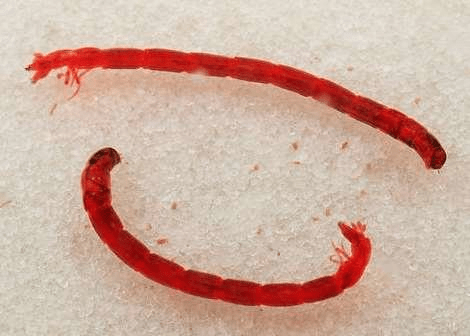
So why are bloodworms so feared?
I don’t think there is a true origin to this, it is still one of the most common live and frozen foods used, it’s cheap and easy to find. Maybe there are still some aspects of when tubifex was feared due to sewage contamination.
Bloodworm being the larvae of an insect does have a casing, known as an exoskeleton formed of chitin. This can be difficult to digest and for some fishes impossible, although many species are possibly sold as bloodworm it’s likely there is some diversity. There are reports of constipation and similar caused by bloodworm, although bloating is tricky and can have many causes from bacterial infections to a food item not being processed.
Bloodworm is not the entire diet of any fishes I’ve researched and when fed as an entire diet it results in liver enlargement and and poorer body condition (Žák et al., 2022), these results are similar to Hao et al. (2021) where removing to a formulated diet increases general health of the fish.
I chose this topic to find reasons that I am wrong, that bloodworm is much better then I thought it was. It doesn’t seem bad for fattening up fishes but does seem to come with a variety of problems, as a result I think I will continue to recommend Tubifex.
The real worm to try
Tubifex is a relatively common live, frozen and freeze dried food available. Unlike bloodworm it’s an annelid, true worm and is fully aquatic. It lacks the thick chitin casing of bloodworms, making them much more easy to digest. To cultivate they are less tricky given their lifestyle but do need a constant flow of freshwater.
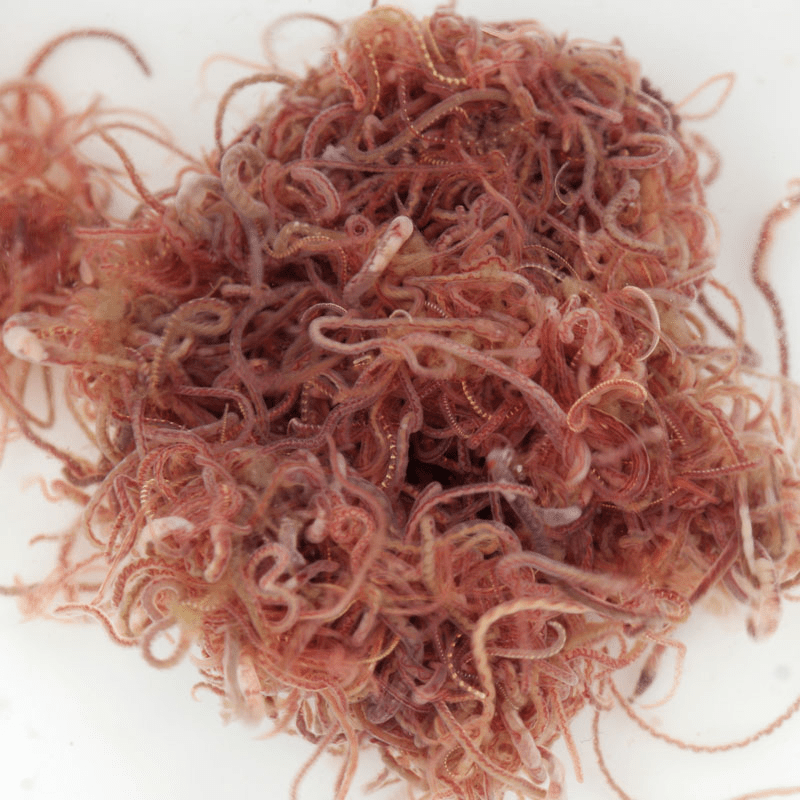
Unlike bloodworm, Tubifex was vilified for years, this amazing genus is extremely adaptable. This adaptability has meant that Tubifex can be found in the most hostile and polluted habitats and at one time this is where they were collected for the aquarium trade. Due to being collected from very polluted habitats it was not the most ideal live food to avoid pollution. Frozen will be another story as most are gamma irradiated, killing most bacteria on them. But for many years Tubifex is farmed in a clean and sustainable matter.
Unlike bloodworm Tubifex is very high in nutrition (Herawati et al., 2016) and has shown to increase growth when mixed with a prepared diet (Alam et al., 2021) even when compared to other live foods (Mellisa et al., 2018).
Human health
Bloodworm is a known allergen leading to asthma (Wu et al., 2005; Nandi et al., 2014). As someone who is not a medical practitioner I cannot offer much advice, allergies can occur at any time and it is good to be cautious. When dealing with bloodworm, handling particularly wearing disposable gloves can be a good idea, using a tub to defrost it in. It does beg the question given it is quite a common allergen whether to use it at all? In my experience I have met very few people who are allergic to bloodworm.
References:
Alam, M. A., Khan, M. A., Sarower-e-Mahfuj, M. D., Ara, Y., Parvez, I., & Amin, M. N. (2021). A model for tubificid worm (Tubifex tubifex) production and its effect on growth of three selected ornamental fish. Bangladesh Journal of Fisheries, 33(2), 205-214.
Crampton, W. G. (2008). Ecology and life history of an Amazon floodplain cichlid: the discus fish Symphysodon (Perciformes: Cichlidae). Neotropical Ichthyology, 6, 599-612.
Delariva, R. L., & Agostinho, A. A. (2001). Relationship between morphology and diets of six neotropical loricariids. Journal of Fish biology, 58(3), 832-847.
Hao, Q., Teame, T., Wu, X., Ding, Q., Ran, C., Yang, Y., … & Zhou, Z. (2021). Influence of diet shift from bloodworm to formulated feed on growth performance, gut microbiota structure and function in early juvenile stages of hybrid sturgeon (Acipenser baerii× Acipenser schrenckii). Aquaculture, 533, 736165.
Herawati, V. E., Nugroho, R. A., Hutabarat, J., & Karnaradjasa, O. (2016). Profile of amino acids, fatty acids, proximate composition and growth performance of Tubifex tubifex culture with different animal wastes and probiotic bacteria. Aquaculture, Aquarium, Conservation & Legislation, 9(3), 614-622.
Mellisa, S., Rahimi, S. A. E., & Umiati, U. (2018). The effect of different live feeds on the growth and survival of comet goldfish Carrasius auratus auratu larvae. In IOP Conference Series: Earth and Environmental Science (Vol. 216, No. 1, p. 012025). IOP Publishing.
Nandi, S., Aditya, G., Chowdhury, I., Das, A., & Saha, G. K. (2014). Chironomid midges as allergens: evidence from two species from West Bengal, Kolkata, India. Indian Journal of Medical Research, 139(6), 921-926.
Valtierra-Vega, M. T., & Schmitter-Soto, J. J. (2000). Feeding habits of cichlid species (Perciformes: Cichlidae) in Caobas lake, Quintana Roo, Mexico. Revista de Biologia Tropical, 48(2-3), 503-508.
Wu, K. C., Räsänen, K., & Hudson, T. J. (2005). Fishing for allergens: bloodworm-induced asthma. Allergy, Asthma & Clinical Immunology, 1, 1-2.
Žák, J., Roy, K., Dyková, I., Mráz, J., & Reichard, M. (2022). Starter feed for carnivorous species as a practical replacement of bloodworms for a vertebrate model organism in ageing, the turquoise killifish Nothobranchius furzeri. Journal of Fish Biology, 100(4), 894-908.
 The Scientific Fishkeeper