
Many fishkeepers are after something unique and usual for their aquarium and sadly many of what we call oddballs are usually quite large. There are always exceptions to this and these only need to be encouraged.
The eel issue
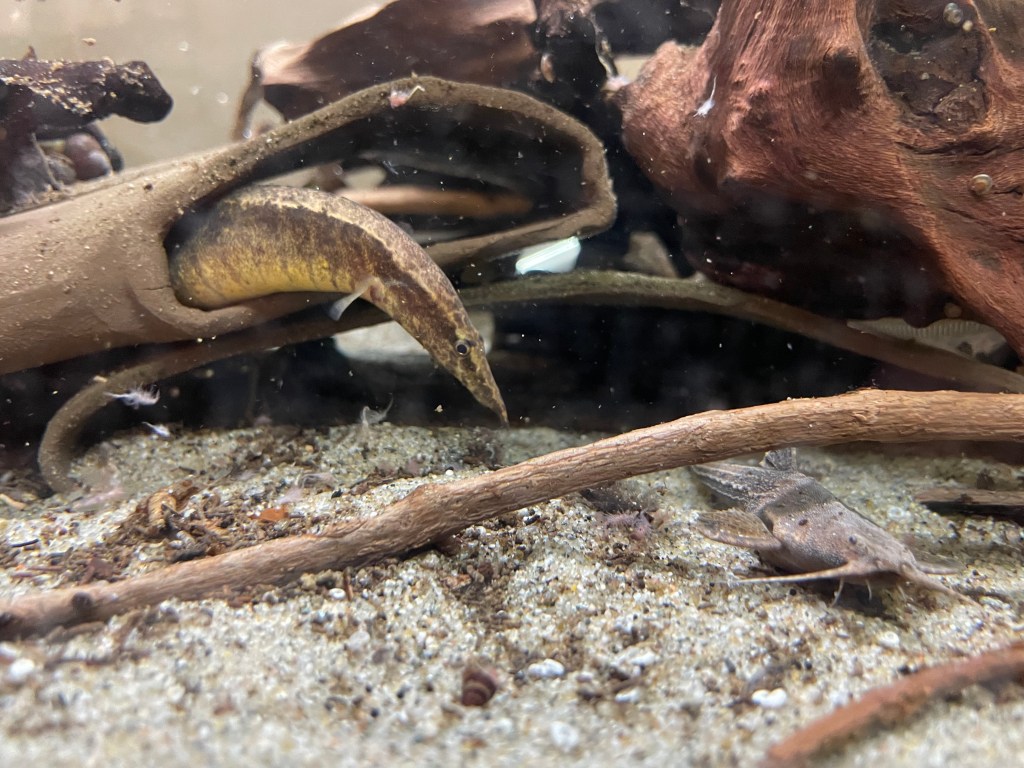
Before exploring Macrognathus circumcinctus I should explain the issue with the word eel. Eel is a common name that realistically describes anything anguilliform in shape. Anguilliform is a fish shape which refers to that elongate body shape and would generally use that body for locomotion. This is easily confused with Anguilliformes, true eels are quite distantly related from what we see sold as freshwater eels with the exception of the large Gymnothorax polyuranodon (Lifestyle is debated; Ebner et al., 2011; Ebner et al., 2019) and G. tile (actually brackish). Eels are found in many clades from the eel loaches in Pangio and Vaillentella; to the eel catfishes in Channallabes. Gymnotiformes, true knifefishes are also described as either eels or having anguilliform morphology.
No group is referred to as eels as much as Synbranchiformes and this is where Macrognathus circumcintus places. Other popular ‘eel’ fishes are also found in this clade, Mastacembelus erythrotaenia (Fire eel), Mastacembelus armatus (tyre track eel) and if more interested in Asian cooking then Monopterus spp. (swamp eels). The South American swamp eel, Synbranchus spp. is particularly interesting given along with being obligate air breathers they are sequential/diandric hermaphrodites (Barros et al., 2017).
The Half Banded Spiny Eel, Macrognathus circumcinctus
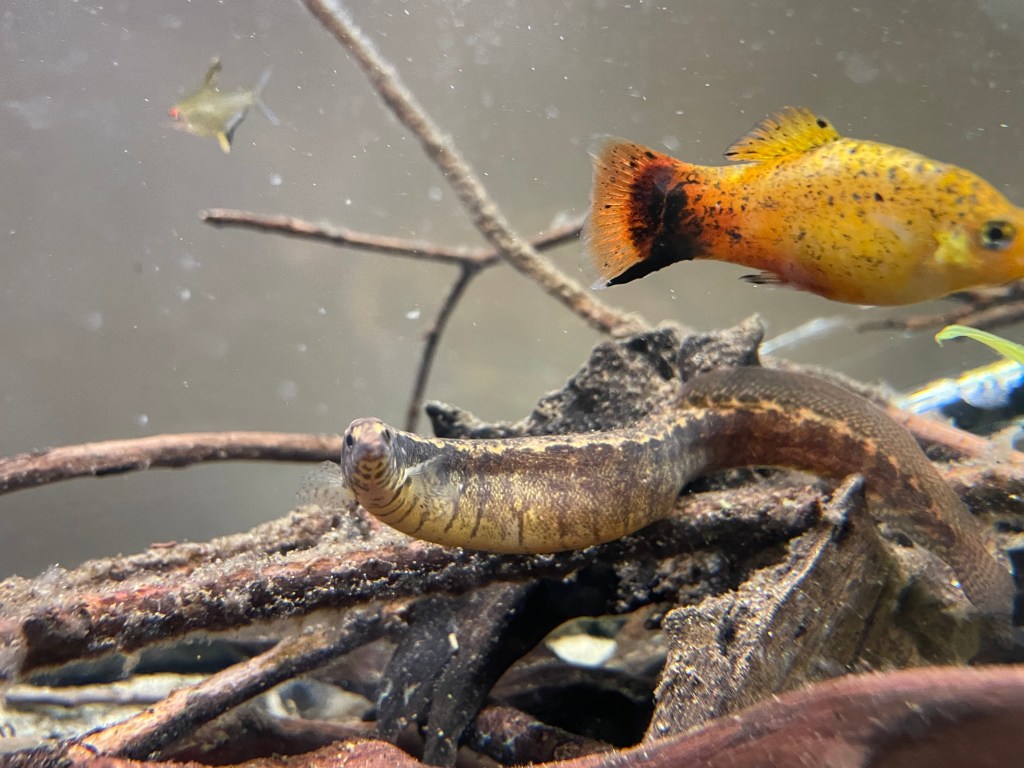
Taxonomy: Previously Mastacembelus before being revised in 1984.
Locality: Widespread throughout South East Asia. GBIF (Global Biodiversity Information Facility) records this species largely in Thailand and Cambodia with a few reaching out into Vietnam, Malaysia, Borneo and Sumatra. Whether these represent the same species I don’t know.
Size: 9-13cm SL (Maharsi et al., 2024; Parenti & Lim, 2005), there is some report of a 28.5cm individual from Fishbase but this seems exceptional.
Habitat: It seems they prefer rocky habitats with reasonable currents (Maharsi et al., 2024), they prefer it shaded and it also seems to be largely turbid not by tannins but by sediment. These habitats probably have a lot of invertebrates feeding on the diversity of bacteria.
Temperature: 26.7-29.2 (Maharsi et al., 2024)
pH: 6.4-8.33 (Maharsi et al., 2024).
Diet: Invertebrates (Maharsi et al., 2024), maybe small fishes but I have seen mine actively feed on mushrooms. They can be quite quick ambush predators while also capable of searching for food amongst crevices. This invertebrate diet is pretty consistent throughout Macrognathus (Sarmah & Kardong, 2024). Ideally as a fishkeeper it would be worth aiming for a diet with an insect/invertebrate based dry/gel diet such as Repashy Bottom Scratcher Or Fluval Bug Bites. Building on that diet with a diversity of frozen and freeze dried foods. You can also try live foods such as earthworms on larger individuals but tubifex, blackworms, daphina etc. on smaller.
Hardscape: A lot of decor so they have places to hide and explore, a confident individual will come out but also if in a group it gives them space to hide should be required.
Substrate: While I’ve never experienced this species burying particularly and even less with age many will bury in the sand and it is therefore beneficial as enrichment to provide that for them.
Sociality, a problem?
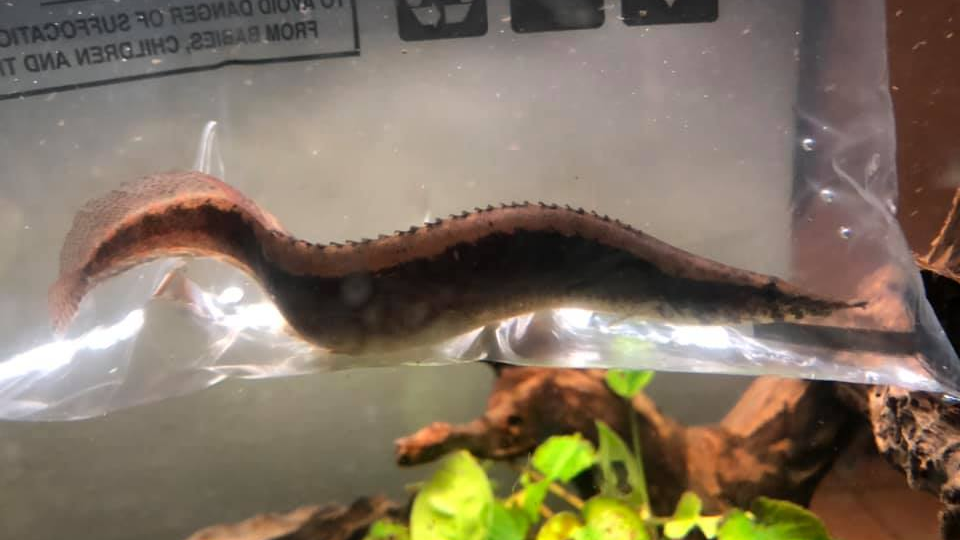
While almost all websites on the species will record this species as social, it doesn’t take much to find out the picture is a little more complicated. In reality some are and it’s worth buying more if you can because if yours are social they will benefit from that interaction as basic enrichment. Mine and many others have M. circumcinctus who wont tolerate others of their species and even other eel shaped fishes, while I thought it was because even before I took on mine it was housed alone for potentially many years. Over time it’s become clear mine is not alone and they can even be aggressive from a younger age. They are very much individuals so it is likely that more then anything else.
References:
Barros, N. H. C., De Souza, A. A., Peebles, E. B., & Chellappa, S. (2017). Dynamics of sex reversal in the marbled swamp eel (Synbranchus marmoratus Bloch, 1795), a diandric hermaphrodite from Marechal Dutra Reservoir, northeastern Brazil. Journal of Applied Ichthyology, 33(3), 443-449.
Ebner, B. C., Donaldson, J. A., Courtney, R., Fitzpatrick, R., Starrs, D., Fletcher, C. S., & Seymour, J. (2019). Averting danger under the bridge: video confirms that adult small-toothed morays tolerate salinity before and during tidal influx. Pacific Conservation Biology, 26(2), 182-189.
Ebner, B. C., Kroll, B., Godfrey, P., Thuesen, P. A., Vallance, T., Pusey, B., … & Perna, C. N. (2011). Is the elusive Gymnothorax polyuranodon really a freshwater moray?. Journal of Fish Biology, 79(1), 70-79.
Fricke, R., Eschmeyer, W. N. & Van der Laan, R. (eds) 2024. ESCHMEYER’S CATALOG OF FISHES: GENERA, SPECIES, REFERENCES. (http://researcharchive.calacademy.org/research/ichthyology/catalog/fishcatmain.asp). Electronic version 05/09/2024.
Maharsi, G. J., Waluyo, W., & Armando, E. (2024). Study of Ecobiological Characteristics of Spiny Eel (Mastacembelidae) in Elo River, Magelang, Central Java. JFMR (Journal of Fisheries and Marine Research), 8(3), 8-15.
Parenti, L. R., & Lim, K. K. (2005). Fishes of the Rajang Basin, Sarawak, Malaysia. The Raffles Bulletin of Zoology, 13, 175-208.
Sarmah, P., & Kardong, D. (2024). Biology Of Macrognathus Sp. With Special Reference To Macrognathus Pancalus (Hamilton) And Macrognathus Aral (Bloch And Schneider). Journal of Advanced Zoology, 45(1).
 The Scientific Fishkeeper