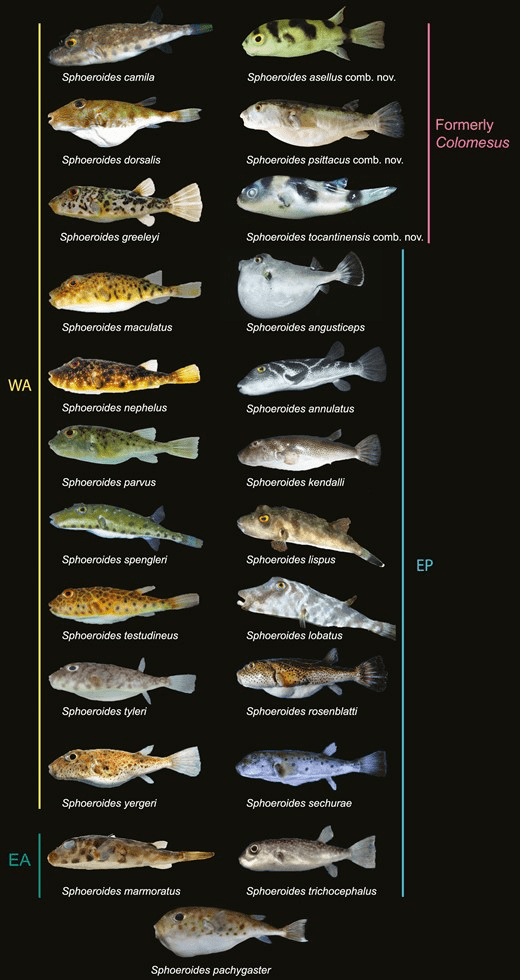
Previously Tetradontiformes in South America were previously recognised as Sphoeroides and Colomesus but with the latest scientific evidence Colomesus has been synonymised with Sphoeroides. Sphoeroides (syn. Colomesus) contains two freshwater species, S. ascellus and S. tocatinensis, particularly the former is a frequent import for the aquarium trade.
Figure 1: The species of the revised Sphoeroides as described in Araujo et al. (2023).
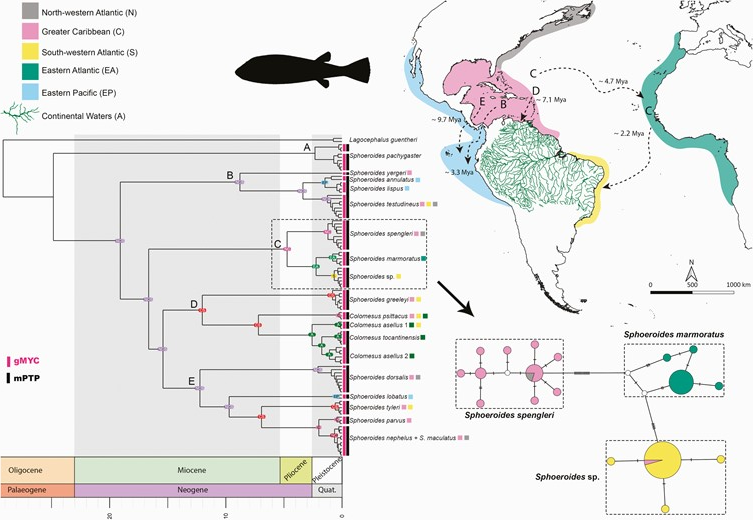
This study used molecular phylogenetics to identify a phylogeny of the genus Sphoeroides (Fig 2) discovering the paraphyletic nature of Colomesus. The gene COI from the mitochondrial genome was used, which does beg the question how the phylogeny would differ with more genes including contributions from the nucleus.
Figure 2: Phylogeny of the South American Tetraodontiformes according to Araujo et al. (2023).
While this has changed a lot it’s possible more revisions and adjustments will be made, science has some level of opinion so it’s going to be an interesting future.
Source:
Araujo, G. S., Kurtz, Y. R., Sazima, I., Carvalho, P. H., Floeter, S. R., Vilasboa, A., … & Carvalho-Filho, A. (2023). Evolutionary history, biogeography, and a new species of Sphoeroides (Tetraodontiformes: Tetraodontidae): how the major biogeographic barriers of the Atlantic Ocean shaped the evolution of a pufferfish genus. Zoological Journal of the Linnean Society, zlad055.
Now this is only an introduction to my favourite dietary niche, I think. When algae eating is mentioned most will think about Loricariids, a 1,040 species strong family of Siluriformes (catfishes) according to Catalog of Fishes as of 2023 but many many more are to be described and discovered. It might be the small Otocinclus or the reasonably sized Pterygoplichthys and Hypostomus, if in the aquarium hobby even just a short time a wider diversity of this family becomes obvious with almost everyone having kept the common bristlenose, Ancistrus aff. cirrhosus or one of the ‘L numbers’ as they are called regardless if they have a number or not.
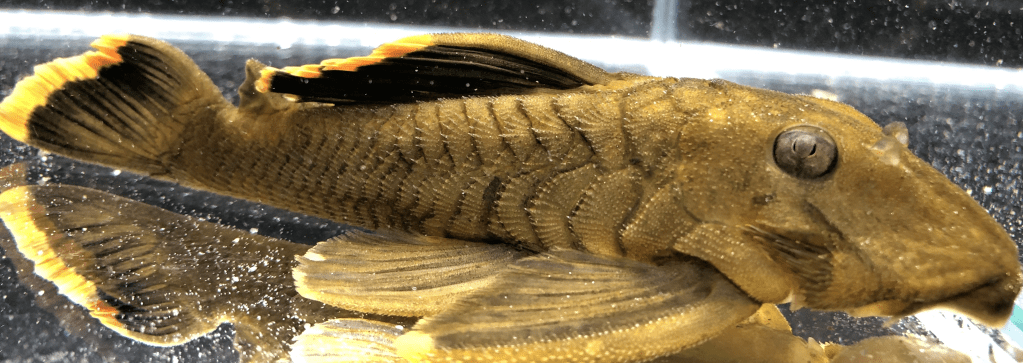
Baryancistrus chrysolomus, an algivore from the Rio Xingu, Brazil.
It’s also pretty well known that there are other fishes who do not rasp, maybe in the same way and feed on algaes, the diversity of Rift Valley cichlids who are a model taxa for adaptive radiation (McGee et al., 2020) has many species that frequently feed on algaes (McKaye & Marsh, 2020). The extent of their specialisation is certainly interesting given they are more then capable of generalisation where possible as explained in the Liems paradox (Liem, 1980). There is definitely the Gastromyzontidae, these are the hillstream loaches and looking at their mouth parts they don’t rasp in the same way to Loricariids.
So if not Loricariids what am I talking about? And ignoring those other groups? When looking at the mouth of any Loricariid you can’t help but notice those big rasping plates, part of the reason these are the suckermouth fishes. But are there others?
Loricariids obviously dominate South America, yet elsewhere that clade is not found. Africa, a vast but underrated continent when looking beyond the Rift Valley, we need to look no further then the secretly well known but diverse family, Mochokididae. I cannot even just express how fascinating this family is for algae raspers.
Synodontis brichardi
Synodontis, the genus anyone with Rift Valley will be aware of. But there is a lot more to this genus, they are found further then the Rift Valley and across the vast nature of Synodontis. There is also a wide diversity of diets within this genus (Yongo et al., 2019). Synodontis brichardi, S. shoutedeni and S. victoriae (Elison et al., 2018) are well known algae raspers, sometimes based on that very specialised rasping morphology. There has been little studies to whether they are able to generalise but in my personal experience I have seen Synodontis brichardi at least be able and willing to feed on live earthworms over algae, Liems paradox maybe?
There is one other Mochokidae you might not have heard of regarding algae rasping, Chiloglanis although others I shall not have the time to mention (Gerrinckx & Kegal, 2014) . A good sized genus, Chiloglanis (Van Wassenbergh et al., 2009) these feed on algaes and other Periplankton. They are not common in the trade but maybe they should be? As riverine fishes adapted to low flow maybe they should be?
Looking towards Asia Sisoridae (Mousavi-Sabet et al., 2021) could contain many algae raspers but maybe just adapted to that high velocity water?
The answer might be partially is there other taxa that might rasp on the algae or how much do we know about fish diets? Most understanding seems reasonably limited.
While I say all of this it doesn’t mean they are eating exclusively algae but maybe other periplankton or aufwuch by a specific feeding motion. The jaws outside of Loricariid seem to be a lot less diverse and more specialised competing I assume with other species and genera whereas Loricariidae dominate so much.
References:
Elison, M. V., Mlaponi, E., Musiba, M. J., NGUPULA, G. W., Kashindye, B. B., & Kayanda, R. J. (2018). Changes in the Diet of Synodontis victoriae and Synodontis afrofischeri in Lake Victoria, Tanzanian waters. African Journal of Tropical Hydrobiology and Fisheries, 16(1), 10-15.
Geerinckx, T., & De Kegel, B. (2014). Functional and evolutionary anatomy of the African suckermouth catfishes (Siluriformes: Mochokidae): convergent evolution in Afrotropical and Neotropical faunas. Journal of Anatomy, 225(2), 197-208.
Liem, K. F. (1980). Adaptive significance of intraspecific and interspecific differences in thefeeding repertoires of cichlid fishes. American Zoologist20,295 – 314.
McGee, M. D., Borstein, S. R., Meier, J. I., Marques, D. A., Mwaiko, S., Taabu, A., Kiche, M. A., O’Meara, B., Bruggmann, R., Excoffier, L. & Seehausen, O. (2020). The ecological and genomic basis of explosive adaptive radiation. Nature, 586(7827), 75-79.
McKaye, K. R., & Marsh, A. (1983). Food switching by two specialized algae-scraping cichlid fishes in Lake Malawi, Africa. Oecologia, 56, 245-248.
Mousavi-Sabet, H., Eagderi, S., Vatandoust, S. A. B. E. R., & Freyhof, J. Ö. R. G. (2021). Five new species of the sisorid catfish genus Glyptothorax from Iran (Teleostei: Sisoridae). Zootaxa, 5067(4), 451-484.
Van Wassenbergh, S., Lieben, T., Herrel, A., Huysentruyt, F., Geerinckx, T., Adriaens, D., & Aerts, P. (2009). Kinematics of benthic suction feeding in Callichthyidae and Mochokidae, with functional implications for the evolution of food scraping in catfishes. Journal of Experimental Biology, 212(1), 116-125.
Yongo, E., Iteba, J., & Agembe, S. (2019). Review of food and feeding habits of some Synodontis fishes in African freshwaters. OFOAJ, 10, 27-31.
To put it more then simply, no the swim bladder is not a disease. It is an organ, also known as the gas bladder largely used for buoyancy in many of the fishes we are familiar with. Of course given the wide diversity of fishes there is variations on this for example; Polypterus (bichir) use it as an equivalent of a lung (Pelster, 2021) and it’s pretty well known sharks lack this organ (Yalowitz & Feriuson, 2006).
It’s a rather curious organ, as ichthyologists or even biologists we learn about it pretty early during our university undergraduate degree. Maybe like me it’s a lot of physiology that involves biochemistry so I phase out a little at the niche aspects.
There are also two main types of fishes, Actinopterygii fishes to be correct I guess depending on this organ:
Physostomes: This is where there is a direct duct/tube from the gas/swim bladder to the gut. This includes what seems to be groups of fishes that branched out earlier; carps, catfish, eels, Polypterus. It is largely assumed they fill up the organ by gulping for air (Solberg & Kaartvedt, 2014’Sundnes & sand, 1975).
Diagram of trout internal anatomy, sourced from Pearsons Education Inc. An example of a Physostome.
Physoclisti: These species lack a duct, the gas is secreted into the organ (Ross, 1979).
Maybe more to the point of this article, it is an organ with an important purpose.
What about the disease some might ask?
A panda coloured globe eye goldfish.
It’s no different from heart disease, it’s anything causing an issue with an individual organ.
It’s brilliant just for showing the gross anatomy, gross as in just the anatomy as it’s not simple. Given the funding of fish pathology how much do we know? I feel sometimes it just shows we are jumping at strings. Much of what we see in goldfish I think is anatomical but other fishes might have complex answers.
What else?
Well when people see this they will be asking why does this fish spin, why does it move how it does? My fish is acting different?
The short answer is like with most animals that strange behaviours can be a sign of many things. If your spatial awareness and balance is gone is the answer always the inner ear, maybe our equivalent? I must always ask can we define the difference? Beyond goldfishes where it is likely the cause due to their shape, I’m not sure but maybe it seems less likely the swim bladder.
Neurological disorders (Burton & Burgess, 2023) can cause issues with balance that could look like swim bladder disorders such as those caused by malnutrition or oxygen starvation. Both of these examples either limit those elements or compounds required for neurological function or in the case of oxygen, the starvation of that can cause areas of the brain to die as they can no longer respire.
There is so little maybe we do know about fish pathology and for individual situations then there is individual solutions, another aspect is when researching fishes it comes up with mostly how to eat fish haha.
References:
Burton, E. A., & Burgess, H. A. (2023). A Critical Review of Zebrafish Neurological Disease Models− 2. Application: Functional and Neuroanatomical Phenotyping Strategies and Chemical Screens. Oxford Open Neuroscience, 2, kvac019.
Pelster, B. (2021). Using the swimbladder as a respiratory organ and/or a buoyancy structure—Benefits and consequences. Journal of Experimental Zoology Part A: Ecological and Integrative Physiology, 335(9-10), 831-842.
Ross, L. G. (1979). The haemodynamics of gas resorption from the physoclist swimbladder: the structure and morphometrics of the oval in Pollachim virens (L). Journal of Fish Biology, 14(3), 261-266.
Sundnes, G., & Sand, O. (1975). Studies of a physostome swimbladder by resonance frequency analyses. ICES Journal of Marine Science, 36(2), 176-182.
Solberg, I., & Kaartvedt, S. (2014). Surfacing behavior and gas release of the physostome sprat (Sprattus sprattus) in ice-free and ice-covered waters. Marine biology, 161, 285-296.
Wildgoose, W. H. (2007). Buoyancy disorders of ornamental fish: A review of cases seen in veterinary practice. Fish Vet. J, 9, 22-37.
Yalowitz, S., & Ferguson, A. (2006). Sharks: Myth and mystery. Monterey Bay Aquarium.
Is it the real villain botanical? The one we should all avoid.
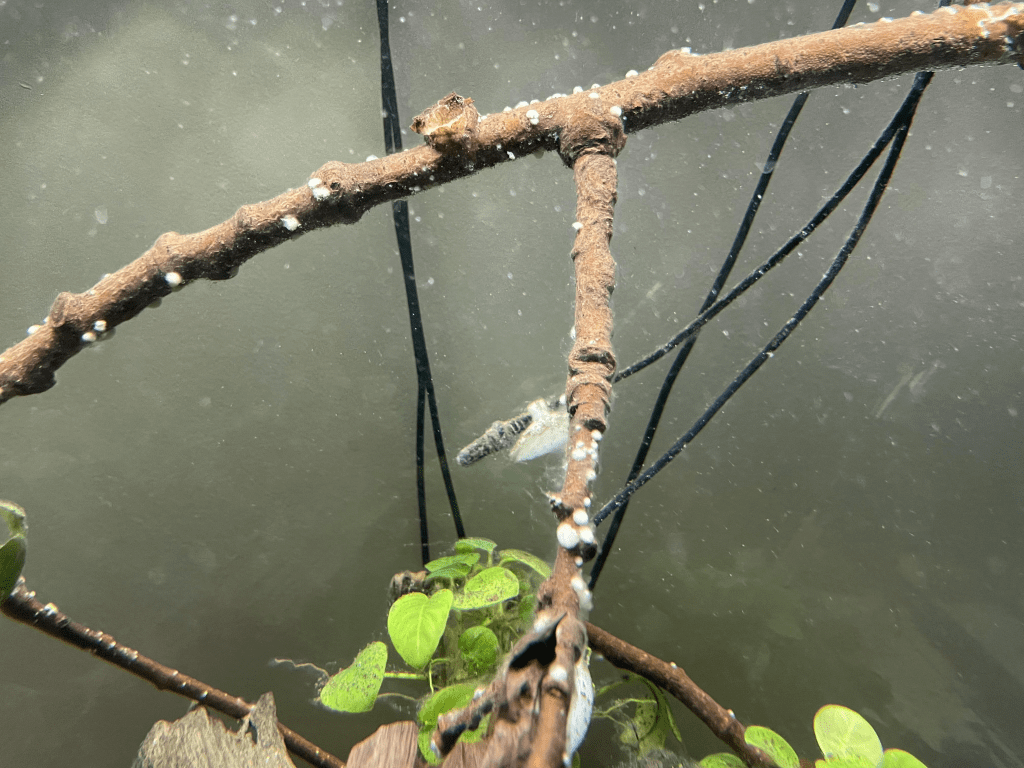
Wood we all think we know what it is but can we describe what it is? Woody? We somewhat know what it does, for plants it gives them structure but also allows for the transportation of materials and water, it’s highly vascular allowing to transport different compounds and importantly water (Groover & Mansfield, 2020). Bare this in mind, it’s like a train network for the plant or blood vessels.
One of the most well known networks is known as xylem, these are the vessels that transport nutrients and water upwards (Kasper et al., 2022). On the other hand phloem, another set of vessels transports much of the nutrients around the plant; sugars and amino acids are some of the things (Killiny, 2019). Both using sap to transport these materials around the plant.
Lets cut to the chase though, plant toxins.
There are many different toxins plants use largely for preventing herbivory or maybe disease. These toxins can be potentially seasonal but more then often localised, like how you can eat a potato but not the leaves.
Toxins are also very taxa specific so there are definitely plants to avoid, if unsure of the species of if it’s safe don’t use. I cross out evergreens as an example but particularly conifers, notoriously toxic to most animals.
A quick list of woods/trees to avoid (Morgan, 2023):
Pines/conifers such as Ceder or Cypress.
Grape vines.
Ivy
Horse chestnut, Aesculus (not sure why?).
Yew, Taxus.
Walnut, Juglans.
Any Euphorbia.
In many cases except Euphobia it’s very difficult to know how it effects aquatic organisms due to a lack of studies.
Safe woods
So with a few definite safes like apple, cherry and pear fruit trees. Others like some of our deciduous trees in the UK; beech, sycamore, birch and oak.
And a reader might ask where are you references? Well this is because well time…. I could do an xyz of all the plants mentioned but then I couldn’t provide much other content. In addition what about the plants where you live? So I’m going to really talk about how I research what is safe and not.
Identify the species of tree, if I cannot do this I wont collect the wood. Many trees do have ivy attached so beware of that but you should be able to identify ivy from the tendrils.
Research: So it is great for the first go to use search terms like x tree toxic. Scientific names and the genus is a great idea too, there might be records on other species of that genus. Then I use the search term ‘journal’ to bring up scientific papers. Instead of toxic maybe sap, poison, aquatic life.
Critically analyse your sources. How are these plants toxic, what type of toxin and where on the plant is toxic?
It’s a mine field due to lack of research, most recommendations will be working off the same knowledge or educated assumptions.
Is fresh wood toxic?
There seems to be no logic or argument behind this idea. If a plant tissue is toxic it’s going to be toxic dry or fresh, that toxin isn’t going anywhere maybe unless you boil it. For tannin’s which are quite often the toxin in a few species of plants well they certainly aren’t going anywhere, don’t be mistaken though there are many different tannoid compounds.
Yet, like anything the right amount and right compound of tannins can be beneficial or neutral (Ashraf & Bengston, 2007; Peng et al., 2022).
Lets discuss the sap a little further.
Sap isn’t a toxin as explained earlier but it can transport toxins, we have already established how to identify toxic plants though. By removing the bark it doesn’t remove the vascularised areas of the wood, they are still there and as is the sap, drying out might be another argument.
Just by the nature of what particularly the phloem is carrying it is very nutrient dense, as explained earlier, it transports nutrients. So any wood is going to carry quite a bit of nutrients, this nutrients definitely does encourage biofilms particularly and I find they grow extremely well at first, taking advantage of the nutrients while it can. Adding Poly-Filter can be beneficial here along with water changes to help control how much nutrients is present.
A great precaution just to control any bacterial blooms would be adding a little wood at a time over a few months.
We don’t really see these nutrient bursts in those woods you buy from aquarium stores, like they might have a short quick burst of growth but it really doesn’t last long. I partially think it’s how the woods are treated, many people boil them and the species used differ massively. Of course this is the only issue I see with fresh wood but then dried wood I can’t say I’ve experienced personally these blooms.
The time scale of any bacterial blooms or nutrient leakage seems to vary, some woods it definitely lasts much longer and maybe is more localised to notches, others is a bit more all over the plant.
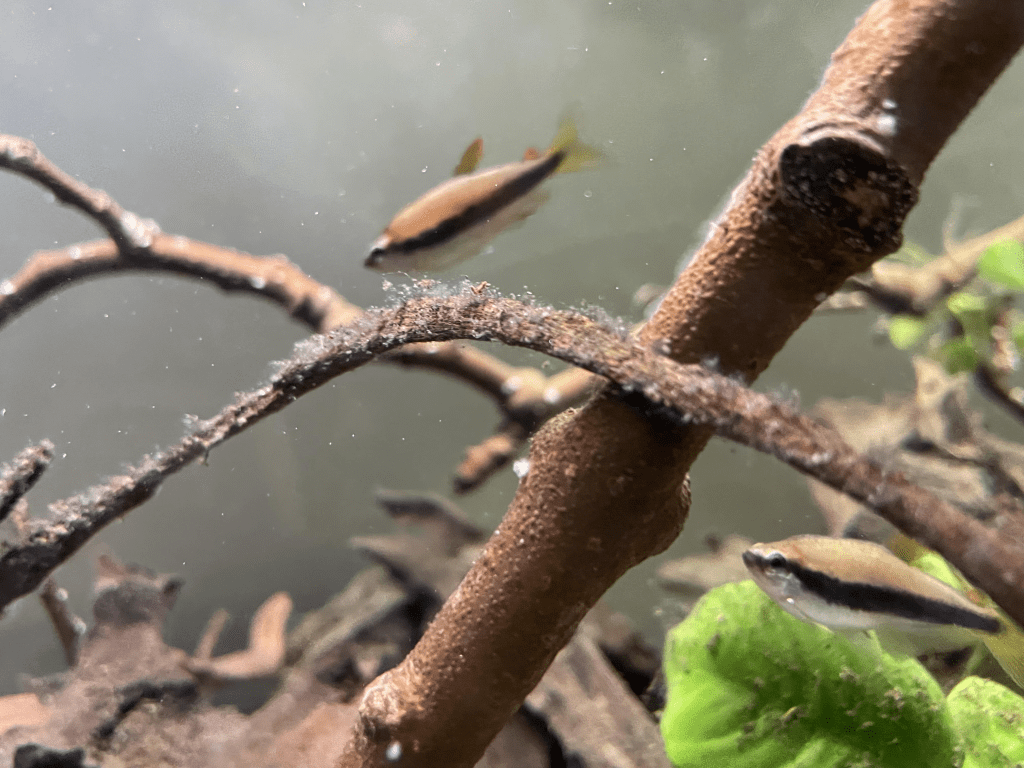
In my observation these biofilms aren’t utilised by the fishes I keep but I’d be curious how maybe smaller Loricariids, Hypoptopominae utilise them, snails do seem to.
Extra precautions for collecting wood from outside.
Ensure you collect from an area that has had no fertilisers or pesticides being sprayed, it would be a good idea to avoid areas with dog fouling.
As a good precaution definitely rinse the wood, if possible under the shower. Soaking might not be a bad idea just to help remove any potential residues.
References:
Ashraf, M., & Bengtson, D. A. (2007). Effect of tannic acid on feed intake, survival and growth of striped bass (Morone saxatilis) larvae. International Journal of Agriculture and Biology, 9, 751-754.
Groover, A., & Mansfield, S. D. (2020). An introduction to a Virtual Issue on Wood Biology. New Phytologist, 225(4), 1401-1403.
Kasper, K., Abreu, I. N., Feussner, K., Zienkiewicz, K., Herrfurth, C., Ischebeck, T., … & Polle, A. (2022). Multi‐omics analysis of xylem sap uncovers dynamic modulation of poplar defenses by ammonium and nitrate. The Plant Journal, 111(1), 282-303.
Killiny, N. (2019). Collection of the phloem sap, pros and cons. Plant signaling & behavior, 14(8), 1618181.
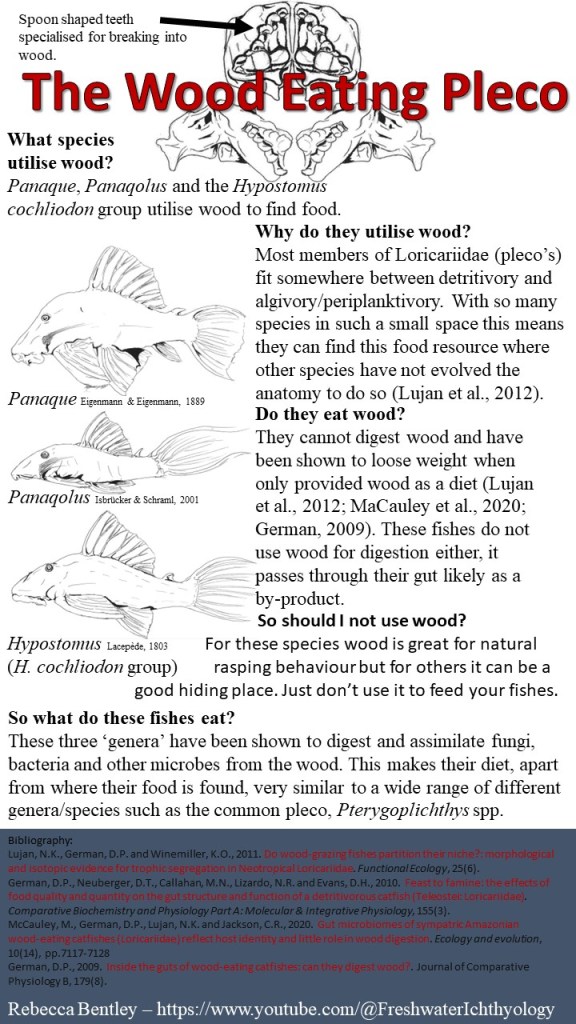
Do plecos need wood? Now this has to be one of the most commonly mentioned things within the pleco part of the aquarium hobby. First as always when talking about plecos I should specify, the Siluriforme (catfish) family known as Loricariidae. To set the first bit clear, the majority of this family do not utilise wood as anything more then a place to hide or a surface for food. This is quite clear as in the many gut content analysis studies wood is not found in them. So here we are talking about Panaque, Panaqolus, Hypostomus cochliodon group and maybe Lasiancistrus heteracanthicus (I’ve yet to certainly confirm that species).
For those wanting the major points I made this poster below with all references:
Another argument is that the wood is used for digestion, this is unlikely given only these genera are found with wood in their gut and whatever is in the wood is what they are digesting.
This is the best example of niche partitioning, with so many detritivores/algivores in the same area it means these genera are able to feed where others can’t. Is that not more interesting then them being xylovores?
So is wood worth it?
Yes, as a hiding place it is great. It can be great for growing different microbial films that the fish might feed on. In my experience those microbial films will be hit and miss if they do feed on them at all.
For those genera that find their food within the wood then there will be some behavioural enrichment by providing that wood so why not.
Why?
Does it matter? Yes because quite often these genera have not been fed and expected to survive on wood and the family in general, Loricariidae have a misconception as a clean up crew. I see this quite often leading to starvation, malnutrition and definitely stunting.
In general without that first point the presence or lack of a presence of wood is used to detract from the main reason a fish might be having issues. It is also spreading a myth, I cannot justify that.
Freshwater is a very diverse set of habitats located across the world, given this there is a wide range of different mineral contents within the waters fish inhabit. This mineral content will also vary in elements and compounds present.
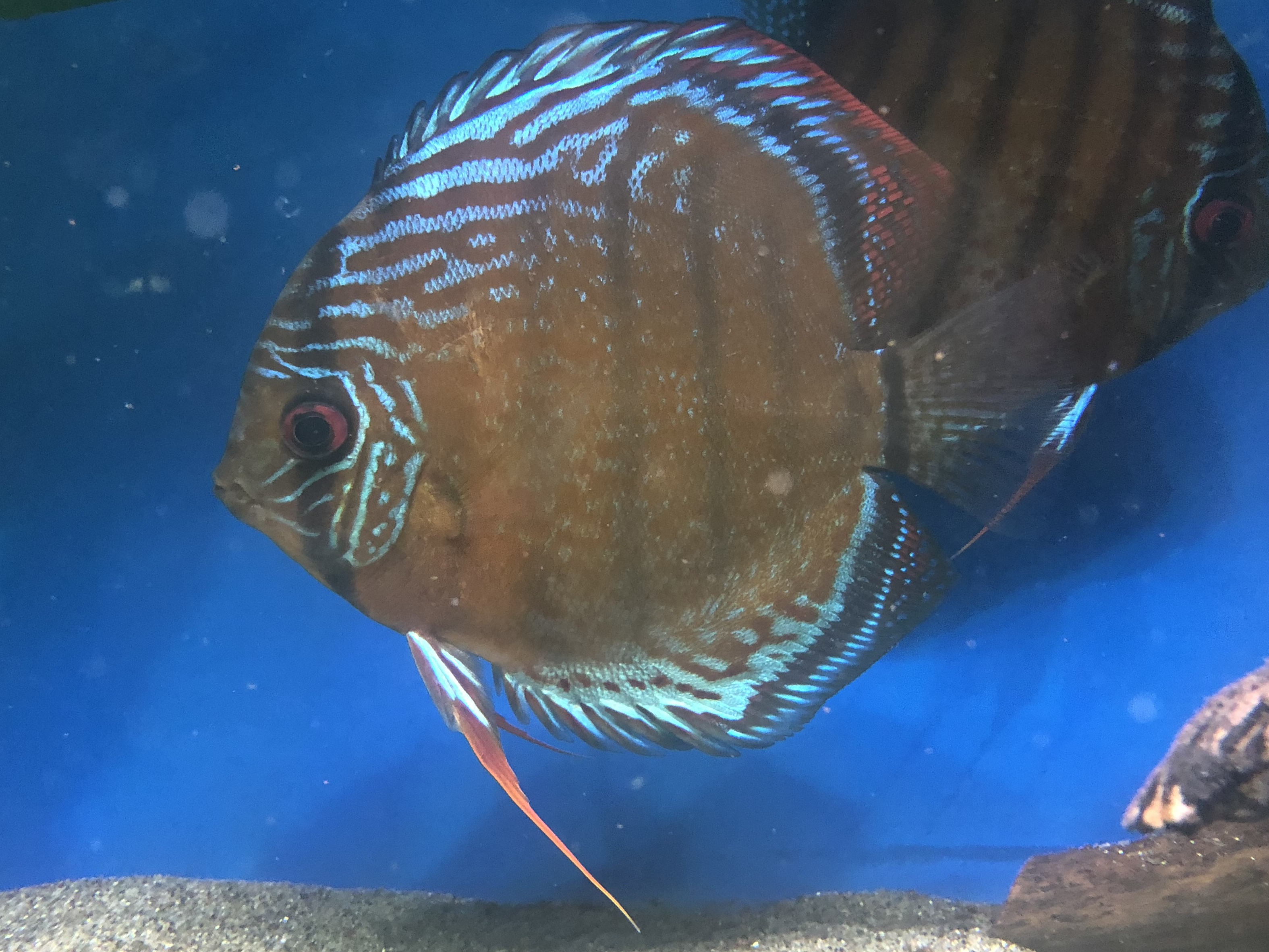
Symphysodon tarzoo from the Rio Nanay, Peru.
Minerals are important for living things to function: Sodium (Na) and calcium (Ca) for example is used in the nervous system and; Ca and Magnesium (Mg) is important in bone growth and repair.
For fishes there might be multiple sources of minerals whether it be dietary or environmental. For Ca around 50-97% depending on the species is taken up from the water itself (Baldisserotto et al., 2019; McCormick et al., 1992; Liao et al., 2007). As far as suggested in the literature fishes are able to adapt to higher and lower levels (Sanderson et al., 2021) although there seems to be no research in how freshwater fishes adapt to none or extremely low levels.
Mg is similarly around 50% is taken up from the water itself in freshwater fishes (Baldisserotto et al., 2019). This value does not seem to vary in Tilapia as to how much is taken up from the water where there is higher or lower dietary additions (Van der Velden et al., 1991) although in goldfishes where dietary Mg was low the fishes has a significant increase in magnesium uptake from the water (Dabrowska et al., 1991). This shows that the amount of magnesium required in the water is at least varies depending on the species but given not every species will be studied it is an important element to provide both in the diet and water.
These are just two examples of the many elements vital to life that maybe need to be considered by a fishkeeper. The only issue is we can’t often test for them so it’s best maybe to work on assumptions, water changes will definitely replenish these elements and many reverse osmosis remineralisation powders/salts contain these.
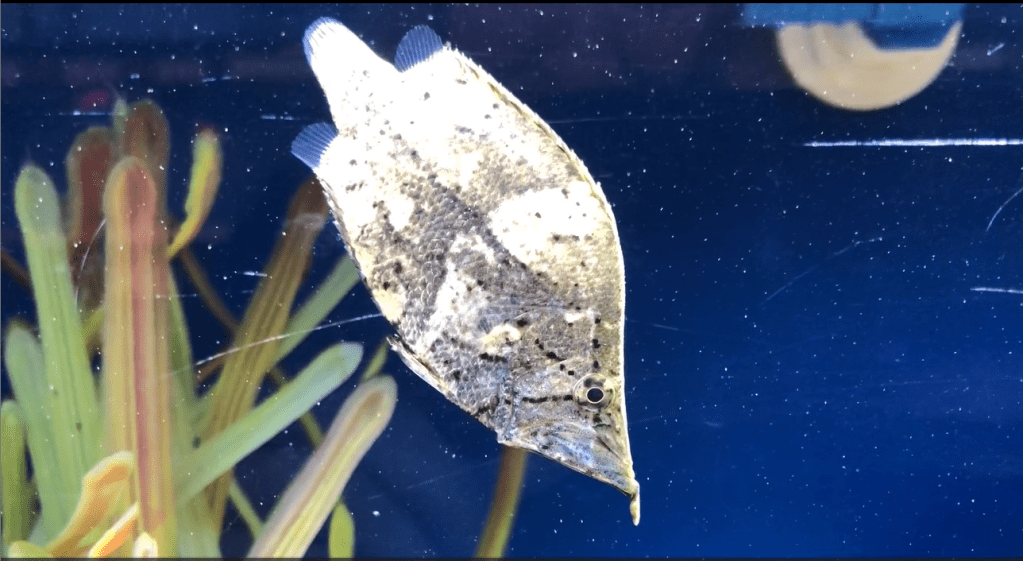
South American leaf fish, Monocirrhus polyacanthus
The influence of pH
The reason I never went into detail regarding Na and Cl is because there is a bit more to it then whether these are present in the water or not. pH has a strong influence on the whether fishes can uptake or maintain levels of these elements. At a low pH of 5 uptake is inhibit and Na loss is increased, higher calcium levels can be important for preventing this. Interestingly fishes some fishes have adapted methods to handle this e.g. neon tetras and angelfishes (Eddy & Handy, 2012).
Conclusion
This is just an example for the importance of water changes in not just removing waste but replenishing mineral content. While we don’t really know the exact levels required for all the fishes we keep we can make assumptions based on the conductivity or TDS based on where fishes are located in the wild.
References
Eddy, B., & Handy, R. D. (2012). Ecological and environmental physiology of fishes (Vol. 4). Oxford University Press.
Baldisserotto, B., Urbinati, E. C., & Cyrino, J. E. P. (Eds.). (2019). Biology and physiology of freshwater neotropical fish. Academic Press.
Dabrowska, H., Meyer-Burgdorff, K. H., & Gunther, K. D. (1991). Magnesium status in freshwater fish, common carp (Cyprinus carpio, L.) and the dietary protein-magnesium interaction. Fish Physiology and Biochemistry, 9, 165-172.
Liao, B. K., Deng, A. N., Chen, S. C., Chou, M. Y., & Hwang, P. P. (2007). Expression and water calcium dependence of calcium transporter isoforms in zebrafish gill mitochondrion-rich cells. BMC genomics, 8(1), 1-13.
McCormick, S. D., Hasegawa, S., & Hirano, T. (1992). Calcium uptake in the skin of a freshwater teleost. Proceedings of the National Academy of Sciences, 89(8), 3635-3638.
Sanderson, S., Derry, A. M., & Hendry, A. P. (2021). Phenotypic stability in scalar calcium of freshwater fish across a wide range of aqueous calcium availability in nature. Ecology and Evolution, 11(11), 6053-6065.
Van der Velden, J. A., Kolar, Z. I., & Flik, G. (1991). Intake of magnesium from water by freshwater tilapia fed on a low-Mg diet. Comparative Biochemistry and Physiology Part A: Physiology, 99(1-2), 103-105.



 The Scientific Fishkeeper