Category Archives: Fish Biology

Pathogens in Aquarium Fishes: 2. Spots, Bumps and Lumps

Many fishes display lumps, spots and bumps which can happen due to a range of pathological conditions whether it being pathogens or other factors. These can easily be confused and if concerned or confused please consult a fish pathologist or trained fish specialist veterinarian. This page is only to help give some clarity

All sources here are from scientific papers and many of the images from these papers for a reliable diagnosis unless otherwise stated for clarity purposes.

Microscopy is required in many cases for a confirmed diagnosis and therefore I recommend their use. Some stores might have one available to be used. In other cases more advanced diagnostic techniques might be required and provided by a pathologist via a veterinarian.

Diseases featured:

  1. White spot/ich (Ichthyophthirius multifiliis)
  2. Velvet (Oodinium, Piscinoodinium and other dinospores) and related taxa
  3. Dermocystidium
  4. Worm cysts
  5. Tumors
  6. Viral papilloma and herpes viruses
  7. Unknown growths

White spot/ich (Ichthyophthirius multifiliis)

Protozoan ciliate pathogen which can cause large mortalities in later stages.
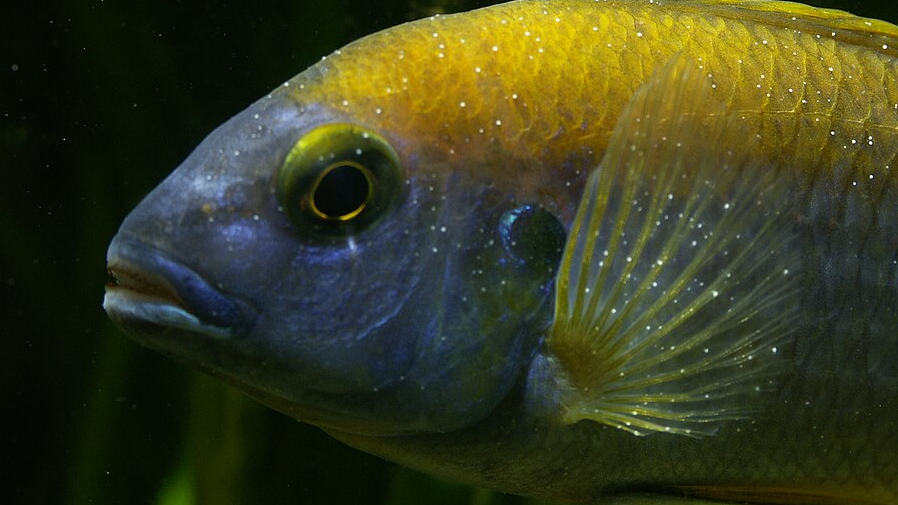
Ichthyophthirius multifiliis on a Rift Valley cichlid, Aulonocara sp.? Image obtained from: Thomas Kaczmarczyk (www.djpalme.de.vu) on Wikipedia.

Occurrence: Seems to be very common and in my opinion largely occurs when fish are sufficiently stressed.

Diagnostics: White spots on the body of the fish, can also be accompanied by shedding of the slime coat. The spots can be varied in size and number. This ciliate additionally targets the gills where it causes the most stress on the fish (Yang et al., 2023; Mallik et al., 2013). This spotted appearance is commonly confused with Epistylis which if symptomatic (of which mostly it is not) appears more as a plaque so will not appear in this article (ESHA video; Ksepka et al., 2021; Valladao et al., 2015; Wang et al., 2017, Wu et al., 2021). Both pathogens can appear with Aeoromonas bacteria that additionally causes hemorrhaging (Kumar et al., 2022).

Microscopic image:
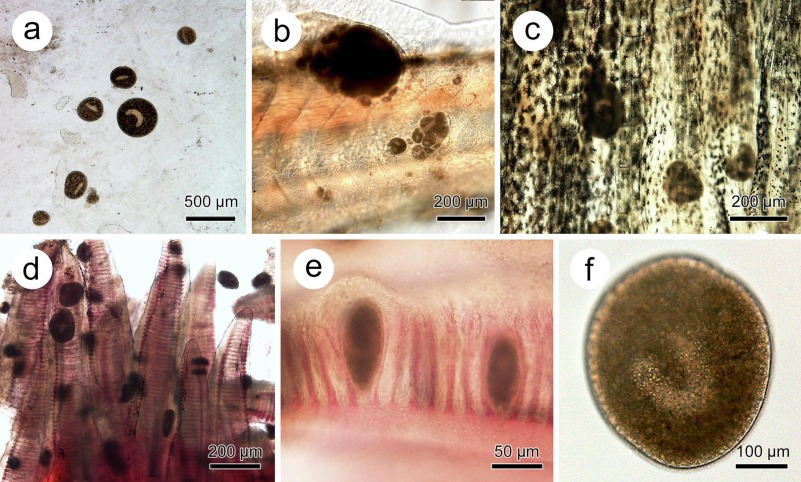
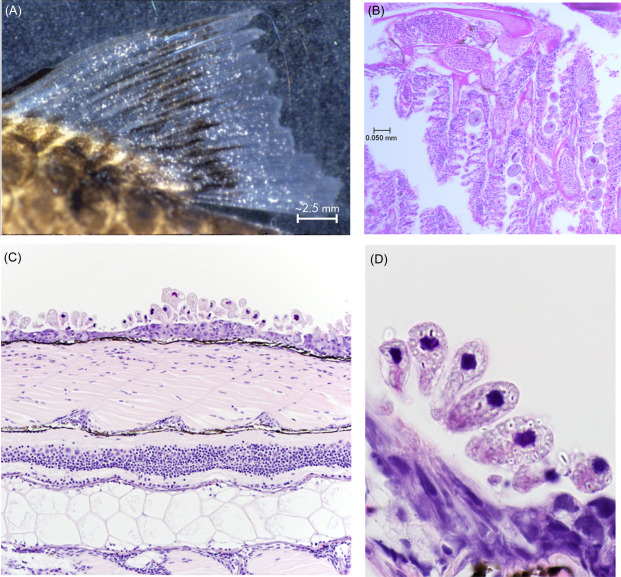
Ichthyophthirius multifiliis under the microscope, images obtained from Yang et al (2023). Yang, H., Tu, X., Xiao, J., Hu, J., & Gu, Z. (2023). Investigations on white spot disease reveal high genetic diversity of the fish parasite, Ichthyophthirius multifiliis (Fouquet, 1876) in China. Aquaculture562, 738804.

Treatment: The most frequent treatments provided in the aquarium hobby is malachite green with either formalin, formaldehyde or copper. Obviously copper is often a concern for those with invertebrates in the aquarium. Salt the old age treatment can work and as a study ABDULLAH-AL MAMUN et al. (2021) infers it depends on time of treatment. There seems to be a multitude of papers narrowing down the best treatment and to me this infers maybe there is no real answer, there might be increasing immunity of the ciliate or just this species is so diverse. Generally it’s assumed the best method is to avoid introducing any fish showing symptoms or on the same system with those who do. Copper sulphate additionally has been shown to treat white spot (Schlenk et al., 1998). In a later 2008 study formalin did not have any effect on the ciliate whereas copper treated it within 14 days (Rowland et al., 2008) which is around two rounds of treatment by most bottles. I therefore just looking at these three studies would not recommend formalin and maybe therefor formaldehyde for treatment and instead focus on copper and maybe salt needs further examination.

One of the most unusual parasites of fishes being an algae known as dinoflagellates.
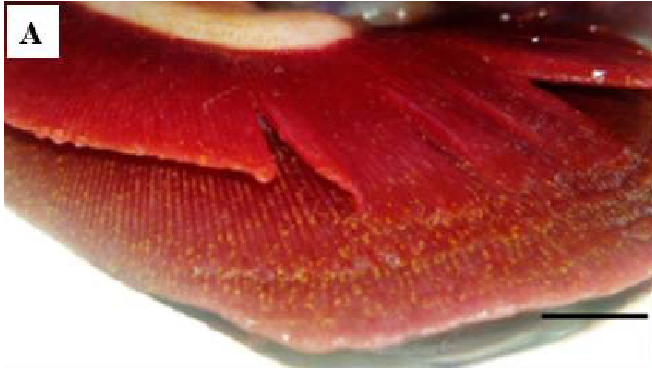
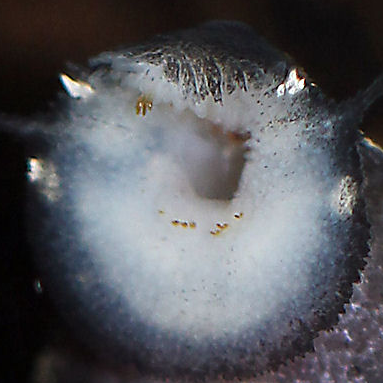
Piscinoodinium pillulare outbreaks: piscinootest. Ciência Rural48. on the gills of a fish (Gomes et al., 2018). Gomes, A. L. S., Costa, J. I. D., Benetton, M. L. F. D. N., Bernardino, G., & Belem-Costa, A. (2018). A fast and practical method for initial diagnosis of Piscinoodinium pillulare outbreaks: piscinootest. Ciência Rural48.
Piscinoodinium spp. infections (Esmail et al., 2015). Image obtained from: Esmail, M. Y., Astrofsky, K. M., Lawrence, C., & Serluca, F. C. (2015). The biology and management of the zebrafish. In Laboratory animal medicine (pp. 1015-1062). Academic Press.

Occurrence: Reasonably common, I can’t comment on cause. It seems Oodinium seems to be less common then Piscinoodinium.

Diagnostics: Different from white spot, being algaes they tend to have some coloration to them. Usually appears as small golden spots across the body, the fish are often lethargic. Mortality is not particularly rapid (Levy et al., 2007). It is not always obvious beyond hemorrhaging (Sudhagar et al., 2022).

Microscopic image: Not entirely required and diverse, although can make it easier to compare.
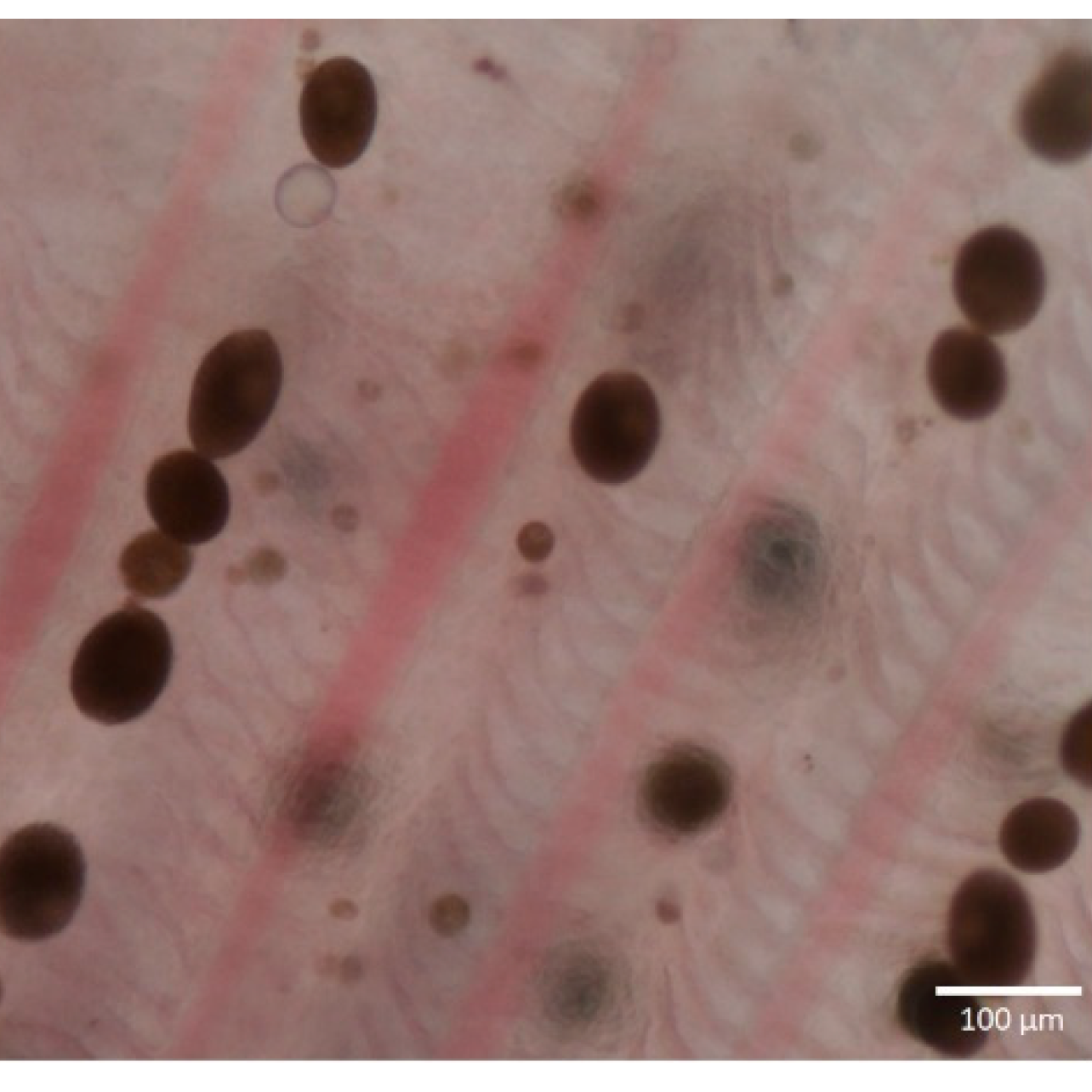
Piscinoodinium sp. copied from Sudhagar et al. (2022). Sudhagar, A., Sundar Raj, N., Mohandas, S. P., Serin, S., Sibi, K. K., Sanil, N. K., & Raja Swaminathan, T. (2022). Outbreak of Parasitic Dinoflagellate Piscinoodinium sp. Infection in an Endangered Fish from India: Arulius Barb (Dawkinsia arulius). Pathogens11(11), 1350.

Treatment: Treatment rarely seems discussed. As these are photosynthetic I agree with many aquarists that keeping the lights off for even two weeks will not harm the fish and even if it minorly effects the algae that’s better then nothing. The aquarium hobby largely jumps to copper based treatments along with malachite green mixed in with methylene blue, it doesn’t seem the most resistant pathogen and I wonder additionally if a fishes immune system handles some of it. Copper is suggested to work (Lieke et al., 2020). There seems to be no research on methylene blue other then being an anti-protozoan compound. Similarly with malachite green, no treatments even salt have any strong background to their effectiveness. The other issue is these compounds can effect the microbes within the aquarium (Yang et al., 2021). All I can say is I had success with the NT labs anti-parasite treatment containing copper sulphate and formaldehyde along with switching the lights off.

Dermocystidium

The strangest in appearance of pathogens, much like a worm but far from that, their taxonomic placement is unclear but they don’t move.
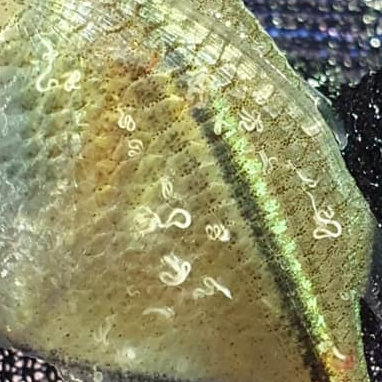
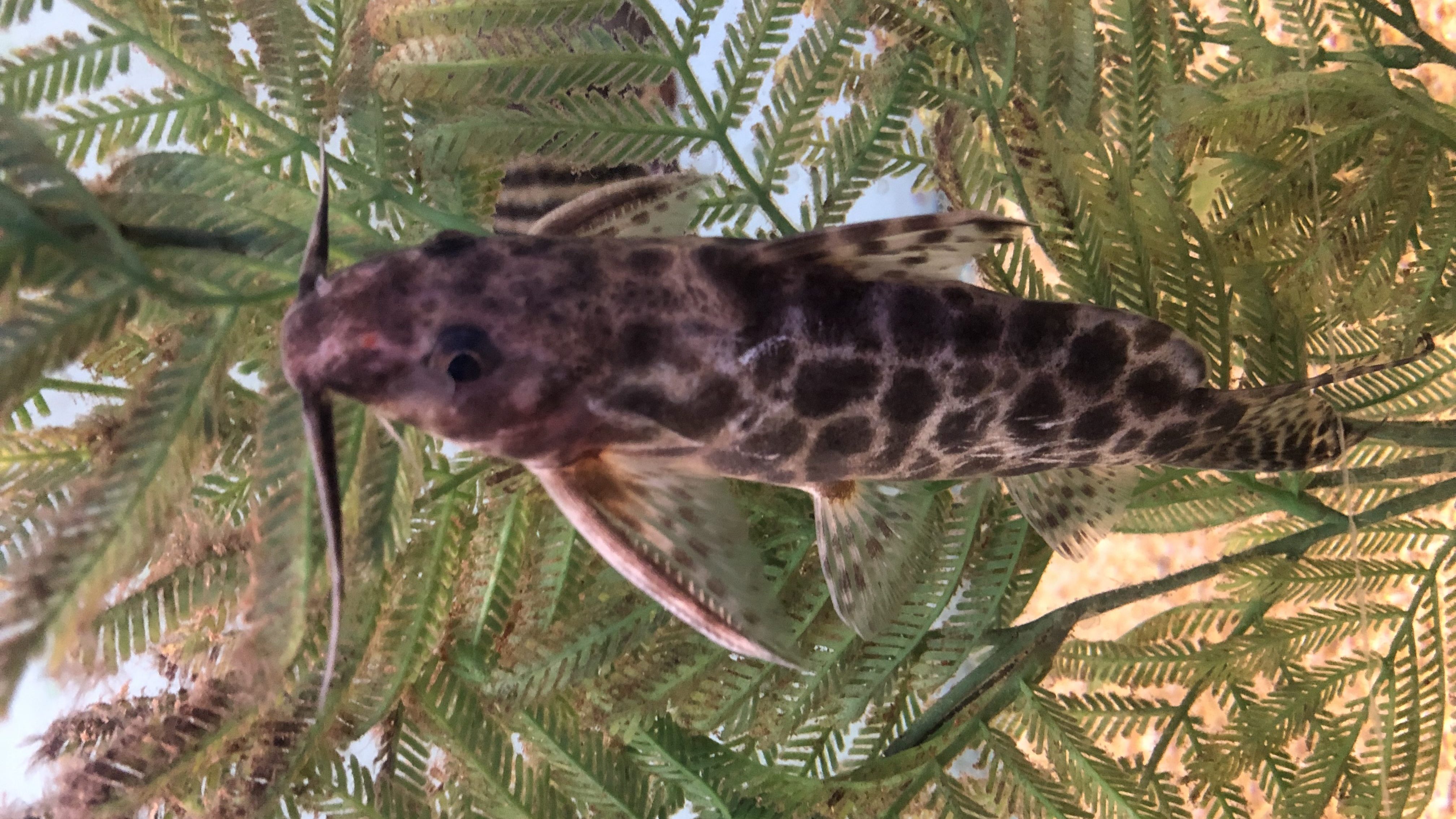
Dermocystidium on a hatchet fish, Gasteropelecus.

Occurrence: Reasonably frequent with a diversity of fishes soon after obtaining.

Diagnostics: Worm like in a variety of forms and size, can be encapsulated by pectoral fins or around the body. Some might appear singularly other fishes might have a lot more. These do not move like nematodes but are extremely diverse (Fujimoto, et al., 2018; Persson et al., 2022).

Microscope image: Not required.

Treatment: It is largely agreed in the aquarium trade which I agree that these protozoans as unsightly as they are do disappear with time and handled by the fishes own immune system.

Worm cysts

Not really possible to obtain much scientific research on the topic with the time I have free. But it does happen and seems frequent with wild imports.

Occurrence: Not common at all, seems to arrive with import.

Diagnostics: Looks much like white spot but larger cysts. Stubborn and white spot treatments do not work regardless of the fish showing no lethargy or poor health.

Microscope image: Usually distinctively different from white spot velvet by size and shape.

Treatment: As suggested by the name, wormers tend to work. I cannot remember which I used but likely first praziquantel, levamisole and flubendazole might work as well.

Tumors

If a tumor occurs certainly this is a situation where veterinarians are recommended.

Occurrences: There are many caused within fishes, sometimes it is genetic causes such as in the dragon scale of Betta splendens, viral causes (Coffee et al., 2013) or dietary (Žák et al., 2022). On a quick scan of the literature papilloma viruses are not associated with tumors.

Diagnosis: These can be large growths, they can be vascularized supplied by blood vessels. Unlike viral growths on my observations tend to be rounder and do not appear in many numbers.

Microscopy: Not required.

Treatment: Discuss with a specialist fish veterinarian.

Viral papilloma and herpes viruses

These are commonly mistaken for lymphocystis and can be very complex growths. Technically Papilloma refers to epithelial groups but can display similarly to herpes viruses. In the aquarium trade it doesn’t seem clear which we are handling and regardless treatment is the same. A wide range of herpes viruses are associated with fishes from KHV, carp pox (Davison et al., 2013) and channel catfish herpesvirus (Davison et al., 1992).
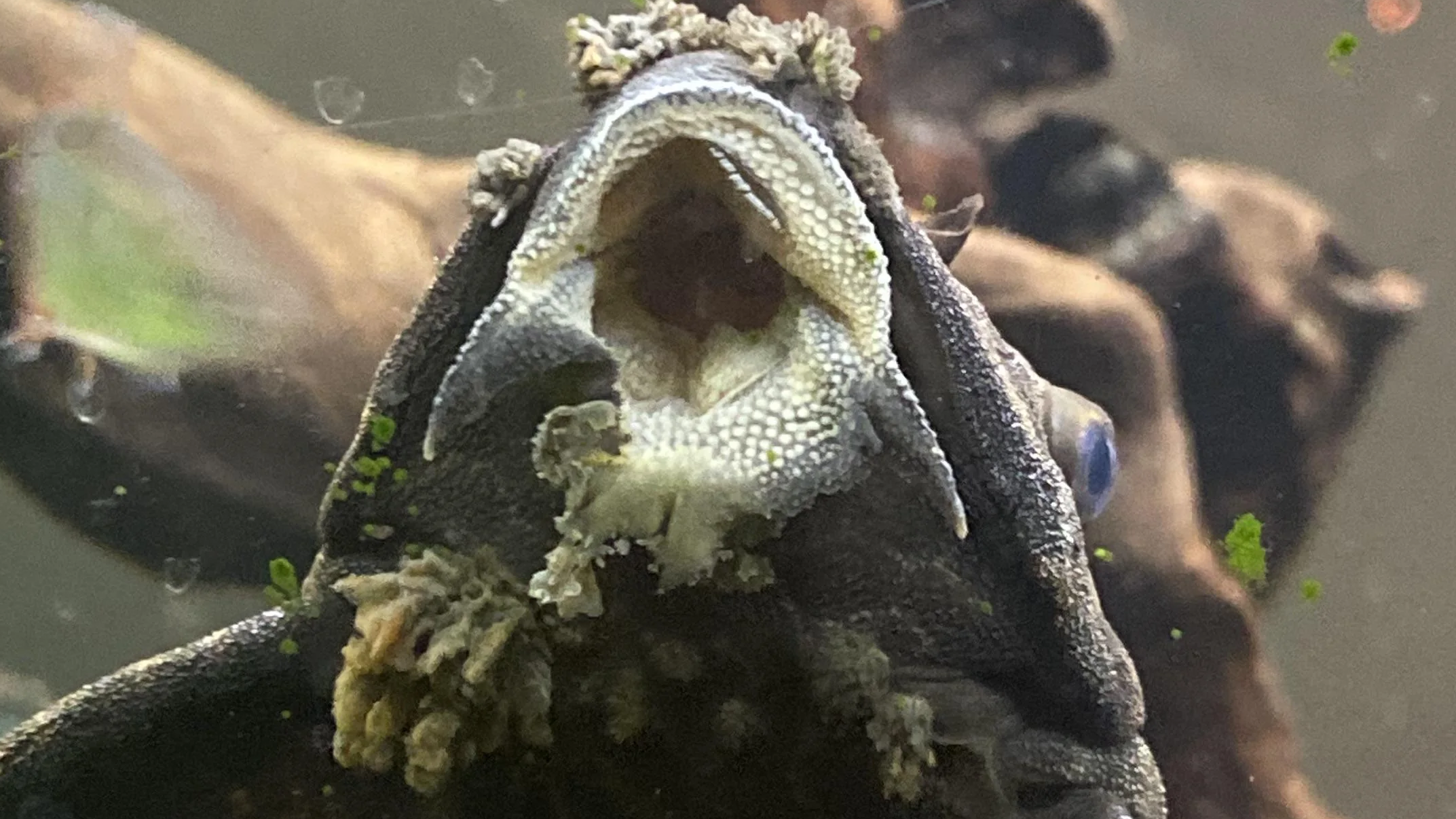
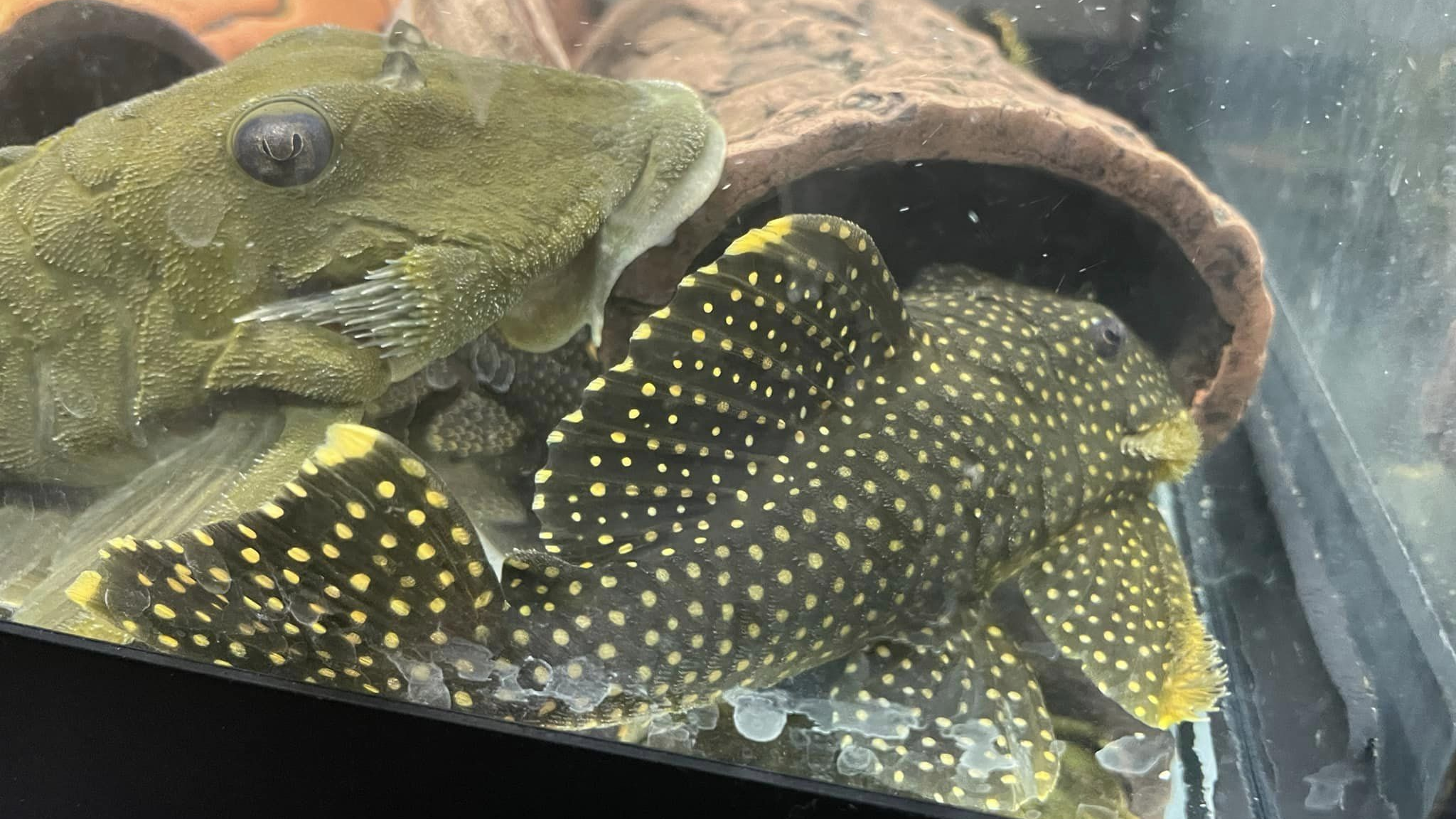
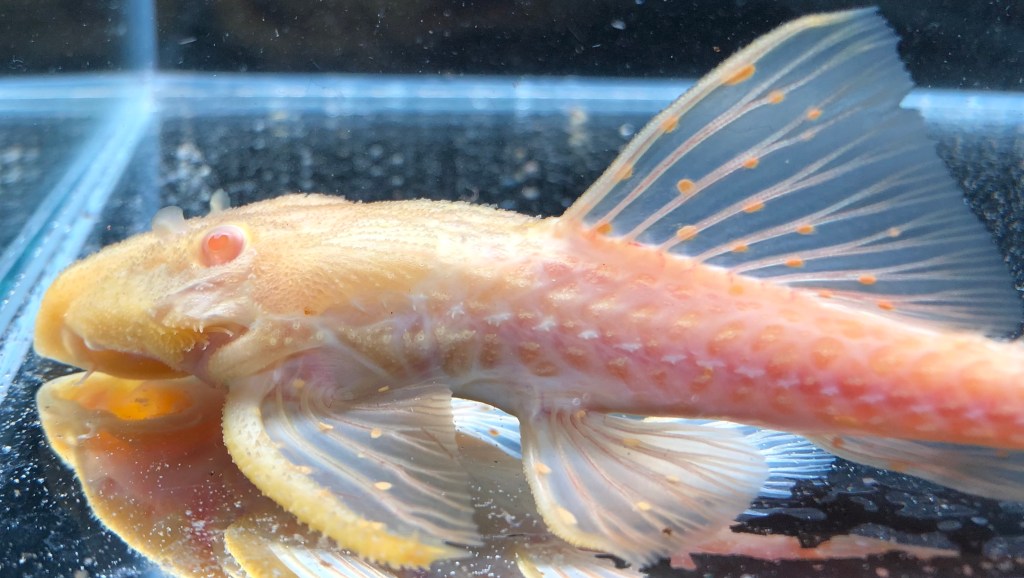
Viral papilloma’s likely caused by a Papillomavirus (PV) in a Pterygoplichthys pardalis, image sourced from Reddit, poster: Render et al., 1721.

Occurrence: Seems reasonably common right now. This virus I can assume once contracted is not removed from the fishes body but are suppressed by the immune system. Koi Herpes Virus (KHV) is fatal and while not wildly common any suspected occurrence might require contacting environmental authorities.

Diagnosis: These are round or very tuberous numerous growths, much more like warts while symptomatic but asymptomatic individuals and time might not display any symptoms (Tarján et al., 2022; Rahmati-Holasoo et al., 2015). Very understudied when it comes to aquarium fishes so whether we are dealing with a herpes or traditional papilloma virus is difficult to say. Rahmati-Holasoo et al. (2015) infers that most viral growths we are seeing in Loricariids is caused by a Papillomavirus, although a previous study by Hedrick et al., (1996) in carp inferred similar growths and concluded due to a herpes virus.

Treatment: Time, these viruses cannot be cured only prevention of introduction. Very few are fatal. These viruses are generally specific to closely related fishes so transfer should not be an issue.

Sources for koi and carp pox:

https://cafishvet.com/fish-health-disease/koi-pox-aka-carp-pox

https://canalrivertrust.org.uk/things-to-do/fishing/caring-for-our-fish/guide-to-fish-health/koi-herpesvirus-khv

https://marinescience.blog.gov.uk/2015/10/02/koi-herpesvirus-khv-disease-and-fisheries

Unknown growths

There is a wide range of unknown growths in fishes we can only make assumptions, veterinary professionals and vets would be worth consulting. I have seen a number which didn’t conform with any of these.

References:

ABDULLAH-AL MAMUN, M. D., NASREN, S., RATHORE, S. S., & RAHMAN, M. M. (2021). Mass infection of Ichthyophthirius multifiliis in two ornamental fish and their control measures. Annals of Biology, (2), 209-214.

Coffee, L. L., Casey, J. W., & Bowser, P. R. (2013). Pathology of tumors in fish associated with retroviruses: a review. Veterinary Pathology50(3), 390-403.

Davison, A. J. (1992). Channel catfish virus: a new type of herpesvirus. Virology186(1), 9-14.

Davison, A. J., Kurobe, T., Gatherer, D., Cunningham, C., Korf, I., Fukuda, H., … & Waltzek, T. B. (2013). Comparative genomics of carp herpesviruses. Journal of Virology87(5), 2908-2922.

Esmail, M. Y., Astrofsky, K. M., Lawrence, C., & Serluca, F. C. (2015). The biology and management of the zebrafish. In Laboratory animal medicine (pp. 1015-1062). Academic Press.

Fujimoto, R. Y., Couto, M. V. S., Sousa, N. C., Diniz, D. G., Diniz, J. A. P., Madi, R. R., … & Eiras, J. C. (2018). Dermocystidium sp. infection in farmed hybrid fish Colossoma macropomum× Piaractus brachypomus in Brazil. Journal of Fish Diseases41(3), 565-568.

Gomes, A. L. S., Costa, J. I. D., Benetton, M. L. F. D. N., Bernardino, G., & Belem-Costa, A. (2018). A fast and practical method for initial diagnosis of Piscinoodinium pillulare outbreaks: piscinootest. Ciência Rural48.

Hedrick, R. P., Groff, J. M., Okihiro, M. S., & McDowell, T. S. (1990). Herpesviruses detected in papillomatous skin growths of koi carp (Cyprinus carpio). Journal of Wildlife Diseases26(4), 578-581.

Ksepka, S. P., & Bullard, S. A. (2021). Morphology, phylogenetics and pathology of “red sore disease”(coinfection by Epistylis cf. wuhanensis and Aeromonas hydrophila) on sportfishes from reservoirs in the South‐Eastern United States. Journal of Fish Diseases, 44(5), 541-551.

Kumar, V., Das, B. K., Swain, H. S., Chowdhury, H., Roy, S., Bera, A. K., … & Behera, B. K. (2022). Outbreak of Ichthyophthirius multifiliis associated with Aeromonas hydrophila in Pangasianodon hypophthalmus: The role of turmeric oil in enhancing immunity and inducing resistance against co-infection. Frontiers in immunology13, 956478.

Levy, M. G., Litaker, R. W., Goldstein, R. J., Dykstra, M. J., Vandersea, M. W., & Noga, E. J. (2007). Piscinoodinium, a fish-ectoparasitic dinoflagellate, is a member of the class Dinophyceae, subclass Gymnodiniphycidae: convergent evolution with Amyloodinium. Journal of Parasitology93(5), 1006-1015.

Lieke, T., Meinelt, T., Hoseinifar, S. H., Pan, B., Straus, D. L., & Steinberg, C. E. (2020). Sustainable aquaculture requires environmental‐friendly treatment strategies for fish diseases. Reviews in Aquaculture12(2), 943-965.

Mallik, S. K., Shahi, N., Das, P., Pandey, N. N., Haldar, R. S., Kumar, B. S., & Chandra, S. (2015). Occurrence of Ichthyophthirius multifiliis (White spot) infection in snow trout, Schizothorax richardsonii (Gray) and its treatment trial in control condition. Indian Journal of Animal Research49(2), 227-230.

Persson, B. D., Aspán, A., Bass, D., & Axén, C. (2022). A case study of Dermotheca gasterostei (= Dermocystidium gasterostei, Elkan) isolated from three-spined stickleback (Gasterosteus aculeatus) captured in lake Vättern, Sweden. Bulletin of the European Association of Fish Pathologists.

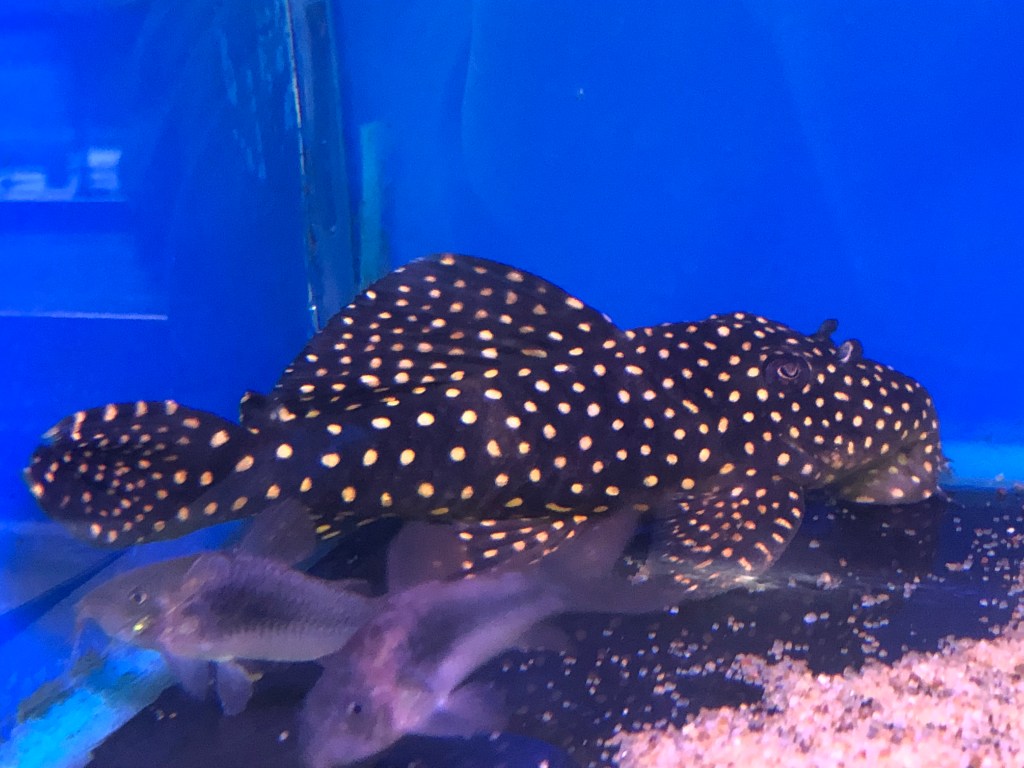
Rahmati-Holasoo, H., Shokrpoor, S., Mousavi, H. E., & Ardeshiri, M. (2015). Concurrence of inverted-papilloma and papilloma in a gold spot pleco (Pterygoplichthys joselimaianus Weber, 1991). Journal of Applied Ichthyology31(3), 533-535.

Rowland, S. J., Mifsud, C., Nixon, M., Read, P., & Landos, M. (2008). Use of formalin and copper to control ichthyophthiriosis in the Australian freshwater fish silver perch (Bidyanus bidyanus Mitchell). Aquaculture research40(1), 44-54.

Schlenk, D., Gollon, J. L., & Griffin, B. R. (1998). Efficacy of copper sulfate for the treatment of ichthyophthiriasis in channel catfish. Journal of Aquatic Animal Health10(4), 390-396.

Sudhagar, A., Sundar Raj, N., Mohandas, S. P., Serin, S., Sibi, K. K., Sanil, N. K., & Raja Swaminathan, T. (2022). Outbreak of Parasitic Dinoflagellate Piscinoodinium sp. Infection in an Endangered Fish from India: Arulius Barb (Dawkinsia arulius). Pathogens11(11), 1350.

Tarján, Z. L., Doszpoly, A., Eszterbauer, E., & Benkő, M. (2022). Partial genetic characterisation of a novel alloherpesvirus detected by PCR in a farmed wels catfish (Silurus glanis). Acta Veterinaria Hungarica70(4), 321-327.

Valladao, G. M. R., Levy-Pereira, N., Viadanna, P. H. D. O., Gallani, S. U., Farias, T. H. V., & Pilarski, F. (2015). Haematology and histopathology of Nile tilapia parasitised by Epistylis sp., an emerging pathogen in South America. Bulletin of the European Association of Fish Pathologists, 35(1), 14-20.

Yang, C. W., Chang, Y. T., Hsieh, C. Y., & Chang, B. V. (2021). Effects of malachite green on the microbiomes of milkfish culture ponds. Water13(4), 411.

Yang, H., Tu, X., Xiao, J., Hu, J., & Gu, Z. (2023). Investigations on white spot disease reveal high genetic diversity of the fish parasite, Ichthyophthirius multifiliis (Fouquet, 1876) in China. Aquaculture562, 738804.

Wang, Z., Zhou, T., Guo, Q., & Gu, Z. (2017). Description of a new freshwater ciliate Epistylis wuhanensis n. sp.(Ciliophora, Peritrichia) from China, with a focus on phylogenetic relationships within family Epistylididae. Journal of Eukaryotic Microbiology, 64(3), 394-406.

Wu, T., Li, Y., Zhang, T., Hou, J., Mu, C., Warren, A., & Lu, B. (2021). Morphology and molecular phylogeny of three Epistylis species found in freshwater habitats in China, including the description of E. foissneri n. sp.(Ciliophora, Peritrichia). European Journal of Protistology, 78, 125767.

Žák, J., Roy, K., Dyková, I., Mráz, J., & Reichard, M. (2022). Starter feed for carnivorous species as a practical replacement of bloodworms for a vertebrate model organism in ageing, the turquoise killifish Nothobranchius furzeri. Journal of Fish Biology100(4), 894-908.

Aquarium Fish Diseases For Fishkeepers – The Basics

Like any other organism fishes can host pathogens and contract diseases, unlike many other pet related hobbies we are dealing with a wide diversity of different species. The diseases of aquarium fishes is there for a vast topic.

As my specialty is in the evolutionary biology of fishes, diseases are not my specialty. That is not to say like any other fish biologist I do not encounter them, given I am often not using high magnifications I actually am more familiar with larger ectoparasites then bacteria or protozoa. I do have a background in taxonomy as well so am familiar with understanding how even these bacteria, protozoa, fungi etc. are diagnosed to a degree.

Previously there have been many brilliant aquarium books focused on disease and I think more then anything I recommend an aquarist to have at least one. These books were often written by those with a background in pathology, included images of microscope slides and based in science.

Books I’d recommend (there will be others I have forgotten):

  • Discus Health, TFH Publication by Dieter Untergasser
  • Handbook of Fish Diseases, TFH Publication by Dieter Untergasser.
  • The Interpet Manual of Fish Health: Everything You Need to Know About Aquarium Fish, Their Environment and Disease Prevention, Firefly Books Ltd by Dr. Chris Andrews, Adrian Excell and Dr Neville Carrington.
  • The Practical Guide to Fish Diseases by Dr. Gerald Bassleer

The main issue with disease is to take anything also marketing a product with a pinch of salt unless it’s discussing a general compound e.g. malachite green, formaldehyde etc.

Diseases of aquarium fishes has become one of the most hotly contested topics within the aquarium hobby of recent years. With many websites making unfounded claims that lack citations where maybe they should to backup any novel ideas or information. This makes diagnosing disease for the general fishkeeper rather challenging. I hope I can make it a little easier or give areas to start researching.

This topic will cover multiple articles and therefore this contents should help guide a user through this page and others.

  1. Preventative care to avoid disease
  2. What are pathogens?
  3. Disease and pathogen specificity.
  4. Notes on Antibiotics
  5. Pathogens of fishes and relevant articles to aid in diagnosis:
  6. References
Corydoras (syn. Brochis) at Wildwoods, Enfield.

Preventative care to avoid disease

One of the biggest factors when it comes to any organism of preventing disease is ensuring the organism is healthy. There are several influences that might mean a fish is stressed enough to become more susceptible to disease; behavioral, environmental and also diet. If an organism is stressed then the immune system might not be functioning as well as it could and will be less able to fend of disease, this isn’t something new. Some disease might additionally be directly caused by these factors rather then by external pathogens.

So, lets explore preventative care.

Preventing disease by understanding specific fish behavior.

This is probably the most difficult to identify and sometimes the most difficult to cater for as we know so little about fish behavior. Here there are probably two outcomes of not catering for a fishes behavior; poor physiological health or abnormal behavior.

Poor physiological health is very obvious, a fish might have tattered fins, lost scales and reduced colouration. It could be that the fish is being directly attacked in territorial aggression or from a more predatory tankmate. In some fishes just simply removing an offending individual might solve the issue but with some fishes such as the Aulonocara (peacock cichlids), mbuna (multiple genera), Haplochromis etc. of the Rift valley this can create instability in the social hierarchy of the group (Piefke et al., 2021). Of course removing some worst offending species would maybe be a benefit and therefore considering what species are to be included to start off. These voids in hierarchy can create more aggression as individuals are additionally are then identifying where they all fit. It’s a common assumption to assume aggression is male focused, as I discuss in a previous article females do frequently display aggression (Female Aggression).

Aggression can just be simply territorial, Neolamprologous cichlids can be good examples of this where individuals will maintain a space and the location based often on maintaining resources reproductive, predator protection and dietary. Fish sociality can be so very complex so it’s not entirely simple (Walter et al., 1994). This territoriality can also be seen in many Loricariids (Plecos) but also Anabantoids such as Channa or gourami’s, not always related to reproduction but just defense of a space.

Even many shoaling species might show aggression and therefore in that context a good number with an appropriate sex ratio would be best. Sociality in many species is important though, even if it is fleeting there is a behavioral enrichment, this isn’t always possible. But for shoaling and schooling species having others of the same species or population is important.

Many popular fishes can be counted as some what shoaling or schooling such as clown loaches, Chromobotia macracanthus to neon tetra, Paracheirodon innesi. These fishes alone or even in small numbers such as 3 or 6 depending on the species you might see abnormal behavior. Sometimes difficult to identify as some species are just illusive. A shoaling species kept alone could be illusive, swim erratically around the glass or even maybe shoaling with a different species. It’s definitely very context dependent. Sociality is important for behavioral and maybe even physiological development (Riley et al., 2018), we know that though from other verebtrates……. The understanding of species can be difficult but realistically multiple individuals of different species would not make up a shoal. Whether it be Corydoras or tetra, these species might not be closely related but even if they are it doesn’t mean they can communicate and therefore benefit socially. In other fishes such as discus communication is so much in their coloration given they can recognize individuals (Satoh et al., 2016), many varieties have lost or altered this ability and could result in communication issues between domestics, wilds and certain varieties. This means it’s highly likely discus can identify the different species and even populations. I have experienced this myself. Just by the fact so many fishes of the same genus or group are located together behavior likely results in this speciation.

Tankmates themselves can provide another kind of harm, they could be eaten and vice versa. Generally avoiding tankmates that will fit in the mouth is a good rule of measure. Some fishes can expand their mouth further then expected and while many are gape limited (limited by the size of their mouth) others this limitation is minor. Even the slowest fish are more then capable of eating faster fishes, discus feeding on cardinal/neon tetra is commonly accounted and goldfish frequently feed on smaller tankmates. The biggest risk here is if the smaller fish is too big to be swallowed down and that larger fish chokes.

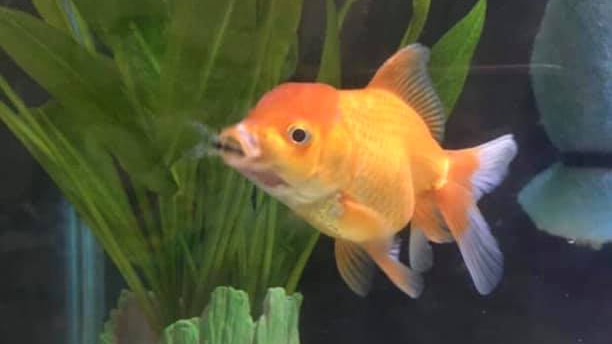
Goldfish, Carassius aureatus choking on an Otocinclus sp. the catfish had been housed with the goldfish for 2 years before this situation. Photo used with permission from the owner and the Facebook group: Goldfish Care.

The effect of the environment on fish disease.

More then often we think of the environment as purely about water parameters in fishes but the actual décor is important as well. I have been a long standing admin of goldfish groups and frequently seen where they have choked on gravel for example.

This is so diverse as so much can effect a fishes health.

Water parameters

The influence of water parameters on the health of fishes is so complex and so diverse, here I wont discuss hardness I have discussed it partially in the article on pH and hardness (here). Associated with mismanagement of hardness is gas bubble disease of which would require it’s own article or discussion, it is likely confused with a pH crash due to how quickly it occurs.

So, the main parameters we will focus on will be those related to nitrogen; ammonia, nitrites and nitrates. The values which cause death will vary depending on the fish and other parameters, many effects might seem asymptomatic unless a dissection is undertaken so do not assume because you cannot see an effect the fish isn’t affected. Ammonia itself burns the gills (Liu et al., 2021) but largely targets the the brain (Ip & Chew et al., 2010). Nitrite is the most well known as crossing into the blood combining with the blood to form methaemoglobin resulting in less oxygen carried around the body (Ciji & Akhtar, 2020), it can kill particularly rapidly seeming like a crash. These all are managed by a stable and cycled aquarium. Nitrate is maybe the least understood and the least studied as most studies focus on fishes with particular adaptability. This compound functions the same way as nitrites by combining with the blood to reduce oxygen saturation within the blood at higher volumes (Camargo et al., 2005). Many websites and a number of Youtubers focus on whether it kills but it shouldn’t be about rapid deaths rather long term effects, this is likely due to promoting methods where high nitrates are inevitable (Hrubec et al., 1996). So the question about low volumes becomes difficult, this is because most studies are short term and on fishes completely different from what we keep but even Hrubec et al. (1996) displays the toxicity of nitrate. It is better to assume toxicity then not just for the sake of water changes and half an hour or few hours a week, after all no one would argue for mammals to be left in their own waste because of intensive farming methods that do so.

Most of these nitrogen based compounds effect how oxygen is taken up whether it’s from burning the gills or the binding to the blood. So increasing oxygenation will not be harmful, methylene blue in small volumes is associated with increasing oxygen saturation in humans although it is difficult to find any research into the topic. Olufayo and Yusuf (2016) suggested that volumes of 67ppm to 199ppm of methylene blue didn’t increase oxygen saturation but previous research lists methylene blue as decreasing the solubility of oxygen (Khan et al., 2022). One aspect could be that largely when used in medicine it’s in humans and direct in the body, for fishes it’s added into the water so I think there is a whole other level of things at play. Another aspect of treating any higher values of these compounds is the use of Seachem prime, yes it does but decrease oxygen saturation so there is a balance (Seachem’s website).

Substrate

One of the things that least comes to mind when it comes to the health of fishes is substrates, there is so much diversity of them in stores and this can be overwhelming. Some might interact with the water parameters which is not usually ideal for many fishes as the focus of these is on plants.

The biggest risk substrate is gravels with any fish that might dig around in the substrate. It is frequently accounted particularly with goldfish where the gravel becomes stuck in either the oral or pharyngeal jaws of the fish.

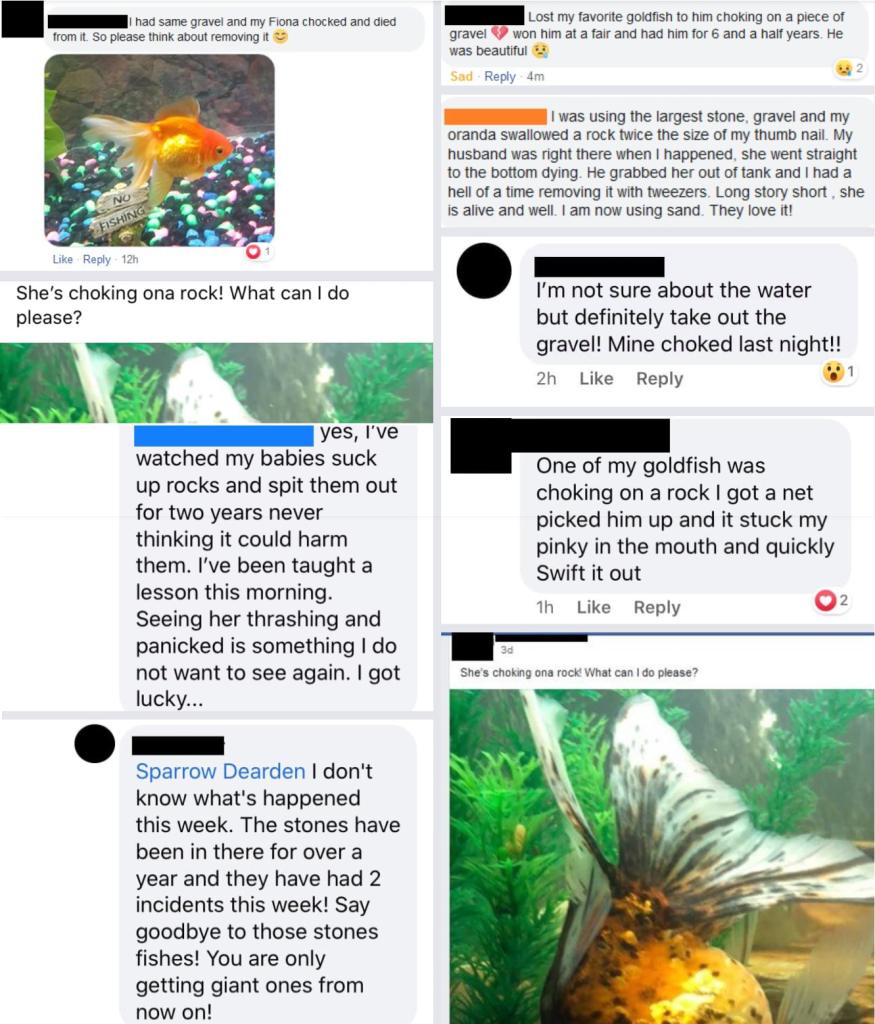
Some of many situations where goldfish have choked on goldfish, used with permission of the owners and the facebook group: Goldfish Care.

Just as seriously from gravel is impaction although I have never encountered a certain case myself, if that gravel enters the digestive tract it wont exit easily unlike sand of which many fishes pass through their gut even in larger amounts harmlessly (Lujan et al., 2012).

Substrates offer an enrichment for so many fishes which is very important to recognise as so many species naturally search for food. I would rarely have a tank without it. The safest and most natural for many species is sands. One of these fishes that benefits so much are Corydoras and a number of loaches. Sharp substrates in these fishes is associated with erosion of the barbels present around the mouth although there is no studies on the topic and it is sometimes associated with the bacteria that gravel traps. This erosion leaves open wounds and an area highly open to infection.

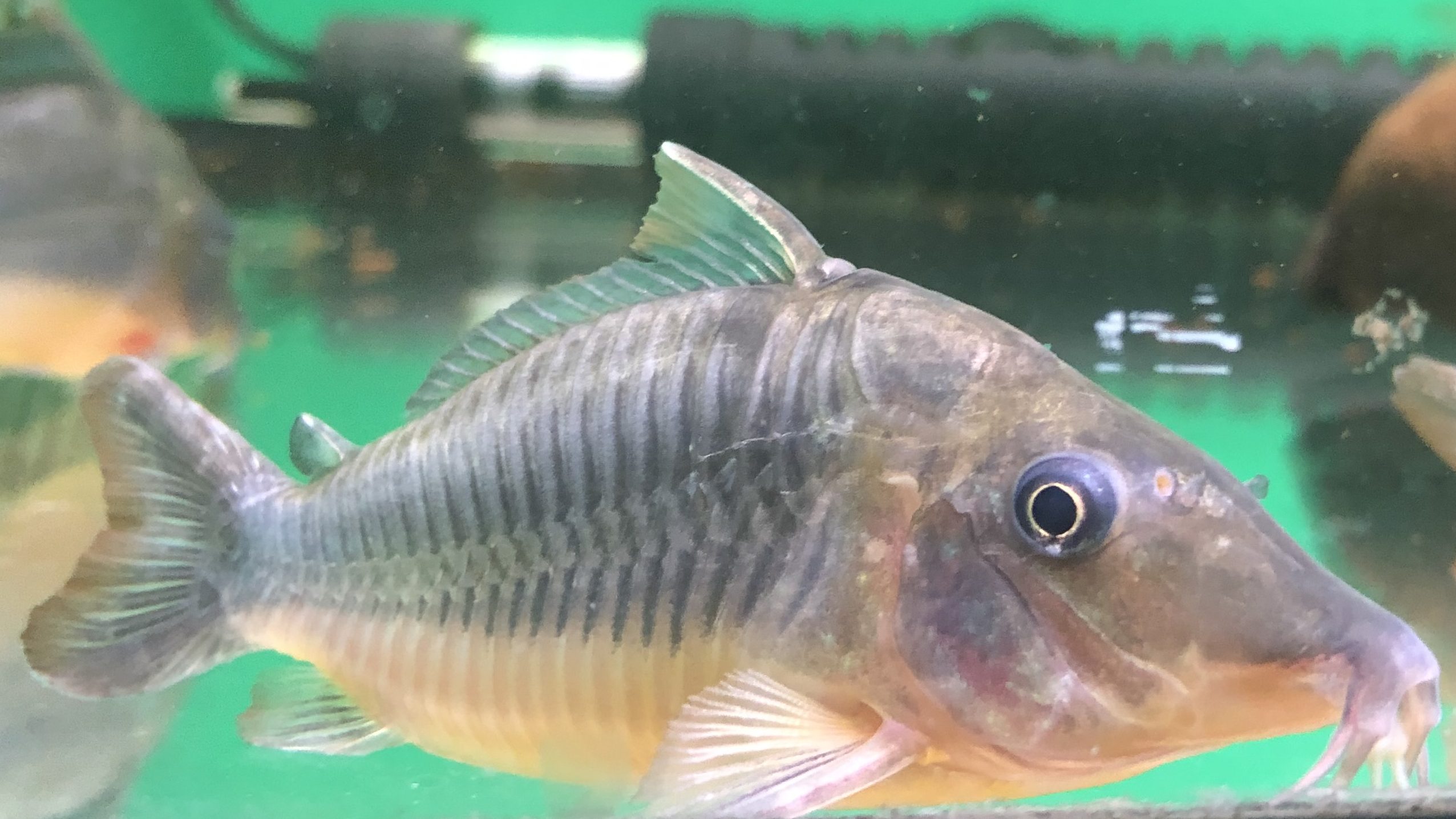
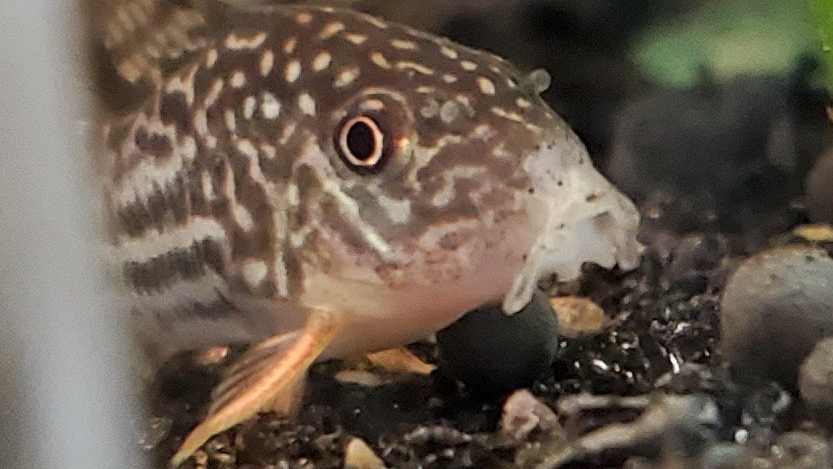
Corydoras sterbai with erosion of the barbels caused by the sharp gravel and substrate. Image sourced from Aquarium Coop Forum, CARE and the user BMBSAD.

décor

This is probably the most logical but in the stress of setting up a tank it can be a bit overwhelming to decide what to get. Generally consider if you are having any secretive fishes they will need plenty of spaces to hide in a variety of shapes and sizes, being exposed can be stressful for them and you’ll see the stress patterning on them. When it comes to these fishes always be sure there isn’t decor that the fish can get stuck on, this seems more of an issue with artificial décor then natural.

Sharp décor can also cause wounds whether it be the metal rods in silk plants or sharp dragon rock, for many fishes this is no issue but for clumsy species or some bottom dwellers accidents happen. Some species which might have very rough spawning or aggressive behaviour then they can bash against décor so maybe avoiding anything too rough here but we shouldn’t exchange enrichment to almost bubble wrap our fishes.

Some items might have a risk if eaten, I am not sure how true this is but some people do record rasping fishes such as Loricariids feeding on the paint of some artificial décor. This is probably best avoided just because of the potential chemicals. Similar any decor from plastics you are not familiar with and might degrade in the water releasing microplastics or other compounds.

Conclusion

Obviously for preventative care there is so much more that needs to be considered. Think about the habitats these fishes experience in the wild. Observe your fishes and their behaviour, sometimes it’s worth doing so from a distance so they aren’t expecting food either that or a camera to see them at night. Some behaviour is not always seen.

What are pathogens?

Pathogens are organisms that cause disease. These in fishes can be as followed:

  • Viruses: Debatable if they are alive and therefore an organism. These cannot therefore do not have any treatment against them beyond keeping the immune system at it’s best and preventative care. Some viruses cannot be ‘cured’ and will always exist within the fish and some the fishes immune system will kill. Some viruses are fatal to the fish and others are not.
  • Bacteria: This is a massive group of organisms. Unlike viruses and like all the other groups I will later list not all are pathogens or parasites, many have different roles. These can be killed by a variety of treatments and by the fishes immune system.
  • Protozoa: This is a paraphyletic group of random organisms, not all are parasitic and some can be particularly difficult to treat while others much easier. A huge diversity of organisms.
  • Annelid/worms: Very few are ever seen in the aquarium other then leeches, these are true worms and more tricky to treat.
  • Nematodes: Similar to worms but not closely related at all. These are most often known for inhabiting the digestive tract or tissues in cysts. Many different wormers target this group.
  • Copepods, isopods: Easier to see in most situations and best removed by hand if spotted, these larger Arthropod invertebrates can be difficult to treat once becoming an infestation. The only ones a fishkeeper will usually encounter is fish lice, Argulus sp.
  • Algaes: The least obvious group to be parasitic/pathogenic but many are, velvet (Oodinium spp.) and related species with similar symptoms are reasonably common. This includes Cyanobacteria which are still algaes (Yanong et al., 2002). Technically as quite a lot of algae’s are protozoan and similar treatments sometimes work.

Disease and pathogen specificity.

Diseases and pathogens can be specific to certain groups of fishes or sometimes certain age demographics. A great example is some herpes type viruses many of which are specific to certain species or families (Hanson et al., 2011). This does mean if one fish has such a virus it wont be contracted by other taxa. You will also not find any confirmed cases of some diseases/pathogens in some fishes e.g. lymphocystis in carp and catfishes.

This is likely due to a diversity of different physiology between species, genera and even further families and more. Biology in general can differ so much certain groups might prevent access to certain taxa or they might lack the target organs and tissues.

Some individuals might be asymptomatic to certain diseases and pathogens.

Notes on Antibiotics

Antibiotic resistance is listed as one of the largest threats to humanity by the World Health Organisation, CDC etc. Bacteria and other pathogens are capable of resistance to a treatment on frequent exposure but bacteria being the most threatening. This has lead to many countries restricting their use, in countries like the UK they are only legal via prescription. Antibiotics unrestricted are commonly used without considering if the pathogen is actually a bacteria, if it is not it’ll have no effect but likely result in resistance of any bacteria around that are not currently a pathogen resulting in disease. In the aquarium there are many other treatments to try first. Antibiotics are reasonably specific to certain bacteria so would require knowing which are being targeted. If antibiotics are required then visit your vet, there are many fish vets within the UK who can be consulted on their opinion of the pathogen and course of treatment.

Pathogens of fishes and relevant articles to aid in diagnosis:

Spots, lumps and bumps: Click Here.

Sudden and rapid deaths (Unfinished)

Discolouration and change in skin/scale condition (Unfinished)

Abnormal external bodies (Unfinished)

References

Camargo, J. A., Alonso, A., & Salamanca, A. (2005). Nitrate toxicity to aquatic animals: a review with new data for freshwater invertebrates. Chemosphere58(9), 1255-1267.

Ciji, A., & Akhtar, M. S. (2020). Nitrite implications and its management strategies in aquaculture: A review. Reviews in Aquaculture12(2), 878-908.
Hanson, L., Dishon, A., & Kotler, M. (2011). Herpesviruses that infect fish. Viruses3(11), 2160-2191.

Hrubec, T. C., Smith, S. A., & Robertson, J. L. (1996). Nitrate toxicity: a potential problem of recirculating systems. Aquacultural Engineering Society Proceedings II: Successes and Failures in Commercial Recirculating Aquaculture. Northeast Regional Agricultural Engineering Service Cooperative Extension, Ithaca, NY.

Ip, Y. K., & Chew, S. F. (2010). Ammonia production, excretion, toxicity, and defense in fish: a review. Frontiers in physiology1, 134.

Khan, I., Saeed, K., Zekker, I., Zhang, B., Hendi, A. H., Ahmad, A., … & Khan, I. (2022). Review on methylene blue: Its properties, uses, toxicity and

Liu, M. J., Guo, H. Y., Liu, B., Zhu, K. C., Guo, L., Liu, B. S., … & Zhang, D. C. (2021). Gill oxidative damage caused by acute ammonia stress was reduced through the HIF-1α/NF-κb signaling pathway in golden pompano (Trachinotus ovatus). Ecotoxicology and Environmental Safety222, 112504.photodegradation. Water14(2), 242.

Lujan, N. K., Winemiller, K. O., & Armbruster, J. W. (2012). Trophic diversity in the evolution and community assembly of loricariid catfishes. BMC Evolutionary Biology12(1), 1-13.

Olufayo, M. O., & Yusuf, H. O. (2016). Toxicity of methylene blue on nile tilapia (Oreochromis Niloticus) juveniles. IOSR Journal of Environmental Science, Toxicology and Food Technology10, 9-16.

Piefke, T. J., Bonnell, T. R., DeOliveira, G. M., Border, S. E., & Dijkstra, P. D. (2021). Social network stability is impacted by removing a dominant male in replicate dominance hierarchies of a cichlid fish. Animal Behaviour175, 7-20.

Riley, R. J., Roe, T., Gillie, E. R., Boogert, N. J., & Manica, A. (2018). The development of social interactions in Corydoras aeneus larvae. bioRxiv, 455188.
Satoh, S., Tanaka, H., & Kohda, M. (2016). Facial recognition in a discus fish (Cichlidae): experimental approach using digital models. PloS one11(5), e0154543.
Walter, B., & Trillmich, F. (1994). Female aggression and male peace-keeping in a cichlid fish harem: conflict between and within the sexes in Lamprologus ocellatus. Behavioral Ecology and Sociobiology34, 105-112.

Yanong, R. P., Francis-Floyd, R., Curtis, E., Klinger, R. E., Cichra, M. F., & Berzins, I. K. (2002). Algal dermatitis in cichlids. Journal of the American Veterinary Medical Association220(9), 1353-1358.

Chaetostoma – The Coolest Plecos/Loricariidae

I am personally most charmed by those Loricariids with unusual anatomy and none more then that dorso-ventrally compressed body shape. Most of these fishes enjoy high velocity water, living in the cracks and crevices of the rocks present, more then often not fishes you’d find around plants or even wood. Two genera come to mind when we think of this, Chaetostoma and Ancistrus although many more do exploit such a niche like Pseudolithoxus. Many genera we do not see in the trade though, these are largely members of that Chaetostoma clade; the paraphyletic Cordylancistrus, Andeanancistrus, Transancistrus and Leptoancistrus (Lujan et al., 2015).

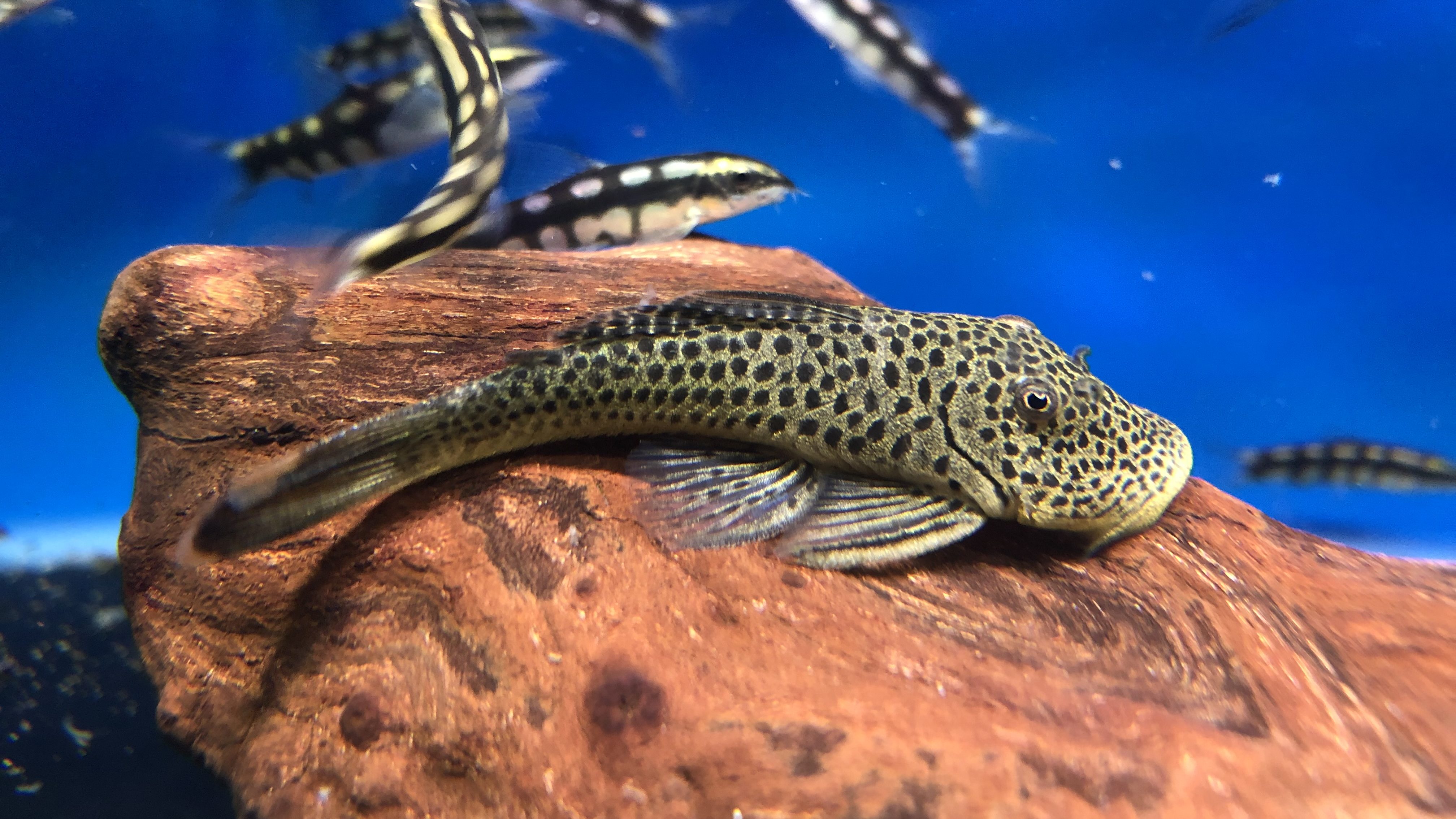
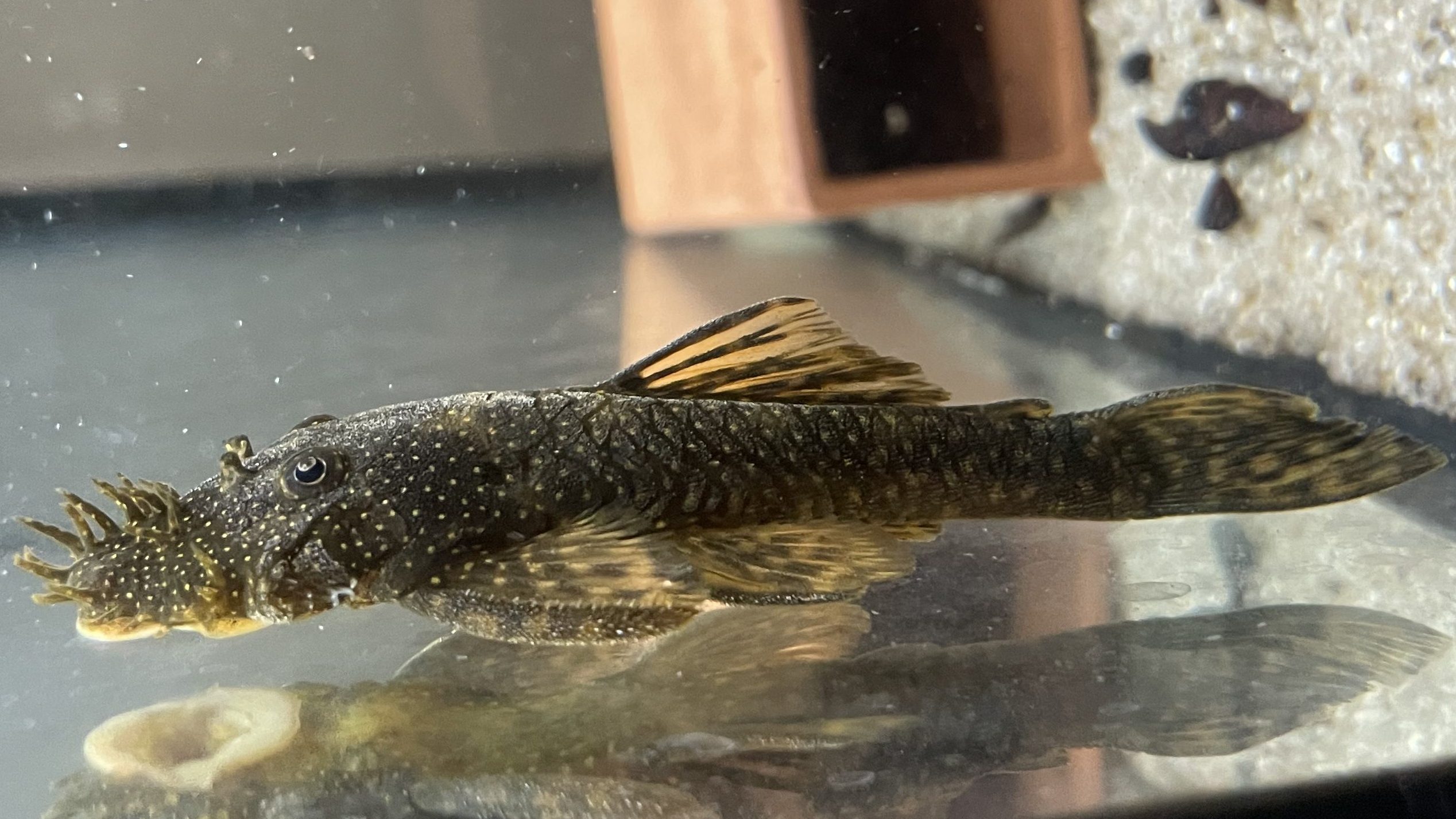
Chaetostoma cf. joropo

This Chaetostoma clade have a unique appearance of long wide jaws and dermal plating stopping before the end of the head leaving a fleshy rim that lacks tentacles. The only taxa that look similar would be a few Ancistrus and the Neoplecostominae, Pareiorhapis but the latter displays quite reasonable hypertrophied odontodes and a much wider head. There is more precise skeletal anatomy to identify Chaetostoma (Lujan et al., but not really the easiest for the fishkeeper to identify.

As of 2022 there were 49 currently described species in the genus (Meza-Vargas et al., 2022) making Chaetostoma one of the numerous Loricariid genera excluding Ancistrus and Hypostomus all of which have many undescribed species. While in the aquarium trade we see very few with some rarities appear on occasion, the majority seem to be imported rather generally and therefore bycatch is not rare. This is one of the genera you can find something almost unseen in a general fish store due to this lack of identification. The most common being Chaetostoma formosae, C. sp. ‘L147’ and C. dorsale but Chaetostoma sp. L455/L457 is not unseen and has some amazingly striking patterning.

Chaetostoma brevilabiatum at Pier Aquatics

Chaetostoma has often been associated with being small but this genus represents some larger species such as Chaetostoma brevilabiatum growing to over 18cm Standard Length (SL) although most are around that 6/7cm SL mark (Lujan et al., 2015). They are notorious fast growers if in the right setup so certainly not one to forget about upgrading soon enough.

Habitat

While largely a hillstream or high velocity fish (In terms of our fishkeeping) they can be particularly widespread or less so depending on the species (Lujan et al., 2015). Ecology is rarely recorded as with many fishes where taxonomy has been the focus and while most descriptions come with coordinates that can be crosschecked against other information it is still somewhat making assumptions. Although for Chaetostoma chimu, C. formosae, C. dorsale, C. platyrhynchus and C. joropo all three are found in the same locality, explains mixed imports and we do have ecological records focused on C. chimu. The water is well oxygenated and by our aquarium standards has a high flow, temperatures of 21-29c, a pH of 7.1-8.9 along with a conductivity of 20.4–269.0 μS (Urbano‐Bonilla & Ballen, 2021) . This suggests fishes that experience quite a bit of variation and swings seasonally or maybe if there is frequent rainfall. Generally this does infer maybe a few species not difficult to house in captivity. That neutral pH is not uncommonly recorded, Chaetostoma spondylus is recorded from a habitat of a pH of 7.1 with again highly oxygenated water (Salcedo & Ortega 2015). Chaetostoma joropo also inhabiting highly oxygenated water at a pH of 7.1-8.6, a conductivity of 10.4–258.0 μS and temperatures of 21-30c. These are certainly not fish to keep at least at the high extreme but given the locality of many it seems particularly those at higher elevations would need much cooler water year round.

Chaetostoma sp. ‘L445/L457’

These habitats are extremely rocky with round boulders weathered from the flow of the rivers (Urbano‐Bonilla& Ballen, 2021; Meza-Vargas et al., 2022). Whether it be rocks, wood, pleco caves etc. plenty of hiding spots are a must for this genus.

Diet

While the habitat of Chaetostoma proves them adaptable their diet might not, these elongate jaws are extremely similar to other genera that have provided a challenge to aquarists e.g. Baryancistrus. The longer jaws with more numerous teeth are strongly associated with algivory (feeds on mostly algaes/aufwuch/periplankton; Lujan et al., 2012). Zúñiga-Upegui et al. (2017) is probably the most detailed paper on the diet of Chaetostoma although few ever discuss their diet, from their analysis the genus feeds almost entirely on algaes particularly diatoms. These diatoms are unlikely to be those highly stubborn ones to cause issues in the aquarium though.

If anything much like Baryancistrus this is a genus who would benefit from large amounts of algae’s in their diet whether it be Repashy soilent green with additional algal powders mixed in or In The Bag’s Pleco Pops. Many fish diets even most claimed as algae wafers contain very little and this genus has shown adaptable to these diets nutritionally I can’t see them being ideal.

Behaviour

I can’t argue for or against their territoriality as I haven’t seen it, even with any territorial species there is a benefit in others for enrichment given the right amount of space. Many fishes seem to learn feeding behaviours off each other.

Chaetostoma sp. ‘L445/L457’

Conclusion

Chaetostoma, it’s so unusual looking and can look creepy, they often get forgotten. These algivores who enjoy high flow and velocity would certainly make interesting tankmates in some of those aquariums which allow for such seasonal variation. Adaptable in parameters and maybe less so in diet is probably what defines the genus.

References/species descriptions:

Lujan, N. K., Meza-Vargas, V., Astudillo-Clavijo, V., Barriga-Salazar, R., & López-Fernández, H. (2015). A multilocus molecular phylogeny for Chaetostoma clade genera and species with a review of Chaetostoma (Siluriformes: Loricariidae) from the Central Andes. Copeia103(3), 664-701.

Lujan, N. K., Winemiller, K. O., & Armbruster, J. W. (2012). Trophic diversity in the evolution and community assembly of loricariid catfishes. BMC Evolutionary Biology12(1), 1-13.

Meza-Vargas, V., Calegari, B. B., Lujan, N. K., Ballen, G. A., Oyakawa, O. T., Sousa, L. M., … & Reis, R. E. (2022). A New Species of Chaetostoma (Siluriformes: Loricariidae) Expands the Distribution of Rubbernose Plecos Eastward into the Lower Amazon Basin of Brazil. Ichthyology & herpetology110(2), 364-377.

Salcedo, N. J., & Ortega, H. (2015). A new species of Chaetostoma, an armored catfish (Siluriformes: Loricariidae), from the río Marañón drainage, Amazon basin, Peru. Neotropical Ichthyology13, 151-156.

Urbano‐Bonilla, A., & Ballen, G. A. (2021). A new species of Chaetostoma (Siluriformes: Loricariidae) from the Orinoco basin with comments on Amazonian species of the genus in Colombia. Journal of Fish Biology98(4), 1091-1104.

Zúñiga-Upegui, P. T., Villa-Navarro, F. A., García-Melo, L. J., García-Melo, J. E., Reinoso-Flórez, G., Gualtero-Leal, D. M., & Ángel-Rojas, V. J. (2014). Aspectos ecológicos de< em> Chaetostoma sp.(Siluriformes: Loricariidae) en el alto río Magdalena, Colombia. Biota Colombiana15(2).

Leporacanthicus and Scobinancistrus: A dietary guide to molluscivorous Loricariids.

While the majority of Loricariids are algivores/detritivores (Lujan et al., 2012), there is a number of those who are carnivorous and even less likely specialise in molluscs.

Figure 1: Scobinancistrus auratus at Maidenhead Aquatics, Ascot.

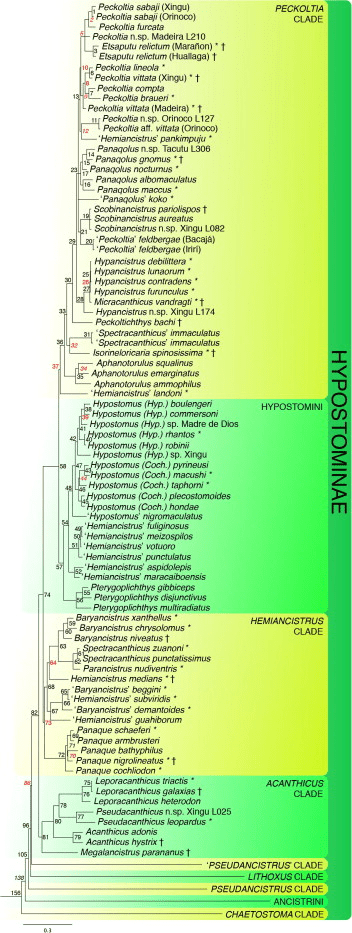
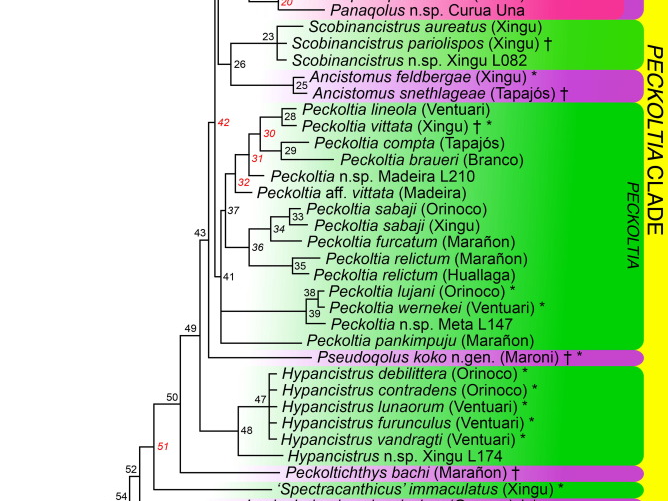
Scobinancistrus and Leporacanthicus are both genera in the subfamily Hypostominae of the Siluriforme (catfish) family, Loricariidae. Scobinancistrus is nested within the Peckoltia group while Leporacanthicus places within the Acanthicus group (Fig 2). As a result these two species are not closely related at all, making the molluscivorous dietary niche convergent.

Figure 2: Phylogeny of the Peckoltia group from: Lujan, N. K., Armbruster, J. W., Lovejoy, N. R., & López-Fernández, H. (2015). Multilocus molecular phylogeny of the suckermouth armored catfishes (Siluriformes: Loricariidae) with a focus on subfamily Hypostominae. Molecular phylogenetics and evolution82, 269-288.

Both genera are reasonably small in size, Leporacanthicus contains four described species: L. galaxias (Galaxy/vampire pleco/L007/L240), L. joselimai (Sultan pleco/L264), L. heterodon (Golden vampire pleco) and L. triactus (Three becon pleco/L091); Scobinancistrus contains three described species: S. auratus (Sunshine pleco/L014), S. pariolispos (Golden cloud pleco/L133) and S. raonii (L082). There are multiple undescribed species or variant’s in both genera. Species descriptions are included in the reference list.

Neither of these genera are particularly small in size particularly Scobinancistrus where both S. pariolispos, S. auratus and the undescribed species grow to 30cm SL, S. raonii being an exception at 22cm SL (Chaves et al., 2023). On the other hand Leporacanthicus while the Acanthicus group represents the largest species is generally around 24cm SL (Collins et al., 2015) with the exception of Leporacanthicus joselimai at around 15cm SL (Isbrücker & Nijssen, 1989). So these are not the smallest of fishes but generally the scientific literature includes much smaller sizes then some of the images of fishes obtained from the wild.

When we look at habitats for this clade it is generally always rocky with little to no macrophyte plants, these fishes enjoy a good current (Chaves et al., 2023; Isbrücker & Nijssen, 1989; https://amazonas.dk/index.php/articles/brasilien-rio-xingu). This is partially a clue to why their morphology is the way it is. Particularly those Rio Xingu species e.g. Scobinancistrus auratus, S. raonii and Leporacanthicus heterodon will not experience temperatures below 28c (Rofrigues-Filho et al., 2015).

While juveniles are not noted to be a particular issue unlike the majority of the Acanthicus clade both can be particularly territorial with age. I have a clear memory of a Leporacanthicus breeder explaining how a pair couldn’t be housed with other Loricariids due to the level of aggression. In a larger aquarium with plenty of caves and decor to break up the tank could work but this has to be taken into consideration for the future.

Figure 3: Scobinancistrus aureatus at Maidenhead Aquatics, Ascot.

Dietary niche

Both of these genera have very specialist jaws, they are particularly agile to move around or into a food item as displayed in figure 3. This mobility of the soft oral suction cup-like mouth is to more of an extreme then other carnivores; Pseudacanthicus who is much more general as a carnivore.

Figure 4: Leporacanthicus galaxias from: https://www.suedamerikafans.de/wels-datenbank/maulstudien/

Leporacanthicus goes a little more further with a particularly large, fleshy with many particularly large unculi.

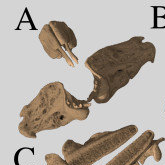
Figure 5: The jaws of Leporacanthicus sp. as featured in: Lujan, N. K., Winemiller, K. O., & Armbruster, J. W. (2012). Trophic diversity in the evolution and community assembly of loricariid catfishes. BMC Evolutionary Biology12(1), 1-13.

If anything talks about diets so much, it is the skeletal anatomy and the jaws (Fig 5). These two genera have very robust jaws but other Loricariids particularly Hypostominae have this, what separates Scobinancistrus and Leporacanthicus is the area around the tooth cup. It is extremely elongate downwards, protruding but unlike other Loricariids it is also very limited for teeth (Fig 5).

The teeth are very few and sparse, which correlates with carnivory (Lujan et al., 2012). These teeth being strong, maybe due to colouration maybe mineralised and, more then anything long.

Their diet

These fish are adapted for reaching into something so……..molluscs……..

The interesting thing about diets is for quite a lot of species we don’t entirely know what they eat. Gut analysis is still the most common method of analysing animal diets but that only shows a snapshot of what is in their gut at that time but ignores seasonal variance or digestion. Hence Panaque being a particular curiosity, few organisms can digest wood were studied further but others it’s not looked further. Often with fishes only a small number of individuals are used which can limit it further. When thinking functionally half of diet is what they eat the rest is where they eat, like it’s fine to eat invertebrates, many animals do but to extract it from an object is another, you can’t compare their morphology.

The suggestion of these fishes feeding on molluscs is not old (Black & Armbruster 2022), other groups e.g. fishes are confirmed to feed on molluscs but morphologically nothing similar. Morphology doesn’t mean molluscs are not their diet as molluscs can be in difficult to reach areas.

The description of Scobinancistrus raonii was the most detailed of their diets inferring the use of invertebrates, algaes and porferia (I know an invertebrate; Chaves et al., 2023). Porferia is not a rare mention in the scientific literature as a Loricariid diet as featuring in the diet of Megalancistrus aculeatus but based on dietary analysis (Delariva & Agostinho, 2001). Sponges are a discussion that would need analysing further, Professor Donovan P. German, a scientist specialising in fishes diets discusses that previous fishes that specialise in sponges do so similar to Panaque, they break down the sponges in search of things they can digest. So I will illude suggestions they can digest sponges, either way not a viable diet in captivity as sponges take so long to grow.

Personal experience only hold up so much ground but I have experienced both take particular interest in molluscs and extracting them from their shells, unlike other taxa they cannot crush those shells. Their jaws and teeth even just suggest how they cannot crush, look at your own teeth, your crushing teeth are rounder and shorter.

We don’t really know if they do eat molluscs, the bodies of molluscs wont appear on gut analysis as easily processed. I don’t know yet enough about isotope analysis to test other methods. But if they show the interest it’s something to explore.

The other avenue is these long jaws and teeth are for extracting things from the cracks and crevices in wood.

Either way though we don’t have the captive diets to really cater carnivory that well yet so no harm in the snails but look at a diet that is based on invertebrates. They show an interest in molluscs so those without the trapdoor would be amazing.

In Loricariidae there is the new frontier in diets, places to explore and understand. We do not know yet so worth looking further. We are miles from the answer in what they really digest and eat.

References:

Black, C. R., & Armbruster, J. W. (2022). Chew on this: Oral jaw shape is not correlated with diet type in loricariid catfishes. Plos one17(11), e0277102.

Collins, R. A., Ribeiro, E. D., Machado, V. N., Hrbek, T., & Farias, I. P. (2015). A preliminary inventory of the catfishes of the lower Rio Nhamundá, Brazil (Ostariophysi, Siluriformes). Biodiversity Data Journal, (3).

Delariva, R. L., & Agostinho, A. A. (2001). Relationship between morphology and diets of six neotropical loricariids. Journal of Fish Biology58(3), 832-847.

Lujan, N. K., Armbruster, J. W., Lovejoy, N. R., & López-Fernández, H. (2015). Multilocus molecular phylogeny of the suckermouth armored catfishes (Siluriformes: Loricariidae) with a focus on subfamily Hypostominae. Molecular phylogenetics and evolution82, 269-288.

Lujan, N. K., Winemiller, K. O., & Armbruster, J. W. (2012). Trophic diversity in the evolution and community assembly of loricariid catfishes. BMC Evolutionary Biology12(1), 1-13.

Rios-Villamizar, E. A., Piedade, M. T. F., Da Costa, J. G., Adeney, J. M. and Junk, W. J. (2013). Chemistry of different Amazonian water types for river classification: A preliminary review. Water and Society 2013, 178.

Species descriptions:

Burgess, W. E. (1994). Scobinancistrus aureatus, a new species of Loricariid Catfish from the Rio Xingu (Loricariidae: Ancistrinae). TFH Magazine. 43(1):236–42.

Chaves, M. S., Oliveira, R. R., Gonçalves, A. P., Sousa, L. M., & Py-Daniel, L. H. R. (2023). A new species of armored catfish of the genus Scobinancistrus (Loricariidae: Hypostominae) from the Xingu River basin, Brazil. Neotropical Ichthyology21, e230038.

Isbrücker I. J. H. and Nijssen H. (1989). Diagnose dreier neuer Harnischwelsgattungen mit fünf neuen Arten aus Brasilien (Pisces, Siluriformes, Loricariidae). DATZ. 42(9):541–47

Isbrucker, I. J., Nijssen, H., & Nico, L. G. (1992). Leporacanthicus triactis, a new loricariid fish from upper Orinoco River tributaries in Venezuela and Colombia (Pisces, Siluriformes, Loricariidae). Die Aquarien-und Terrarienzeitschrift (DATZ)46(1), 30-34.

Hypancistrus – A Dietary Guide to the Fancy Pleco

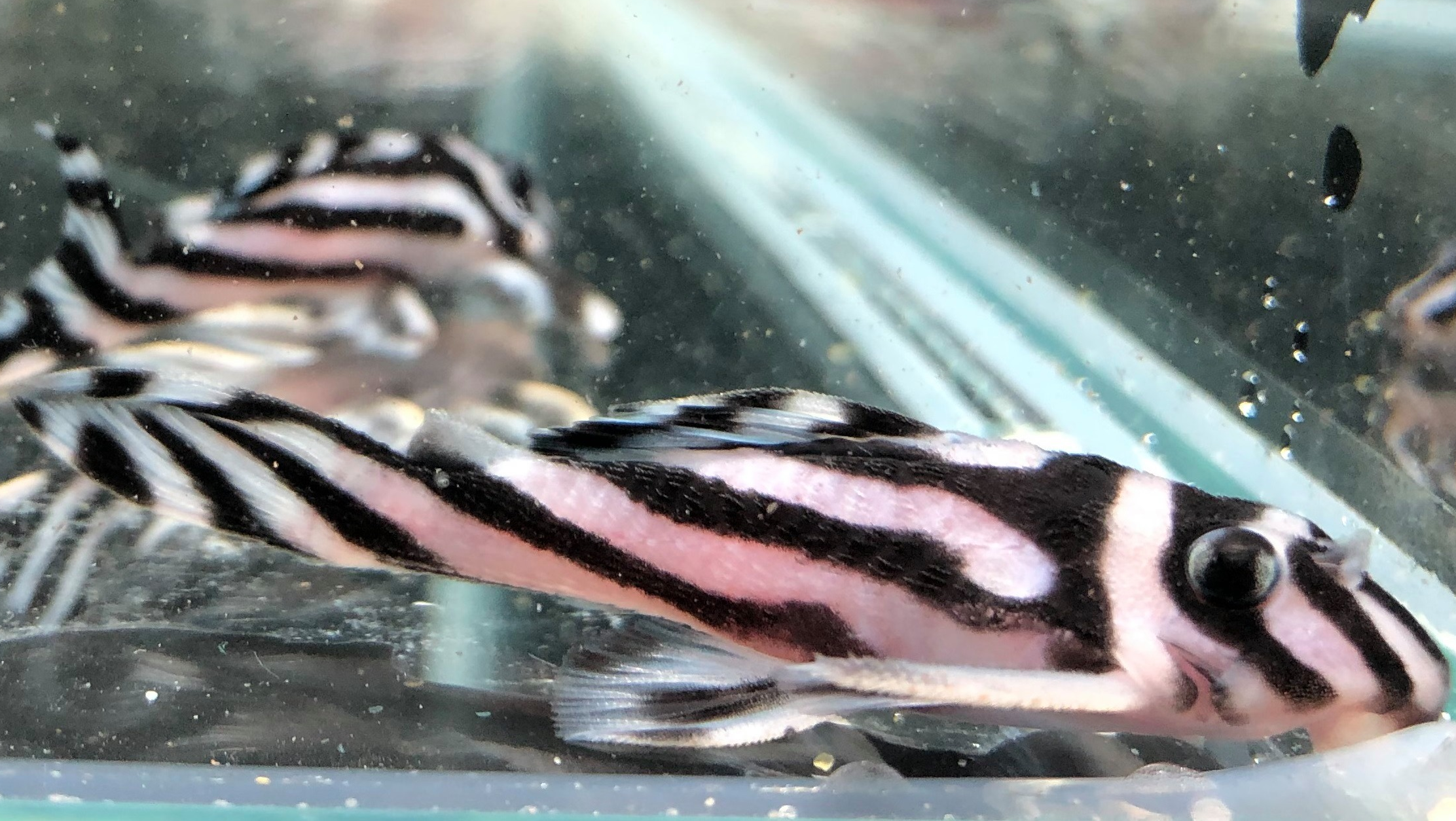
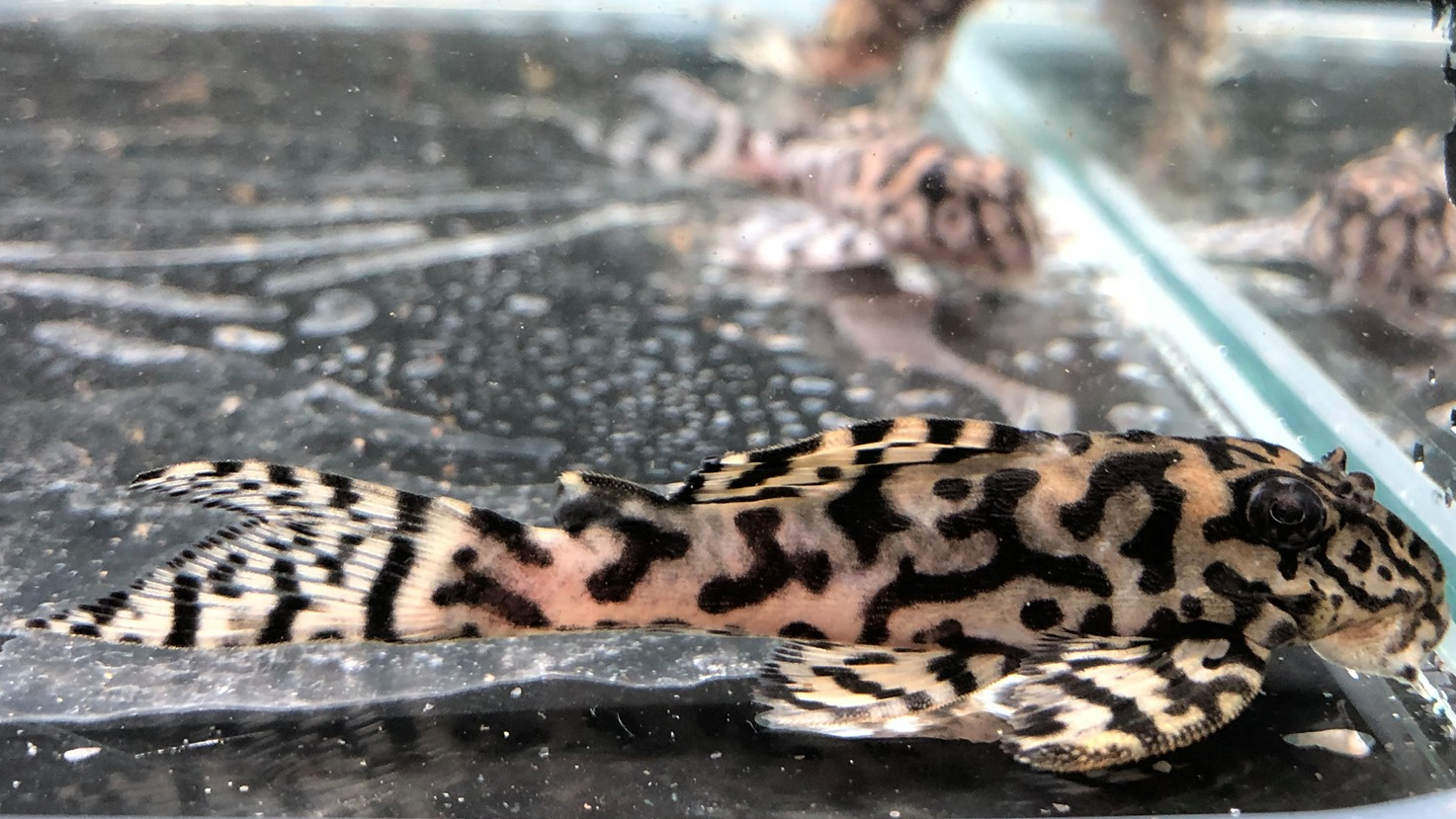
Figure 1: Hypancistrus zebra (Zebra pleco, L046)

Hypancistrus is a relatively medium sized genera with a type species of Hypancistrus zebra (Fig 1). The genus is nested within the Peckoltia clade in the subfamily Hypostominae (Fig 2) and displays similar morphology to many members of this group.

Figure 2: Phylogeny of the Peckoltia clade: Lujan, N. K., Cramer, C. A., Covain, R., Fisch-Muller, S., & López-Fernández, H. (2017). Multilocus molecular phylogeny of the ornamental wood-eating catfishes (Siluriformes, Loricariidae, Panaqolus and Panaque) reveals undescribed diversity and parapatric clades. Molecular phylogenetics and evolution109, 321-336.

The body shape of Hypancistrus is generally quite characteristic of many typical Hypostominae plecos. They tend to have a shorter head and larger eyes compared to Panaqolus and Peckoltia. Markings are spotted or striped but vermiculations are present, these might reduce with age or change shape. Colouration similarly becomes less distinctive with age but the majority of members are white/yellow and grey/black.

Like the majority of the Peckoltia group Hypancistrus displays hypertrophied (large) odontodes (external teeth, not used for feeding) on the caudal peduncle, pectoral fin spines and at the gill opercula. These odontodes are sexually dimorphic being hypertrophied in the caudal peduncle and pectoral fin spines within males while females also absent. In mature males the odontodes that cover the body tend to become larger giving a more blurred appearance to the fish (Reis et al., 2022).

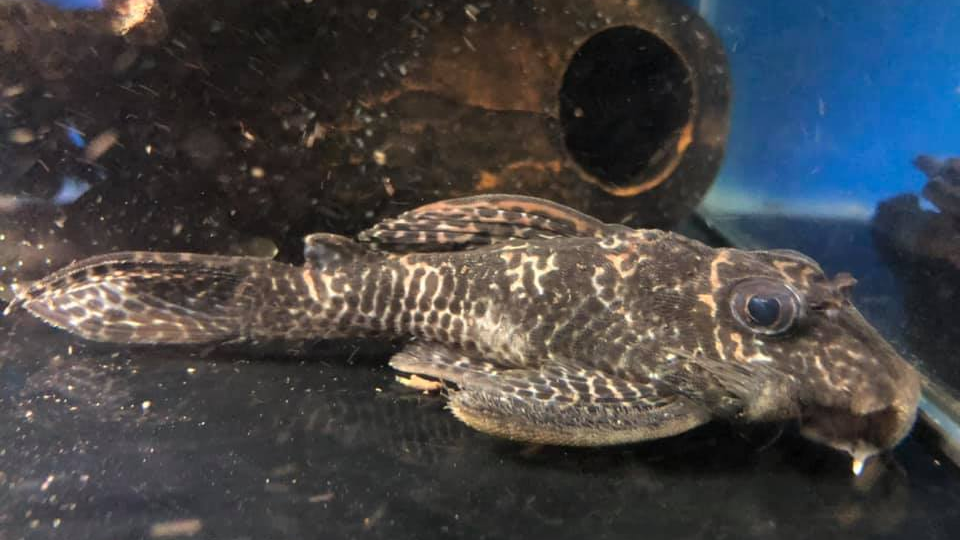
Figure 3: Hypancistrus sp. ‘L236’

Regardless of the popularity of the genus Hypancistrus, there are only 9 described species (Fricke et al., 2023) but almost four times that are undescribed with and without L numbers. This doesn’t define if these undescribed individuals are species as L066 and L333 has been suggested to be the same species (Cardoso et al., 2016).

Hypancistrus is generally located within areas of high velocity water residing between the cracks and crevices. Water temperatures are a minimum of 28c and this is why flow within captivity is important to keep oxygen levels high (de Sousa et al., 2021).

The Ecomorphology of Hypancistrus

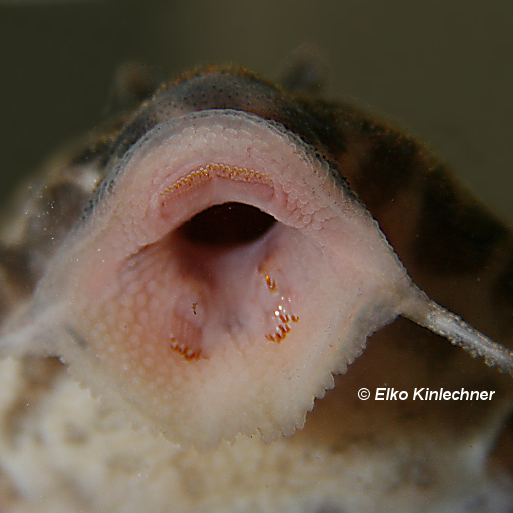
Figure 4: Hypancistrus sp. L333, the image is from the amazing website: https://www.suedamerikafans.de/en/wels-datenbank/maulstudien/?cookie-state-change=1701028628501 Great for anyone wanting to look at mouths of Loricariids and other information.

Ecomorphology are anatomical traits that are involved in functional behaviour such as feeding. This oral morphology (Fig 4) is very similar to particularly Peckoltia itself. There are a reasonable amount of teeth particularly on the maxaillae, upper jaw and less on the dentary, lower jaw. While there are a few it is a lot more then the closely related, carnivorous Scobinancistrus. The jaws of Hypancistrus are strong and robust, very similar again to Peckoltia but not quite the same as the other closely related genus, Panaqolus.

Dietary Ecology

Hypancistrus is often recorded as being a carnivore, I don’t entirely know where the assumption comes from but it must stem from this common idea that any of the colourful Loricariids are, I have seen this stated quite frequently. Additionally maybe the doctorial thesis of Dr. Jansen Zuanon where the species Hypancistrus zebra is suggested to feed on reasonable amounts of Bryozoa along with algaes (Zuanon, 1999). As many things do with time information is lost, some older information generalises the genus as omnivores and later others have suggested carnivores.

When reading the scientific literature including Zuanon (1999) there is limited references to the diet of Hypancistrus. There is gut analysis attached to the description of four species. While various algae and detritus made up the majority of the gut contents of these four species: numerous processed seeds were located in the gut of Hypancistrus inspector (Armbruster, 2002), bryophytes (mosses) within Hypancistrus lunaorum and; in Hypancistrus contradens in addition to mostly algae and detritus, some aquatic invertebrates were located (Armbruster et al., 2007). This infers that Hypancistrus is some what of a generalist but likely more on the herbivorous side.

So what should you feed Hypancistrus in captivity?

Don’t forget those algae’s, a diet with a range and high amounts of these algae’s will be beneficial. Always check ingredient lists, algae’s unlike many macrophyte plants are high in protein and various vitamins and minerals. As the fish are evolved to feed on these it’ll be much more easy for them to digest and less waste produced as a result. In addition a little bit of variation, the odd frozen food such as brine shrimp, tubifex etc. would not be bad but many diets that contain algaes also contain this. Mosses would be an interesting addition to trial, aquarium mosses can be quite expensive but perhaps terrestrial mosses from areas without pesticides?

Of all the things to trial seeds, as mentioned by Armbruster (2002), at least Hypancistrus inspector feeds on seeds. This is certainly worth exploring with many more Loricariids and a variety of seeds as bare in mind the number of plants that produce seeds is immense, fruits that contain seeds such as blueberries and pomegranate could be worth trying. They might not jump to them but it’s worth sitting back and watching, in discussion with other fishkeepers seeds have been worth the trial. As seeds are almost a storage body for many plants they will contain a lot of nutrition and could explain why Hypancistrus and maybe Peckoltia have such strong jaws. A selective advantage at a seasonal or occasional food item? Selective advantages towards awkward to reach food items are not rare in Loricariidae.

Conclusion

Hypancistrus might be popular for their colours, their patterning but ecologically they offer quite a lot that has yet to be explored. The focus on breeding them has maybe moved the husbandry of the genus away from a curiosity of just keeping them and understanding them.

References:

Armbruster, J. W. (2002). Hypancistrus inspector: a new species of suckermouth armored catfish (Loricariidae: Ancistrinae). Copeia2002(1), 86-92.

Armbruster, J. W., Lujan, N. K., & Taphorn, D. C. (2007). Four new Hypancistrus (Siluriformes: Loricariidae) from Amazonas, Venezuela. Copeia2007(1), 62-79.

Cardoso, A. L., Carvalho, H. L. S., Benathar, T. C. M., Serrao, S. M. G., Nagamachi, C. Y., Pieczarka, J. C., … & Noronha, R. C. R. (2016). Integrated cytogenetic and mitochondrial DNA analyses indicate that two different phenotypes of Hypancistrus (L066 and L333) belong to the same species. Zebrafish13(3), 209-216.

Fricke, R., Eschmeyer, W. N. & Van der Laan, R. (eds) 2023.  ESCHMEYER’S CATALOG OF FISHES: GENERA, SPECIES, REFERENCES. (http://researcharchive.calacademy.org/research/ichthyology/catalog/fishcatmain.asp)

Lujan, N. K., Cramer, C. A., Covain, R., Fisch-Muller, S., & López-Fernández, H. (2017). Multilocus molecular phylogeny of the ornamental wood-eating catfishes (Siluriformes, Loricariidae, Panaqolus and Panaque) reveals undescribed diversity and parapatric clades. Molecular phylogenetics and evolution109, 321-336.

Reis, R. G. A., Oliveira, R. S. D., da Silva Viana, I. K., Abe, H. A., Takata, R., de Sousa, L. M., & da Rocha, R. M. (2022). Evidence of secondary sexual dimorphism in King Tiger Plecos Hypancistrus sp, Loricariidae, of the Amazon River basin. Aquaculture Research53(10), 3718-3725.

de Sousa, L. M., Lucanus, O., Arroyo-Mora, J. P., & Kalacska, M. (2021). Conservation and trade of the endangered Hypancistrus zebra (Siluriformes, Loricariidae), one of the most trafficked Brazilian fish. Global Ecology and Conservation27, e01570.

Zuanon, J. A. S. (1999). História natural da ictiofauna de corredeiras do rio Xingu, na região de Altamira, Pará.

The Myth of Female Aggression: A Focus on Territoriality in Loricariids (Pleco’s) Catfishes.

Men are from Mars and Women are from Venus, Mars the roman god of war and Venus the Roman goddess of love and fertility. Males of a species are often associated with aggression and self determination; females associated with passivity and a peaceful nature. Species such as the Spotted Hyena (Crocuta crocuta) that so obviously turn this view upside down are often of curiosity.

Misconceptions of female aggression are common throughout all vertebrates for various reasons. Within horses one mare determines where the rest of the group are going and the others can determine if to tolerate the male or not. They show a range of different aggressive behaviours between each other and towards males (Curry et al., 2007), hierarchy is as important in the females in a group as it is for males. It’s not all about reproduction but social positioning can effect a females chance as it does for males.

Cichlid Aggression

Cichlids are well known for aggression, perhaps it is a bit overemphasized as their behaviour is much more complex then just needless aggression. It is also a vast grouping where levels of aggression and territoriality vary along with the reasons for. And like Loricariids there are social species and more solitary species, juveniles of any will spend a considerable amount of time in a gregarious state (Forsatkar et al., 2016).

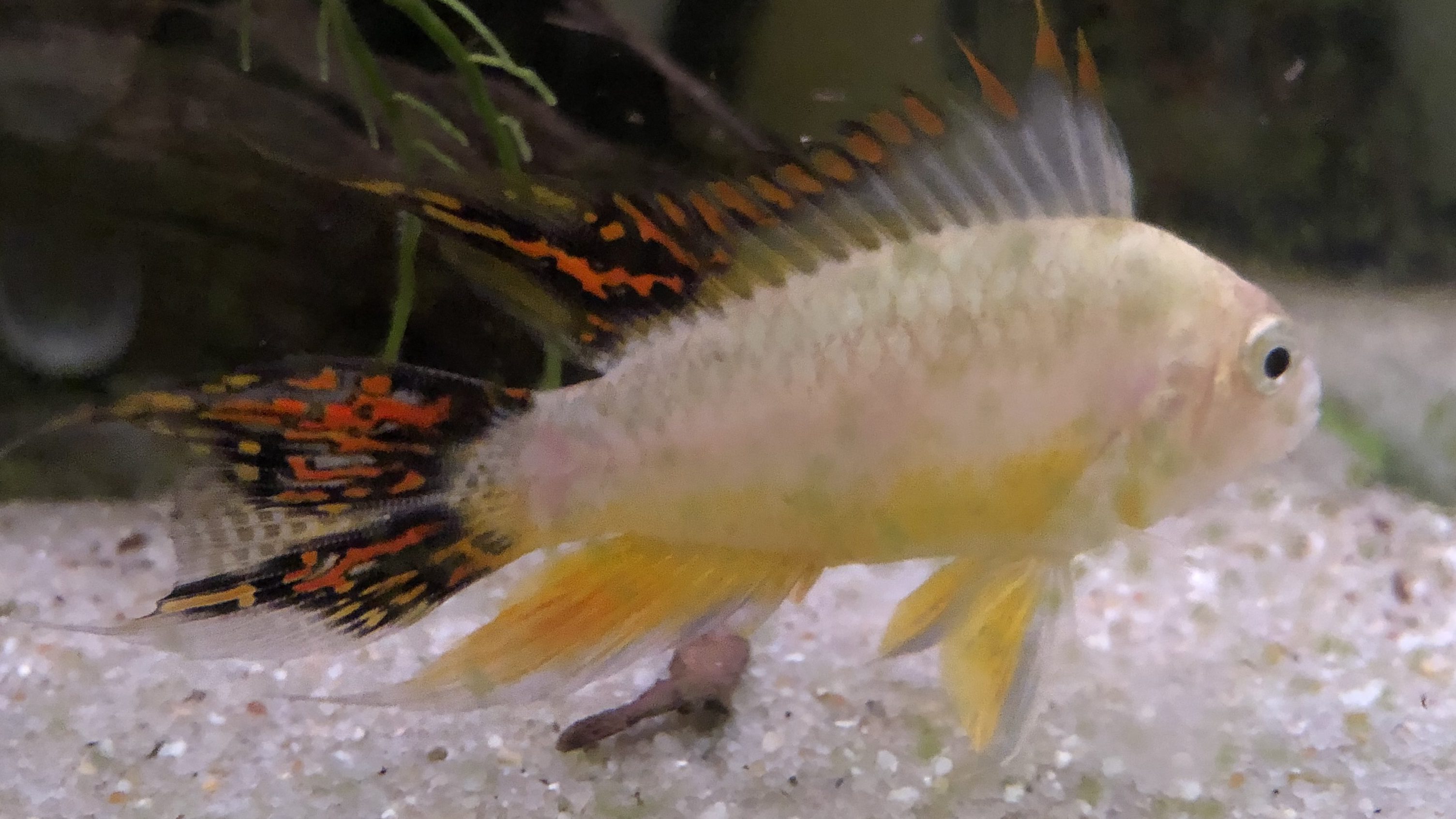
Apistogramma macmasteri, female

Territoriality is common in cichlids where both males and females defend a space particularly if spawning. In species with large size disparity the females contribution might be easily forgotten yet keep a female alone regardless of the presence of eggs and it is notable she is not a passive individual. In hareming species such as many Apistogramma or the shelldwelling Neolamprologous males hold a larger territory. The females are not shoaling passively, they each hold their own territory within the males defending from other females and sometimes keeping the male within a reasonable distance should there be fry and eggs. Interestingly males play a role in mediating aggression between females (Walter & Trillmich, 1994), this is a role I have seen in other animals where the mixture of sexes reduces overall aggression.

The Siamese Fighting Fish, Betta splendens

Male Betta splendens

This species has been the objects of fascination for many for the males beautiful morphology and their territorial behaviour. While the males have often been the highly valued fishes, females are seen as a side addition. Neither sex is social in the wild, these are largely solitary, territorial fishes so the benefit of keeping females in a group is only that of the owners. Females are shown to be equally as aggressive as males with similar aggressive behaviours (Braddock & Braddock, 1955). Where females are not known for aggression likely stems from the majority of these being plakat, short finned whereas many males are long finned and therefore will struggle with any territorial interactions.

Although it could be argued in a sufficiently big enough tank multiple individuals of both sexes could provide social enrichment assuming they can all develop their own territory. I would largely only advice keeping individuals alone unless spawning, there are social species of Betta that might be a better option for some.

I have worked with and kept a lot of Betta splendens, they are a staple of the aquarium trade and if anything can be a problem is sorority setups. Due to the amount of tanks needed to store individuals only males and the most fancy females could be housed alone. In these sorority tanks there was always a high rate of injuries between individuals, some variants were worse then others, particularly long finned females. In store setups it’s quite easy to experiment and increasing the amount of decor or adding in a variety of different tankmates did not reduce these aggressive interactions.

Why might females display aggression?

  • Sociality, even a gregarious species will have many complex interactions between individuals. Maintaining ones place within a shoal hierarchy is a common cause for aggression.
  • Territoriality, maintaining a space in which might contain resources such as food or the best spawning caves. Aggression to defend an item of food is common because this will aid in them maintaining a good condition.
  • Reproduction, sometimes females will defend the offspring from other species, individuals or even the male.

Loricariid (pleco) aggression

Loricariidae is a 1,051 species strong family of fishes so they cannot easily be generalised. There are both gregarious and territorial species within this gigantic clade. Generally Hypoptopominae are social and gregarious, Rinelepinae I have not heard of aggression from this strange subfamily. Deluturinae and Lithogeninae are subfamilies which never reach the aquarium trade so easily can be ignored here. This leaves the two largest subfamilies, Loricariinae and Hypostominae.

Loricariinae (Whiptail catfishes), the majority of these are social such as Farlowella (twig catfish), Sturisomatichthys (royal whiptail), even those which are not the steryotypical pleco/Loricariid like Rineloricariae. Although some species like Planiloricaria cryptodon can be particularly aggressive, it’s not entirely clear why, these are a species that spawns using their amazing barbels so not need to defend a spot. It is not sex specific but in caring for them around maturity they really need a larger tank or one per a tank.

Hypostominae, the largest subfamily with over 500 species. The majority of fishkeepers keep juvenile and with their illusive behaviour many interactions are easily missed. There is only a small number of gregarious species in this subfamily who lack any territorial tendencies e.g. Ancistrus ranunculus. Hypostominae are far from peaceful in general, sometimes fearsely defending an area from congeners (Hossain et al., 2018).

Hemiancistrus subvirdis (Green Phantom Pleco, L200) at Acres Aquatics, Wiltshire.

Hypostominae are crevice spawners in which a male defends a cave when there are fry or eggs within the space (Secutti, S., & Trajano, 2009). Although this doesn’t mean females do not express any aggression, both are territorial and will defend their space from any similarly shaped and sized fishes. It’s not difficult to understand why, as these fishes are likely defending food resources and the best caves to hide from predators regardless if used for spawning. The best grazing spots for many species are probably quite highly prized. Females are only spawning for short periods of time as play no role in brood care (Mendes et al., 2018), but as a result unlike males they tend to roam much larger areas, regarding aggression this poses a larger issue to the fishkeeper.

Some genera display much higher levels of aggression then others, the Acanthicus clade is particularly noted for aggression even in juveniles Pseudacanthicus will rasp on each other. Hypostominae are not loyal with their pairs although fishkeepers have noted aggression towards other fishes of both individuals in a pair preventing other fishes being added. I myself have quite a few mature Baryancistrus, in which the females I’ve seen lunge at other fishes, ram others into caves and intense shoving matches. In the common bristlenose, an Ancistrus, two mature females where this shoving match resulted in serious injuries. I have worked with an adult female Hypostomus luteus who couldn’t be housed with any other fishes within the restricted space of an aquarium after chasing many Pterygoplichthys non-stop.

Juvenile Pseudacanthicus serratus (Black mustang pleco)

Aggression is not restricted to males and for many species they are not easy to sex so for the majority of fishkeepers they would not know whether this fish is male or female. They are fishes who enjoy having their own space so plenty of caves and the space needed, it doesn’t mean multiple species can’t be kept together it just means consideration is needed. Aggression is also not limited to being intrasexual as individuals of different sexes will also display aggressive behaviours when not spawning.

The issue with Loricariidae is outside their phylogenetics and taxonomy we don’t know an awful lot about them so there is little research into their behaviour and the causes of territoriality between the two sexes.

Conclusion

Aggression is found throughout many clades of fishes and there are many different triggers for this behaviour. Where a male is aggressive it’s likely the females will be too and sometimes much more then those males.

References:

Braddock, J. C., & Braddock, Z. I. (1955). Aggressive behavior among females of the Siamese fighting fish, Betta splendens. Physiological Zoology28(2), 152-172.

Curry, M. R., Eady, P. E., & Mills, D. S. (2007). Reflections on mare behavior: Social and sexual perspectives. Journal of veterinary behavior2(5), 149-157.

Forsatkar, M. N., Nematollahi, M. A., & Bisazza, A. (2016). Quantity discrimination in parental fish: female convict cichlid discriminate fry shoals of different sizes. Animal cognition19, 959-964.

Hossain, M. Y., Vadas Jr, R. L., Ruiz-Carus, R., & Galib, S. M. (2018). Amazon sailfin catfish Pterygoplichthys pardalis (Loricariidae) in Bangladesh: a critical review of its invasive threat to native and endemic aquatic species. Fishes3(1), 14.

Mendes, Y. A., Lee, J. T., Viana, I. K., Rocha, R. M., & Ferreira, M. A. (2018). Reproductive biology of the tiger pleco Panaqolus tankei (Loricariidae) in a lentic system of the Amazon Basin. Journal of Fish Biology93(4), 711-714.

Secutti, S., & Trajano, E. (2009). Reproductive behavior, development and eye regression in the cave armored catfish, Ancistrus cryptophthalmus Reis, 1987 (Siluriformes: Loricariidae), breed in laboratory. Neotropical Ichthyology7, 479-490.

Walter, B., & Trillmich, F. (1994). Female aggression and male peace-keeping in a cichlid fish harem: conflict between and within the sexes in Lamprologus ocellatus. Behavioral Ecology and Sociobiology34, 105-112.

Hybridisation, is it such a bad thing?

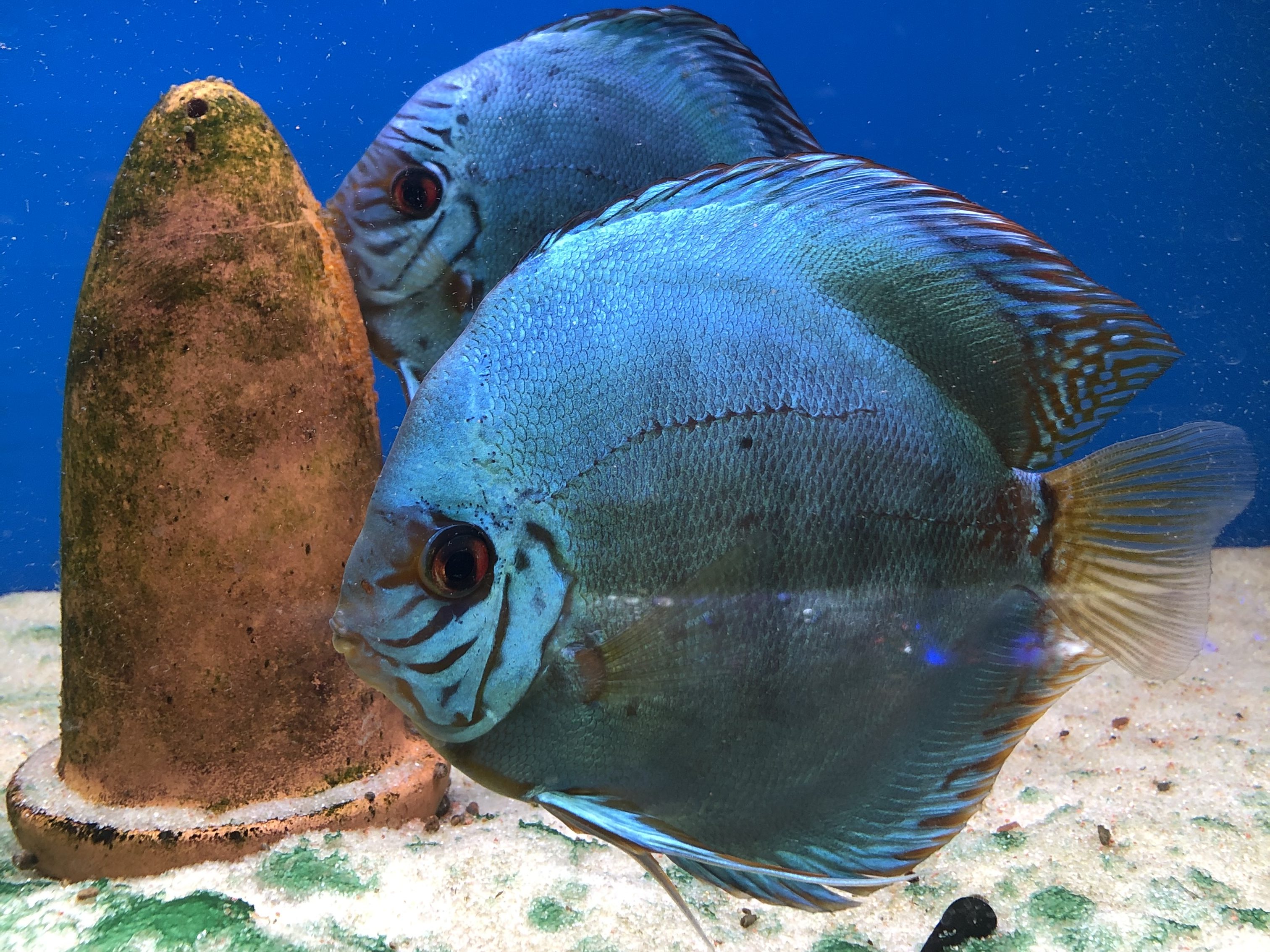
Stendker blue turquoise discus, Symphysodon sp. x. at Maidenhead Aquatics, Ascot 2019.

Hybridisation is such a trigger word these days with many opinions for and against. First there are two definitions required:

Hybridisation: Interbreeding between two members of different species (Adah et al., 2013).

Crossbreeding: Interbreeding between two members of the same species, they might be the same variety/breed/cultivar or different.

These two terms are often used interchangeably even if they do not refer to the same event. Although these terms are different they do rely on the definition of species, genera and higher taxa which is hotly debated. One frequent definition being the biological species definition which relies on hybridisation being a barrier although is largely unreliable (Mallet, 2001).

Hybridisation as an event is not uncommon (Scribner et al., 2000), the event (or events) has resulted in the development of new species, a process known as speciation (Litsios & Salamin, 2014). Not all of the offspring might be fertile, many people in the aquarium trade might be familiar with the hybrid parrot cichlids (Amphilophus citrinellus x. Heros efasciatus), this may be the biggest barrier to speciation.

Synodontis sp. at Maidenhead Aquatics, Ascot 2019.

Barriers to Hybridisation

There are many barriers to hybridisation which really can effect the result if there is some compatibility.

Chromosomal number is the most well known barrier to hybridisation, chromosomes are units within the nucleus that contains all the DNA. Most humans have 22 pairs, fruit flies, Drosophila melanogaster have 4 pairs and the duckbilled platyplus has 26 (a lot of sex chromosomes though!), chromosomal number does not infer complexity at all and nor does the size of a genome. Generally different species might have a different number of chromosomes, this is very well displayed in the Loricariid (pleco) genus, Ancistrus (bristlenoses) which displays a diversity of different chromosomal numbers across a 50 or more species large grouping (Santos da Silva et al., 2022). During reproduction parental chromosome numbers ideally need to match to put simply. While this is a barrier it has resulted in infertile offspring, or in the example of the livebearers from Poecilidae a number of unusual adaptations. These hybrid Poecilidae have the ability to reproduce via gynogensis, asexual reproduction with the requirement of a male to stimulate the process, he contributes nothing to the offspring (Schultz, 1969) and this is displayed potentially in many species originating from hybridisation (Turner, 1980). The limitations of chromosomes really vary though but are definitely present.

Morphology is one of the obvious but so easily forgotten, organisms have to be morphologically compatible not just for the initial act but additionally for fertilisation and gestation. It might not seem it but that minor differences in morphology make a difference, what might seem obscure such as the shape of spermatozoa can differ resulting in the cell not being able to imbed into the egg, it’s even so diverse that the morphology of this cell can infer groups (Quagio-Grassiotto et al., 2020). Species often judge each other via their morphology and therefore there is some level of sameness particularly in the wild.

Behaviour, different species or even different populations might display very different behaviours. Behaviour itself is so integral to reproduction and mate choice, outside of captivity this is such a strong barrier.

Geography is maybe the most well known barrier and often can result in the other divisions. This can be within a small space such as fishes which inhabit deeper water whereas others the shallows. Barriers don’t always have to be spatial but they can also be temporal.

Golden dwarf cockatoo cichlid, Apistogramma cacatuoides

The issues with hybridisation

Hybridisation itself is not negative it’s just a force, in terms of conservation it can provide a variety of effects. Hybridisation can lead to the decline in a population of a species, most well known in the case of the Scottish wildcat (Felis silvestris silvestris) and the sister species, the domestic cat (Felis catus). As hybrids display what is known as a hybrid vigour (a mixture of traits between the two pariental species) it can change how these individuals interact with their environment and the genetic diversity of a species (Selz & Seehausen, 2019). The ecological impact of the introduction of hybrids can be described as unpredictable (Mandeville et al., 2022) which makes it difficult to identify those exact issues. Although, this argument is similar to introducing individuals who are selectively bred who might also influence the gene pool of wild individuals. It is generally not ideal, hybridisation in conservation is reserved for restoring species where no other alternative can be found e.g. Prezewalski’s horse (Equus ferus prezewalskii) and the domestic horse (Equus ferus caballus) in an effort to save the subspecies, although hybridisation is a risk to the subspecies (King, 2005).

But here we are talking about captivity, it’s highly unlikely any of our fishes will be involved in any real conservation effort or practices.

The main issue in captivity with these hybrids is so many do not go recorded, likely due to misidentifications of the parent species and lack of record keeping. Take Ancistrus dolichopterus, this species is generally diagnosed as having 8-9 soft dorsal rays, only one small individual was spotted excluding brown spots on the abdomen. While no seams were mentioned (Kner, 1854) it is commonly stated they display these, as with many other Ancistrus these often do fade with time and I have been shown individuals from the type locality lacking these seams. There are many spotted Ancistrus and over time localities and important information on them are lost. It’s more then often that these seams are how the judgement is based on what species it is. The point I am getting to is how well do we know these species and how they are defined? We are relying here on hybridisation not being able to occur but it likely does because species are kept together who are not the same species but assumed the same. I generally would assume unless wild caught for morphologically indistinctive Ancistrus, they should probably be assumed hybrids. I have frequently seen even Ancistrus ranunculus, a morphologically distinctive Ancistrus be misidentified so it’s a difficult situation. This doesn’t include how little we know about some genera, the frequency of bycatch and misidentifications from suppliers as well.

Surely those who argue against hybridisation should also argue against crossing those from different localities or populations. This is also changing the genetic landscape of a population and asks the question of how to define a species.

In captivity it does effect if you are getting what you think you are getting but for many this might not be an issue. One of the biggest worries though is because hybrids are a pick and mix of the parental species morphology and behaviour is largely unknown, it could be more similar to one parent then the other, an intermediate or totally different. Where parental species have different requirements this is also an issue.

Platy, Xiphophorus sp. x. unknown likely X. maculatus x. X. variatus.

How to avoid hybridisation

For wild caught fishes maybe getting fishes from the same source and checking locality matches if you are not completely confident on the identification. Keep records of who is being crossed with who.

It’s quite simple to keep those who could maybe hybridised apart, this is difficult to judge as it is not just about genera but if it looks similar don’t keep them together. If hybridisation occurs clearly record that and any offspring should be sold labelled as such, if possible to pet only homes with no worries of breeding where that label can be forgotten over generations.

For captive bred individuals the situation is difficult, if you aren’t sure and they aren’t from a responsible or reliable source then don’t buy unless you plan on just having the animals as a pet, assuming you don’t want to increase the number of hybrids.

Hybridisation Bias

The skull of the parrot cichlid, Amphilophus sp. x. Vieja sp. as posted by Fish_Man_Dan on Monster Fish Keepers forum: https://www.monsterfishkeepers.com/forums/threads/my-mind-is-made-up-about-the-creation-of-blood-parrots.374666/

Much of the dislike towards hybrids is focused on certain species although hybrids are much more common then they seem. Fishes such as domestic discus (Symphysodon spp.) are a mixture of the three different species and definitely the different localities depending on the variety (Ng et al., 2021). Some domestic species might have hybrid origins such as the common bristlenose, Ancistrus sp. but we do not know. These species do not seem to have health related defects from their morphology although those such as the parrot cichlid, Amphilophus sp. x. Vieja sp. (not to be confused with the true parrot cichlid, Hoplarchus psittacus), clearly does have health related deformities as a result of selective breeding and hybridisation as displayed in this link to a Monster FishKeepers discussion forum.

The true parrot cichlid, Hoplarchus psittacus at Pier Aquatics, 2021

Conclusion

Hybridisation will always occur in the hobby, it is best that it is labelled so future keepers are aware of what their fishes are. If you are not completely sure of the species you are keeping then don’t breed it, ideally anyone who can identify the species should be able to cite a reliable website or the description of the species. Undescribed species might not have this so should have more precautions made such as keeping to one locality and morphology.

References

Adah, P. M., Onyia, L. U., & Obande, R. A. (2013). Fish hybridization in some catfishes: A review.

King, S. R. (2005). Extinct in the Wild to Endangered: the history of Przewalski’s horse (Equus ferus przewalskii) and its future conservation. Mongolian Journal of Biological Sciences3(2), 37-41.

Kner, R. (1854). Die Hypostomiden: Zweite Hauptgruppe der Familie der Panzerfische.(Loricata vel Goniodontes) (Vol. 1). KK Hof-und Staatsdruckerei.

Litsios, G., & Salamin, N. (2014). Hybridisation and diversification in the adaptive radiation of clownfishes. BMC Evolutionary Biology14, 1-9.

Mallet, J. (2001). Species, concepts of. Encyclopedia of biodiversity5, 427-440.

Mandeville, E. G., Hall Jr, R. O., & Buerkle, C. A. (2022). Ecological outcomes of hybridization vary extensively in Catostomus fishes. Evolution76(11), 2697-2711.

Ng, T. T., Sung, Y. Y., Danish-Daniel, M., Sorgeloos, P., de Peer, Y. V., Wong, L. L., & Tan, M. P. (2021). Genetic variation of domesticated discus (Symphysodon spp.). Aquaculture, Aquarium, Conservation & Legislation14(2), 832-840.

Schultz, R. J. (1969). Hybridization, unisexuality, and polyploidy in the teleost Poeciliopsis (Poeciliidae) and other vertebrates. The American Naturalist103(934), 605-619.

Santos da Silva, K., Glugoski, L., Vicari, M. R., de Souza, A. C. P., Noronha, R. C. R., Pieczarka, J. C., & Nagamachi, C. Y. (2022). Chromosomal Diversification in Ancistrus Species (Siluriformes: Loricariidae) Inferred From Repetitive Sequence Analysis. Frontiers in Genetics13, 838462.

Scribner, K. T., Page, K. S., & Bartron, M. L. (2000). Hybridization in freshwater fishes: a review of case studies and cytonuclear methods of biological inference. Reviews in Fish Biology and Fisheries10, 293-323.

Selz, O. M., & Seehausen, O. (2019). Interspecific hybridization can generate functional novelty in cichlid fish. Proceedings of the Royal Society B286(1913), 20191621.

Turner, B. J., Brett, B. L. H., & Miller, R. R. (1980). Interspecific hybridization and the evolutionary origin of a gynogenetic fish, Poecilia formosa. Evolution34(5), 917-922.

Quagio-Grassiotto, I., Baicere-Silva, C. M., de Oliveira Santana, J. C., & Mirande, J. M. (2020). Spermiogenesis and sperm ultrastructure as sources of phylogenetic characters. The example of characid fishes (Teleostei: Characiformes). Zoologischer Anzeiger289, 77-86.

What is a pleco? To be a pleco or not to be a pleco

Common names are half a mystery to themselves, their origins and what species they really apply to and not. They lack regulations and frequently change spatially and temporally. You can’t expect to go to every country and people call a giraffe, Giraffa, a giraffe. It’s like you can’t expect common names to stay the same, a well known example would be the European robin, Erithacus rubecula was at one point called the redbreast and then that changed to robin redbreast and then just robin. The point maybe is common names change so much with little ability to track, plant common names do so frequently as well.

Pleco is one of those common names, originally Plecostomus but Plecostomus used to be the name of a genus. Much like many have created Cory as a common name for the genus Corydoras. The type and most notable species was Hypostomus Plecostomus (Linnaeus 1758), formally Plecostomus Plecostomus. Plecostomus is no longer a valid genus and has not been since 1980 where species were then placed in multiple other genera such as Ancistrus, Isorineloricaria, Loricariichthys and eventually Aphanotorulus. The majority of those previously known as Plecostomus were moved into Hypostomus, described in 1803 with the type Hypostomus guacari which is now understood to be a synonym of Hypostomus plecostomus (Fricke et al., 2023). Interestingly Pterygoplichthys, a genus that contains species known as the common plecos was never in the genus Plecostomus. This summarizing the main flaws of the arguments behind the common name. Ancistrus, bristlenose plecos are often argued not to be plecos but they had members once in Plecostomus whereas many such as Pterygoplichthys who there is no debate about were never placed in Plecostomus. Currently while there are none with the genus Plecostomus there is Hypostomus plecostomus and H. plecostomoides. Of genera Neoplecostomus, Microplecostomus and Nannoplecostomus exists, currently within Hypoptopominae, which is the same subfamily as Otocinclus. These genera add the other argument do people consider Otocinclus a pleco?

The other issue with the name pleco as a common name is where it is applied evolutionary.

Phylogenetic tree using molecular data of Loricariidae from: Roxo, F. F., Ochoa, L. E., Sabaj, M. H., Lujan, N. K., Covain, R., Silva, G. S., … & Oliveira, C. (2019). Phylogenomic reappraisal of the Neotropical catfish family Loricariidae (Teleostei: Siluriformes) using ultraconserved elements. Molecular phylogenetics and evolution135, 148-165.

Names need some consistency so people can understand each other and that is what scientific names provide. The common name pleco also lacks consistency in where it places in the evolutionary/phylogenetic tree. If you exclude Ancistrus as so many do it is the only member of Hypostominae (coloured in red, Fig 1) to not be a pleco. But members outside of that subfamily are included, right at the earliest branches is Rinelepinae (coloured in yellow, Fig 1) it excludes a lot of later branching Loricariids. Not pictured here is also Pseudancistrus geniseiger who would be considered a pleco and also branches out this far (Lujan et al., 2015). Loricariinae and Hypoptopominae are often debated as if they are a pleco or not.

The problem is more that no one is quite referring to pleco in the same way under this pick and mix system. Some of us refer to the whole of Loricariidae as it would make sense to do, L numbers themselves also do as the L refers to Loricariidae. In Germany these fishes are often referred to as L Welse, meaning Loricariidae Catfish I assume as also members of Siluriforme, catfishes. It means everyone understands each other using this method even if being much broader, we should be recognising the diversity within Loricariidae anyway. In Loricariids and therefore plecos it is an international aspect of the fishkeeping hobby and many countries do not even use the term pleco.

References:

Britto, M. R. (2003). Phylogeny of the subfamily Corydoradinae Hoedeman, 1952 (Siluriformes: Callichthyidae), with a definition of its genera. Proceedings of the Academy of Natural Sciences of Philadelphia153(1), 119-154.

Fricke, R., Eschmeyer, W. N. & Van der Laan, R. (2023).  ESCHMEYER’S CATALOG OF FISHES: GENERA, SPECIES, REFERENCES. (http://researcharchive.calacademy.org/research/ichthyology/catalog/fishcatmain.asp). Electronic version accessed 18/10/2023.

Lujan, N. K., Armbruster, J. W., Lovejoy, N. R., & López-Fernández, H. (2015). Multilocus molecular phylogeny of the suckermouth armored catfishes (Siluriformes: Loricariidae) with a focus on subfamily Hypostominae. Molecular phylogenetics and evolution82, 269-288.

Roxo, F. F., Ochoa, L. E., Sabaj, M. H., Lujan, N. K., Covain, R., Silva, G. S., … & Oliveira, C. (2019). Phylogenomic reappraisal of the Neotropical catfish family Loricariidae (Teleostei: Siluriformes) using ultraconserved elements. Molecular phylogenetics and evolution135, 148-165.

The Medusa Pleco’s, Ancistrus spp. which do you have if one at all?

Ancistrus commonly known as bristlenose plecos, is a gigantic genus with around 50 spp. currently described but many more undescribed species. They are generally described with the presence of tentacles on the head unlike other Loricariids with the exception of Lasiancistrus tentaculatulatus. Tentacles are not a defining feature though for Ancistrus, there are many species who lack them and previously might have been known under the genera Xenocara.

A common misconception is the connection between tentacles and the sex of the fish which is maybe a half truth as for quite a few females tend to have small to no tentacles whereas males develop substantial (hypertrophied) tentacles. Of course there are exceptions here so lets discuss the mythical medusa plecos.

So who are the species called the medusa plecos:

Ancistrus ranunculus Muller et al., (1994)

Common name: L034

Location: Rio Xingu, Brazil

Diagnosis: This is one of the most extreme Ancistrus. This species displays a wide, flat, triangular head. The name ‘ranunculus refers to tadpole and this species definitely looks like the flattest and widest of tadpoles. Some what variable in body shape.

Males and females display very impressive tentacles, males do display often a double row of these tenatacles who are slightly larger. Either way females are often confused with being male.

Colouring is solid black with maybe a little of a blue tinge but not much. When stressed they often express white patches. Juveniles can be spotted in some variants they can have very small almost invisible spotting to maturity.

Ancistrus sp.

Common name: L255, spotted medusa pleco.

Location: Rio Xingu, Brazil

Length: 15cm SL

Diagnosis: This is very very similar to Ancistrus ranunculus although displays spotting into maturity which doesn’t disappear when relaxed. They are very striking and could be confused if it was not for that flat, triangular body shape with A. dolichopterus and other spotted Ancistrus.

Debatable if a new species or not.

Ancistrus macropthalamus Pellegrin (1912)

Common name: LDA074, blue medusa pleco.

Location: Rio Orinoco, Columbia

Length: 7-10cm SL.

Diagnosis: Flat with larger but rounder head then Ancistrus ranunculus. It is very unusual in comparison regarding eye placement to many Ancistrus.

Colouration is much more with a blue tinge and can be spotted but usually not into maturity.

Tentacles tend to be equal size between both sexes.

Ancistrus aguaboensis Fisch-Muller et al. (2001)

Common name: L032, green medusa pleco.

Length: 5cm SL.

Location: Rio Tocatins, Brazil.

Diagnosis: Almost much more like the traditional small Wild Ancistrus. It is some what of a flat head but not particularly wide.

Colouration is a brown/green tone with white spots, nothing impressive.

Tentacles are very sexually dimorphic and while females have tentacles are much smaller.

The Locality Clue

I have to empathise how important the difference in locality is. Always ask where these fishes were imported from as they will not be imported from other countries then their locality listed here. Ancistrus ranunculus is a Brazilian species and this is the biggest mistake as people will sell the Columbian Ancistrus macropthalamus under this name and label.

Husbandry

Not the focus of this article but half a warning. The morphology of these Ancistrus is based on high velocity of water not just that but high temperatures, 28c or more. I’ve tried lower at 26c and it was an awful failure, I don’t just say this from my experience. The Rio Xingu for Ancistrus ranunculus and Ancistrus sp. ‘L255’ rarely if ever dips below 28c (Rofrigues-Filho et al., 2015). Even below they struggle to feed. The other aspect is that as temperature increases oxygen saturation decreases and these are high velocity fishes so a good current is important either a powerhead, wavemaker or a strong air pump.

Many of these Ancistrus are gregarious, social but none more so then the Ancistrus ranunculus and Ancistrus sp. ‘L255’. It came to my notice when I saw so many people struggling but everyone with success had theirs as a group. Even in the ecological and species description of Ancistrus raununculus notes them as gregarious listed as unlike Hypancistrus zebra (Muller et al., 1994). These fishes generally are social in their own space but it goes elsewhere to where they might struggle to feed otherwise.

Diet might be one of the most important aspects of many fishes husbandry, it also is maybe the most forgotten. Most Ancistrus lack any dietary information although Ancistrus ranunculus has some records suggesting they are almost entirely algivores (Zuanon, 2019). Maybe there is evidence to suggest much more diversity to the genus. Generally this genus is very specialist and I cannot empathise the importance of Repashy soilent green.

Ancistrus is one of the most misunderstood genera maybe because everyone sees the common bristlenose, Ancistrus sp. who is largely much more hardy. There are slow feeding species who don’t compete well but could be much more successful in captivity if not treated like side on. They definitely require a tank being considered around them and while I’d love to see more species in the hobby I’d love there be more demand for treating this genus as it is, a pain!

References:

Fisch-Muller, S., Mazzoni, R. & Weber C. (2001). Genetic and morphological evidences for two new sibling species of Ancistrus (Siluriformes: Loricariidae) in upper rio Tocantins drainage, Brazil. Ichthyological Exploration of Freshwaters. 2(4): 289-304.

Muller, S., Rapp Py-Daniel, L. H. and Zuanon, J. (1994). Ancistrus ranunculus, a new species of loricariid fish (Siluriformes: Loricariidae) from the Xingú and Tocantins rivers, Brazil. Ichthyological Exploration of Freshwaters. 5 (4): 289-296.

Pellegrin, J. (1912). Description d’un poisson nouveau de l’Orénoque appartenant au genre Xenocara. Bulletin de la Société Zoologique de France. 37:271-272.

Rodrigues-Filho, J. L., Abe, D. S., Gatti-Junior, P., Medeiros, G. R., Degani, R. M., Blanco, F. P., Faria, C. R. L., Campanelli, L., Soares, F. S., Sidagis-Galli, C. V., Teixeira-Silva, V., Tundisi, J. E. M., Matsmura-Tundisi, T. and Tundisi, J. G. (2015). Spatial patterns of water quality in Xingu River Basin (Amazonia) prior to the Belo Monte dam impoundment. Brazilian Journal of Biology, 75(3).

Zuanon, J. A. S. (1999). “História natural da ictiofauna de corredeiras do rio Xingu, na região de Altamira, Pará” Unpublished Thesis. Dept. Ecologia Universidade Estadual de Campinas : Campinas, SP

You are what you eat – Livefood edition.

So often we don’t really think about what we are feeding our fishes but when we do, do we consider what the food is being fed? This isn’t much of a consideration when it comes to prepared feeds because the companies and manufactures will cater for that. Regarding live foods then what they are fed is up to you. Nutrition doesn’t come out of thin air and unlike plants they cannot manufacture a lot of the sugars.

Here I think we can exclude anything that is not carnivorous as their food requires very different nutrition or more correct fertilising which is a whole other topic.

The term relevant here is known as gut loading and largely refers to the feeding of invertebrate prey to increase nutrition.

Why gut load prey?

As previously mentioned gut loading increases the nutritional value of the prey provided, when initially bought from the store the food item might be low in nutrition particularly calcium and many vitamins (Boykin et al., 2021). While calcium is taken up from the environment in fishes there is still a dietary requirement which varies depending on the species and the environmental calcium values (Baldisserotto et al., 2019) explained a little bit more in my article on mineral content and fish biology.

Considerations

Just feeding anything to the invertebrate feeders wont provide the nutrition required. Whatever going into the prey should be going into the fish so it needs to be a complete diet and there is no benefit from reduced quality. The easiest way to do this would be feeding a complete fish food whether it be dry or a gel diet, alternatively there are many products based on gut loading insects. The issue with exact nutrients required for using feeders depends on the prey item (Finke et al., 2003) and the fish you are feeding of which most will not have complete nutritional studies (Teles et al., 2022; Velasco-Santamaría & Corredor-Santamaría, 2011).

Channa aurantimaculata, the cobra snakehead.

Time after gut loading is also important likely due to that nutrition being used for metabolism and other physiological processes, for dubia roaches and snails after around 1 hour calories decreased but fat content did continue increase up to 12 hours. Mealworms on the other hand nutrition only increases till the 6 hour mark where that creased (Gorst et al., 2015).

What should I gut load?

This really depends on the food items you are using as stated before and what it is possible to feed them. Excluding earthworms fish food would be a logical choice for most, I would not actually say it’d be a bad idea to use generic fish foods to at least meet all of those basic nutritional requirements. Generally a great rule for vegetables in addition to these fish foods is anything but the onion/garlic family so unlike herbivorous rodents even mushrooms. For snails definitely supplement the calcium with cuttlefish shells.

Bran is popular for feeding many feeders particularly insects, it’s not entirely clear the nutritional value of bran as a diet and at least compared to carrots it does seem to have benefits that carrots don’t have and vice versa (Fasce et al., 2022). I wouldn’t be opposed to it’s use with other items included in the insects diet.

Now there are things I would definitely consider avoiding, iceburg lettuce due to low nutrient value and for providing moisture there are many other alternatives.

A. fulica, African land snails. One of the smaller but most common species under that common name.

For feeding snails there are many resources on how to feed them, many snail specialist diets even if maybe not needed around. I give my land snails, A. fulica a variety of vegetables along with frequent fish food that has been mixed in with warm water, not that I use them to feed fishes. Herbs can be really great to add to this mixture of fish food. The fish food is to provide protein as definitely these snails are detritivores, omnivores who can be fed pinkie mice, mealworms and I’ve fed mine dubia roaches obviously those who are not alive though!

This does seem a very understudied topic when it comes to fishes and maybe because when it comes to food that needs to be gut loaded it is largely in the realm of ornamental fishes. I personally think citizen science could easily provide some answers such as whether fish condition improves depending on what the feeder is fed, the issue with calcium might be harder to answer though.

The Ethics

This is the final maybe most important statement. Live feeding obviously comes with ethics. In the UK invertebrates are not included under the Animal Welfare Act 2006 and are therefore not protected by law in terms of their welfare, this is largely why I do not mention fishes here. Fishes as a vertebrate are included in the Animal Welfare Act 2006, section 4 clearly stating they are protected from unnecessary harm. There are no fishes in wide distribution or distribution at all in the UK which are obligatory piscivores requiring a live feeder. Live feeding using vertebrates carries a higher parasite and even damage risk to the fish. Many of these fishes are not piscivores or would feed on vertebrates in the wild.

That is the legislation, the personal ethics and sentience of invertebrates is a long debate. I personally believe all animals should be treated with respect so when feeding invertebrates they shouldn’t be exposed to any suffering where possible. Certain Crustaceans and Cephalopods are protected by law in the UK, particularly the octopus and decapods under the Animal Welfare (Sentience) Act, 2022. It doesn’t seem clear to what extent these animals are protected. This legislation was introduced to recognise the intelligence of such animals. So the live feeding of these should be avoided.

The use of unprotected invertebrates in live feeding is not always a necessity and that should be recognised. This method of feeding is a lot more challenging to meet a fishes nutritional needs so if possible I’d recommend against. Of course some fishes need help after acclimating from the wild or even import. Some species are of particular challenges due to their specialised feeding morphology and behaviour. I would argue if creative enough most fishes can be pushed onto frozen, gel or dry, if not should we question their place in the hobby like many Gymnotiformes and Mormyrids? Or even leave them with those who can cater for them.

References:

Baldisserotto, B., Urbinati, E. C., & Cyrino, J. E. P. (Eds.). (2019). Biology and physiology of freshwater neotropical fish. Academic Press.

Boykin, K., Bitter, A., & Mitchell, M. A. (2021). Using a Commercial Gut Loading Diet to Create a Positive Calcium to Phosphorus Ratio in Mealworms (Tenebrio molitor). Journal of Herpetological Medicine and Surgery31(4), 302-306.

Fasce, B., Ródenas, L., López, M. C., Moya, V. J., Pascual, J. J., & Cambra-López, M. (2022). Nutritive value of wheat bran diets supplemented with fresh carrots and wet brewers’ grains in yellow mealworm. Journal of Insect Science22(3), 7.

Finke, M. D. (2003). Gut loading to enhance the nutrient content of insects as food for reptiles: a mathematical approach. Zoo Biology: Published in affiliation with the American Zoo and Aquarium Association22(2), 147-162.

Gorst, V. M., Mitchell, K., & Whitehouse-Tedd, K. M. (2015). Effect of post-gut loading time on the macro-nutrient content of three feeder invertebrate species. Journal of Zoo and Aquarium Research3(3), 87-93.

Teles, A. O., Couto, A., Enes, P., & Peres, H. (2020). Dietary protein requirements of fish–a meta‐analysis. Reviews in Aquaculture12(3), 1445-1477.

Velasco-Santamaría, Y., & Corredor-Santamaría, W. (2011). Nutritional requirements of freshwater ornamental fish: a review. Revista MVZ Córdoba16(2), 2458-2469.