
The use of various items produced by bees is popular within our daily lives, the most commonly used product being honey. The health benefit of products related to bees have been noticed for many hundreds maybe thousands of years from anti-microbial properties to general health. Honey maybe isn’t the most practical in the aquarium but two products you might find; bee pollen and propolis.
What is bee pollen?
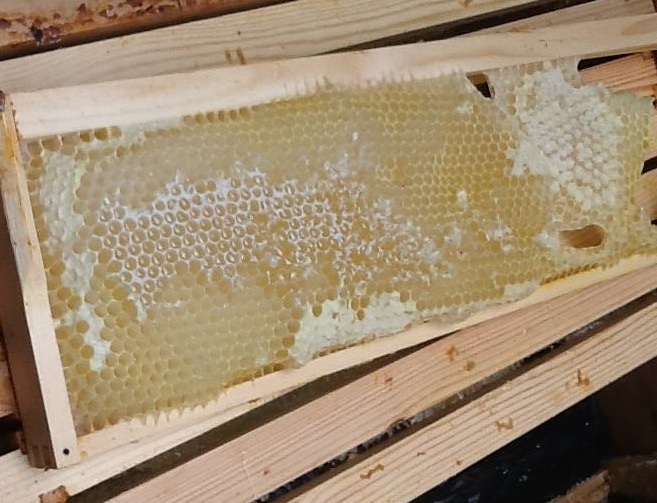
Bee pollen is literally just the pollen collected by the bees. It is generally collected by forcing the bees to enter the hive through smaller then normal holes so the pollen drops below to be collected. This possibly puts a lot of pressure on the hive depending on how this is done.
What is the purpose of bee pollen in the aquarium?
Bee pollen is a dietary additive, there is a rising popularity in regards of this ingredient for people and perhaps this is the source of the idea. While it is an interesting ingredient and for those that might feed on fruit there could be a benefit. The actual benefits in general are debatable, with an omnivorous/carnivorous Clarias sp. catfish there were many physiological benefits shown up to 1% addition (Nowosad et al., 2022). When bee pollen was added to the diet of the insectivore zebrafish, Danio rerio there is no shown benefits to physiology but improve viral resistance (Di Chiacchio et al., 2021). In Nile tilapia, Oreochromis niloticus liver regeneration is shown to occur when fed bee pollen (Picoli et al., 2019).
What is propolis?
Propolis is the compounds and structures that seal the hive and the waxy structures that the hive is built on. It originates from the waxy areas of plants such as buds.
What is the purpose of propolis in the aquarium?
It’s not particularly common in aquariums but you might find the produce available more within the koi hobby. This product is used largely to seal wounds not just for protection against microbes entering them but also if you want to seal in a treatment. There does seem to be little research into the topic although some of the compounds do show promise when it comes to wound healing (Wibowo et al., 2021) and nutrition (Farag et al., 2021). More importantly there seems to be no papers onto any toxicity of propolis which is somewhat promising but could also be useful to cross out.
Conclusion
A very brief article I guess as to what could apply to the aquarist, it seems there needs a lot more research but I wouldn’t be afraid to use it. Personally I think bee pollen could be great for promoting feeding in fishes due to the sugars present. It’s something I think we could explore further.
References:
Di Chiacchio, I. M., Paiva, I. M., de Abreu, D. J., Carvalho, E. E., Martínez, P. J., Carvalho, S. M., … & Murgas, L. D. S. (2021). Bee pollen as a dietary supplement for fish: Effect on the reproductive performance of zebrafish and the immunological response of their offspring. Fish & Shellfish Immunology, 119, 300-307.
Farag, M. R., Abdelnour, S. A., Patra, A. K., Dhama, K., Dawood, M. A., Elnesr, S. S., & Alagawany, M. (2021). Propolis: Properties and composition, health benefits and applications in fish nutrition. Fish & Shellfish Immunology, 115, 179-188.
Nowosad, J., Jasiński, S., Arciuch-Rutkowska, M., Abdel-Latif, H. M., Wróbel, M., Mikiewicz, M., … & Kucharczyk, D. (2022). Effects of bee pollen on growth performance, intestinal microbiota and histomorphometry in African catfish. Animals, 13(1), 132.
Picoli, F., Lopes, D. L. D. A., Zampar, A., Serafini, S., Freccia, A., Veronezi, L. O., … & Emerenciano, M. G. C. (2019). Dietary bee pollen affects hepatic–intestinal histomorphometry of Nile tilapia fingerlings. Aquaculture Research, 50(11), 3295-3304.
Wibowo, I., Utami, N., Anggraeni, T., Barlian, A., Putra, R. E., Indriani, A. D., … & Ekawardhani, S. (2021). Propolis can improve caudal fin regeneration in zebrafish (Danio rerio) induced by the combined administration of Alloxan and glucose. Zebrafish, 18(4), 274-281.
 The Scientific Fishkeeper