
While it has been a hot topic in the exotic pet community for a while this topic is starting to gain traction in the aquarium hobby. The Scottish Government was provided with a report by the SSPCA, Born Free Foundation and One Kind titled “Don’t Pet Me”. This report sets out a case for the restriction and banning of a number of pets although definitions are unclear they largely use the term wild animals.
When analysing a document like this it’s important to understand who wrote it, unlike scientific papers this is not peer reviewed and biases do not have to be declared. Born Free Foundation is already actively against exotic pets (https://www.bornfree.org.uk/wild-animals-pets/), this is also the case for OneKind (https://www.onekind.org/listing/category/dont-pet-me) and the Scottish SSPCA is largely an animal welfare organisation but has done a lot of really good work. The others have done misleading campaigns in the past but I wont get into them as the focus here is this one. None of the contributors seem to be stakeholders in the industry nor scientists studying the relevant taxa.
The Reports Methodology
The first thing to set out is what they mean by a wild animal. This report fails to provide a definition for a wild animal, or as they say an exotic pet, I shall be using these terms interchangeable. This lack of clarity is problematic as the definition and understanding of the term varies. The Cambridge dictionary states a wild animal as “An animal that lives in natural conditions and is not cared for by humans”, which is a broad brush but ignores any captive animals as they are obviously being cared for. UK law doesn’t seem to have a definition beyond a list of those species covered by the Dangerous Wild Animals Act 1976 which require a license. Exotic pets in an interim report with the Scottish government identified the term is misleading and inappropriate with varying definitions (https://www.gov.scot/publications/scottish-animal-welfare-commission-interim-report-exotic-pets-scotland/pages/5/). A debate in the UK parliament identified exotic pets as rare or unusual https://commonslibrary.parliament.uk/research-briefings/cdp-2015-0124/, not a helpful definition. A 2022 final report mentions rabbits and small rodents as exotic pets although doesn’t focus on these excluding dwarf hamsters (https://www.gov.scot/publications/final-report-exotic-pet-working-group-scottish-animal-welfare-commission/pages/4/). When it comes to vets it’s generally considered anything that is neither livestock, horses, a dog or cat is considered exotic. With such a broad definition this makes this 2025 report handed to the Scottish Government concerning but also open.
While literature is present on the topic of a variety of exotic pets, this report also fails to reference much of this peer reviewed scientific literature. Much of the literature provided shows a clear conformation bias rather then an argument, it only portrays one point of view. There is no discussion of the benefits and many of the citations reference trends in other countries opposed to focus on practices in the UK. Some of the sources are irrelevant e.g. the captive husbandry of slow loris (Nekaris et al., 2015) in page 31 and used it to compare to crested gecko’s, could they not find a single source that inferred that the squeaking behaviour was an example of stress in this gecko species? Just because viewers might find a behaviour cute it doesn’t mean they want to buy the animal. Ramsay et al. (2007) is used to discuss red eared sliders, a species already banned in the UK. Realistically given the very limited citations there isn’t so much I can say about them.
They claim to send a mystery shopper to a range of stores as mentioned in page 8, while it sounds ideal how do we know what stores were included and the quality of those stores? Was it just the bad eggs? Could they not say which stores they visited?

There are some issues with the terminology used (Fig 2), maybe it is too simplistic but they could have cited a source with a detailed definition. The one that is most odd to me is morphs, not all morphs are ‘sought after’, this phrase maybe makes it seem like there is a trend or market. A morph really is just a variant. The term morph is very specific to the reptile hobby and seems more like targeting as within other exotic pet hobbies we might use terms such as breeds or variants.
The Reports Results
Some of these results would benefit from reliable citations such as “For example, royal (ball)
pythons (Python regius) are frequently wild-caught”, given the number of morphs in the UK which would not be wild caught as these are captive strains this is likely misleading. Additionally yes there will be royal pythons wild caught but are these reaching the UK? The paper that the report they mention mostly doesn’t infer this is relevant (Green et al., 2020) as the source of royals into the UK isn’t mentioned. This could be solved by asking wholesalers.
The report criticises the use of RUB’s (Really Useful Boxes), the reptile hobby already criticises this and it’s a self policing hobby that is regulating, yet there is little mention of this. This self policing trait within exotic pet communities while sometimes internally criticised is an important part of developing and improving welfare based on science and evidence within a hobby (Muka, 2022), it is not rare either. Maybe this is evidence of how the worst parts of our communities let us down, and could now be our downfall. My community here, on Youtube and Discord is not alone in providing up to date husbandry that also helps self police to the hobby. This has been somewhat recognised within the report for the hedgehog hobby (Page 12) but it makes no effort to recognise how widespread this is. There is frequent criticism of snake enclosure sizes, maybe supporting and promoting those who are encouraging evidence based husbandry would be better then making it seem like the whole hobby is doing this.
Some of the images used (e.g. Page 13) are not from the UK or represent the UK trade, many parrots in the UK will be captive bred. This is emotive imagery but not realistic.
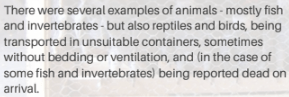
Fishes are often transported as we are well aware in bags sometimes polyboxes but these are safe for the fish in movement and there has yet to be a good alternative. The mention of bedding and ventilation for shipping fishes is just ridiculous, what bedding would they suggest? And ventilation? It’s just as bad as PETA suggesting we use tranquilisers to transport fishes. Any decor does risk breaking the bag but also if it shifts stressing out or damaging the fish.
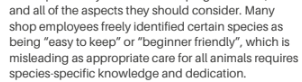
Some of the criticism maybe is a little odd (Figure 4), labelling a species as easy to keep or beginner friendly doesn’t mean the store isn’t recognising there is species specific requirements, it’s inferring that the husbandry is not as difficult as other species. While I disagree often with the species chosen it is not for this reason, often these species might have requirements that can be missed by someone after an ‘easy’ pet but no hobbyist usually wants their animals listed as easy.
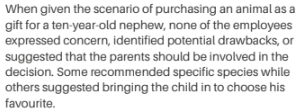
While a problematic scenario is provided (Figure 5) when provided with a challenging situation such as a child wanting a pet the second solution is not bad. Customers can be challenging and this second solution likely would allow the child to obtain some education from the animal, avoid an unwanted pet and hopefully get the parents involved. But without a full script much of this secret shopping experience is biased and unreliable. The report fails to recognise that sales setups are aimed to be short term and therefore often smaller then a long term setup and these are not recommended for long term care.
Issues with Data
There are frequent issues with the data provided which could be misleading but also infer to me a lack of knowledge about animal biology and husbandry.
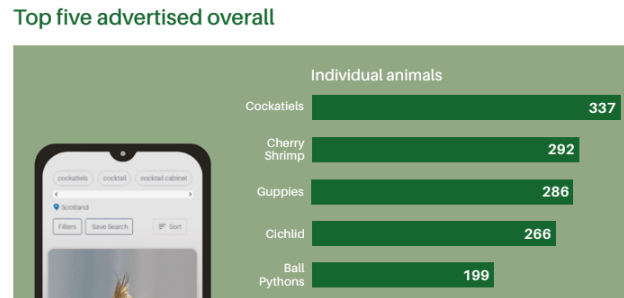
Data often needs to be properly dissected and understood or it can be misread. Figure 6 identifies cherry shrimp (Neocardinia davidi), Guppies (Poecilia reticulata, do they mean P. wingei hybrids as well?) and cichlids as the most populous species sold. There are loads of errors with this statistic. Firstly cherry shrimp and guppies are very frequent spawners and small organisms as hobbyists we know this, so it makes sense so many would be for sale. But given their size they take up much less space and instead particularly for guppies a focus would be better aimed as only buying males given females are often already pregnant. I don’t see how these two are a problem entirely being so high, they are easy going aquatics. Cichlids though is an issue, you first have the bias that this is one of the largest families of fishes with incredible diversity. So it is understandable why there would be so many. I do have an issue with data like this where there is not equitable groups provided. The fishes shown here represent likely multiple species so would represent more individuals, is that bad?
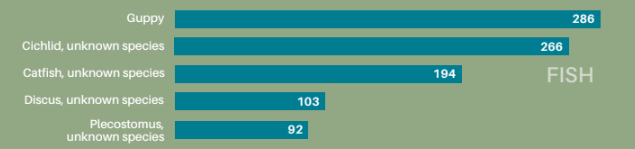
Figure 7 is very problematic to me as none of these groupings really have definitions. My criticism of the term guppy without a scientific name is the same from the previous comment. Unknown species could infer the seller doesn’t know the species, or the writers of the report have no idea, if they can’t identify the species why are they writing a report on husbandry? Is it to make the sellers look bad if it infers that the seller doesn’t know? Discus are cichlids and ‘Plecostomus’ are catfishes. The discus category is concerning as it’s pretty simple, wilds aren’t common in the UK so we are dealing with domestics which are a hybrid, it’s not even unknown they are a mixture of mostly Symphysodon tarzoo and S. aequifasciatus (Ng et al., 2021).
Plecostomus as someone who studies Loricariids is the most problematic category. Plecostomus is no longer a valid genus, Hypostomus plecostomus is barely if at all in the trade. Plecostomus as a common name is a pick and mix name, so how broad do they mean? Could they be including the Chinese algae eater, Gyrinocheilus aymonieri, which is a very frequently rehomed fish. Are they including Ancistrus as some have done? What about Loricariinae? 92 (Figure 7) would be a lot even just for Pterygoplichthys which has never been in Plecostomus. Loricariidae is popular but the term Plecostomus means very little without a definition. Many people breed Loricariids and according to the IUCN what is identified, there are still many threatened in the wild. I’m not being pedantic though, this is not a consistent term.
Exotic pet demographics
As someone who has been diagnosed with dyslexia and SpLD since I was 8 this section infuriated me. There was an obvious targeting of neurodiverse people.

An unneeded targeting of neurodiversity was included (Figure 8), why this was relevant I have no idea. While they recognise precise knowledge it seems to infer there is something problematic with neurodiverse people and animals, that maybe we are less capable. Neurodiversity includes conditions from autism, dyslexia, ADHD and similar, it’s a broad term but we all think differently, this means we can problem solve. These conditions do not infer with our ability to keep animals with high welfare and in fact it might mean we can identify new solutions to husbandry problems.
They continue to target disabilities.
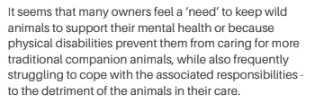
There is no need to explain how animals help with mental health, we all know that. Although I argue fishes are stress causing haha, I must say Zach, my little (6kg! but not overweight) void cat has been a blessing to me (even if he ensures he has breakfast at 2-4am no matter what). Exotics can differ a lot from traditional pets so it makes sense many provide solutions to disabled people, it could be from cleanliness and issues with fur or just fascination. This statement (Figure 8b) infers that disabled people, that includes the neurodiverse community so those with dyslexia, ADHD and autism can’t cope with their animals because we are disabled. Most of us our disability has nothing to do with animal husbandry! While I have short term memory issues, issues with understanding language it has nothing to do with how I can keep my animals. Even when I’ve broken bones I’ve still managed to do water changes, in a way my dyslexia has allowed me to problem solve around not being able to use a broken arm/wrist. It ignores how disabled people can identify new solutions due to differences in thinking. I don’t know what disabled people are frequently saying they can’t cope as that’s definitely a minority. Neurodiversity is common in fishkeeping and no one has told it’s causing them to struggle. I’ve worked in the trade and I know exactly how much I can care for and I know I can keep a lot more then I do now (academia means moving a lot).
Another concern of the report which highlights a bias is they recognise on page 21 that many keepers work with animals, qualifications vary from none to PhD. Yet in the next paragraph they state “Most people who own wild animals appear to be either irresponsible, or well-intentioned but lacking the necessary knowledge and equipment.”. This is clearly stating they think that those who work with the animals husbandry are not as knowledgeable, as who? I assume them? Do they have anything to back this up? And given Born Free has frequently campaigned against zoos it infers that they are inferring there are no husbandry experts. It infers that zookeepers and store staff, academics etc. don’t know as much as they do.

I don’t know why Figure 9 was included, is this inferring that people who show their animals are of a low socio-economic status? And what do they mean by that? How are they judging? You can’t judge from a video or photo someone’s socio-economic status.
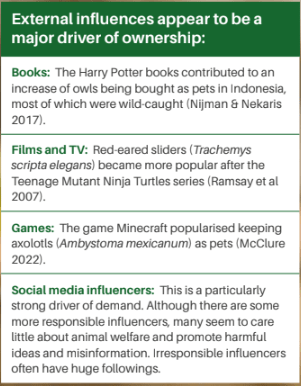
No one is debating the external influences with the hobby (Figure 10), the hobby actively tries to fight it yet little mention or promotion of responsible communities.
Frequently throughout statements are made but not cited or even a lack of values provided. They state their opinions but make it unclear that they are opinions. They do not communicate with husbandry or scientific experts in a variety of groups. Frequently statements are made about the hobby that the hobby is trying to solve.
Page 29 fails to recognise the lack of availability of exotic vets or specialism of vets particularly for diverse groups. It also fails to recognise responsible communities and individuals recommend vets frequently where this is the required intervention and not a husbandry issue.
They state people blame “Flimsy enclosures were often blamed but human error was also a cause.”, both of these can easily be the cause as there are weak enclosures and an owner might not be aware. This is obviously more common with small mammals but with fishes a lid is always promoted for a variety of reasons.
On page 29 they identify the use of live feeding vertebrates, the legislation on this is tricky but it would be great if they could provide clarity as to if their sources were in the US or other countries where this is common. I have yet to hear of this in the UK.
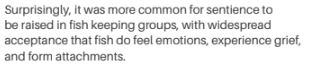
I guess this is a positive for fishkeeping!
They do mention issues with handling on page 31, as someone whose worked with a range of exotic animals but also a fan of choice based handling. It can be useful for animals to get used to handling as sometimes care might be required, this is less common for non-mammalian exotics who lack nails or fur that needs trimming. They mention axolotls being handled which I have yet to see being common practice……. although aquatic species being handled for some such as Loricariids it allows for a quick clear assessment of the fish and as facultative air breathers it causes little harm, most people are only taking photos when being moved between setups so will be out of the water anyway. Seeing defensive as ‘cute’ is not entirely common but for some animals if handling is required confidence is needed as waiting, going in slow will likely result in an accident.
Premature death in the trade is mentioned but there are no real statistics on this and this should be recognised.
For demographics my personal concern has been the age groups between around 16-18 which will be moving for university or perhaps renting, not that they can’t keep pets but it does effect choices. Having animals younger effects where you can live given rental restrictions but also animals being banned from university halls. This has not been identified in the report yet within aquariums and reptiles there is definitely a demographic gap where there are less people between around 18-30 although I would be curious how the upper end might change.
The reports recommendations
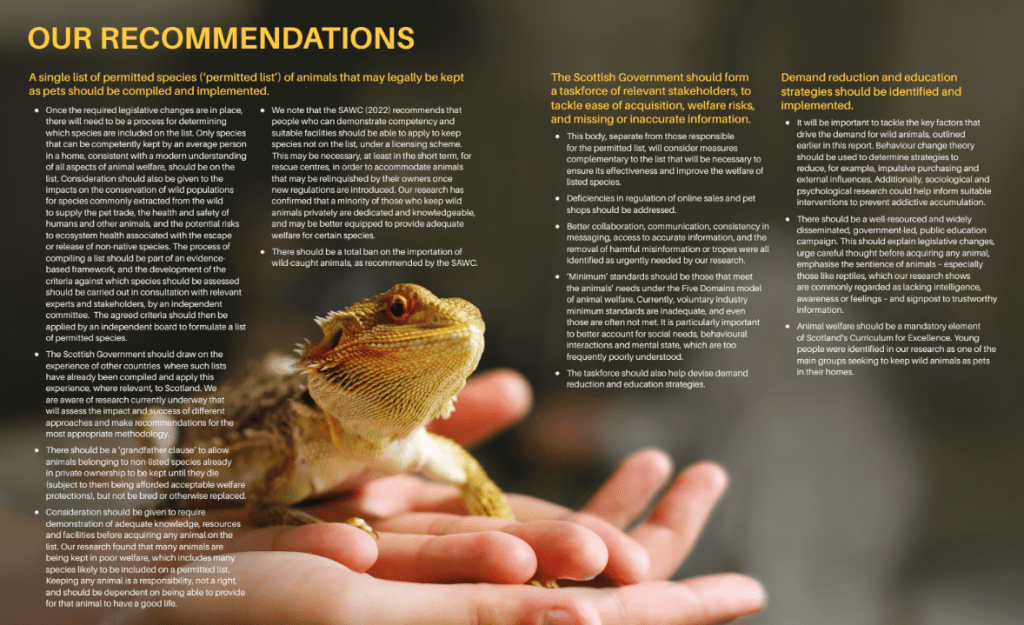
A Positive List
The most concerning part of the report is the promotion of a positive list, this is a list of species that people would be allowed to keep. We have no idea what would be included here and the report provides little clarity other then more common exotics such as rabbits, guinea pigs and hamsters maybe wont be included? This is regardless of those three also facing similar difficulties but also have active communities promoting welfare.
This positive list could mean many things, it could mean that you could keep what you have till it passes. It might mean you cannot breed, trade or sell the animals. It could mean euthanasia. It could mean no imports. Most of these would make legal captive populations extinct.
Illegal populations will always exist but these will go underground, animals will have no access to veterinary care. While exotic vets are rare there will be even less access to them for the animals that exist legally as demand decreases, many of these animals are long lived so catfishes, parrots and reptiles would be without.
The benefits of the aquarium hobby are well known, both to people but also to the species encountered within it (Evers et al., 2019). As a hobby we do need to promote and further these benefits, we need to reduce the pressure on a small number of species but be responsible with what we keep. The hobby is a source of knowledge both from hobbyists (Marchio, 2018) who are not professionals but also from academics and husbandry experts, it has been identified previously vets will defer to hobbyists for knowledge (Walster et al., 2015).
Encounters, awareness and exposure to a diversity species will decrease. Zoos contain a very limited number of exotics for many groups such as freshwater fishes. A lot of interest in many freshwater groups which can lead to scientific research or conservation (ex-situ and in-situ) can originate from this exposure. There are many aspects of the aquarium hobby involved in ex-situ conservation and captive breeding so a positive list would remove this potentially causing an extinction of some species. Captive breeding fishes is promoted within the hobby and often not for money (Pountney, 2023).
The aquarium hobby provides an industry for locals who fish for the species we value as hobbyists. None more obvious then the cardinal tetra and discus of South America such as around Manaus. The aquarium hobby provides a job for locals, without it to support their families they would have to go into other jobs such as deforestation or mining.
The aquarium hobby, it’s exposure and the structure itself has allowed for the identification of new species, while not always classified we have systems such as the L number and CW number system. These can support and aid scientific research.
What can you do to protect your hobby?
While this is a Scottish report and aimed at restricting animals within Scotland there is no harm in making your concerns known throughout the UK. Contact your local MP with your concerns. Within Scotland be aware of who you are voting for.
OATA has great sources as the only representative for UK fishkeeping who is able to fight this report: https://ornamentalfish.org/
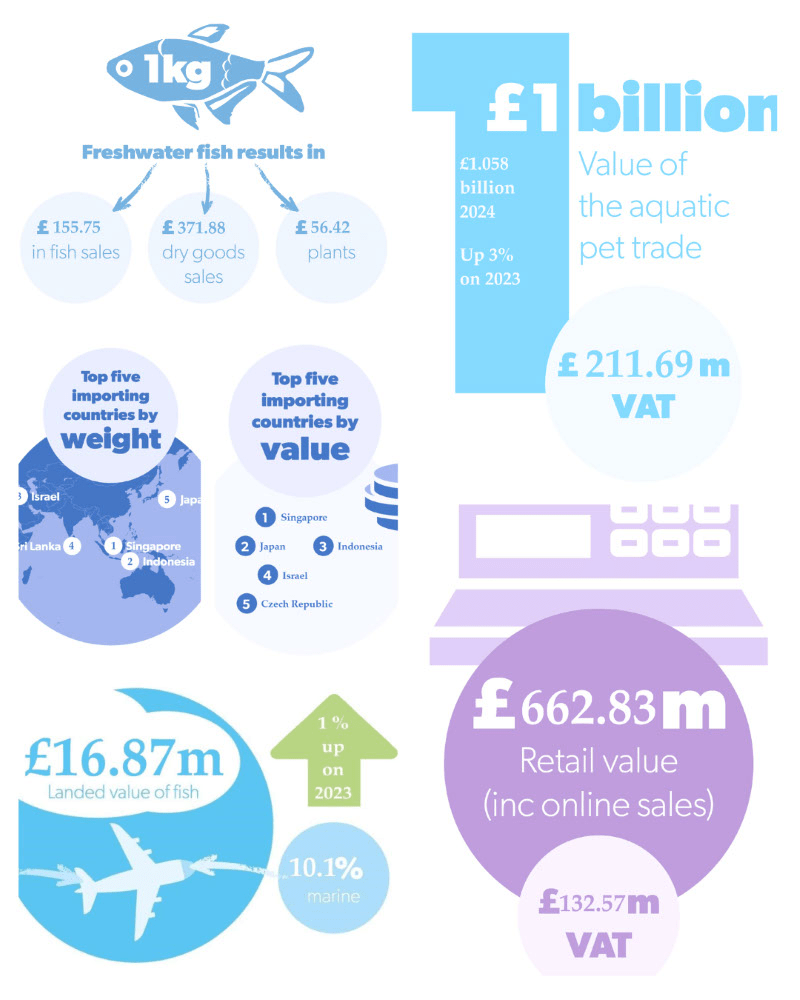
The report itself: https://dontpetme.org/ https://drive.google.com/file/d/1nvje1bJ0x0ESLKbRuPDm7sUyFZ_VVCJN/view
Evers, H. G., Pinnegar, J. K., & Taylor, M. I. (2019). Where are they all from?–sources and sustainability in the ornamental freshwater fish trade. Journal of Fish Biology, 94(6), 909-916.
Green, J., Coulthard, E., Megson, D., Norrey, J., Norrey, L., Rowntree, J. K., … & D’cruze, N. (2020). Blind trading: a literature review of research addressing the welfare of ball pythons in the exotic pet trade. Animals, 10(2), 193.
Marchio, E. A. (2018). The art of aquarium keeping communicates science and conservation. Frontiers in Communication, 3, 17.
Muka, S. (2022). Taking hobbyists seriously: The reef tank hobby and knowledge production in serious leisure. Studies in History and Philosophy of Science, 93, 192-202.
Nekaris, K. A. I., Musing, L., Vazquez, A. G., & Donati, G. (2015). Is tickling torture? Assessing welfare towards slow lorises (Nycticebus spp.) within Web 2.0 videos. Folia Primatologica, 86(6), 534-551.
Ng, T. T., Sung, Y. Y., Danish-Daniel, M., Sorgeloos, P., de Peer, Y. V., Wong, L. L., & Tan, M. P. (2021). Genetic variation of domesticated discus (Symphysodon spp.). Aquaculture, Aquarium, Conservation & Legislation, 14(2), 832-840.
Pountney, S. M. (2023). Survey indicates large proportion of fishkeeping hobbyists engaged in producing ornamental fish. Aquaculture Reports, 29, 101503.
Walster, C., Rasidi, E., Saint-Erne, N., & Loh, R. (2015). The welfare of ornamental fish in the home aquarium. Companion Animal, 20(5), 302-306.
 The Scientific Fishkeeper