
Hole in the Head (HITH) is a disease but like swim bladder disorders more of a symptom rather then a pathogen, it’s quite distinctive but not always the easiest to handle. Most commonly found it seems in cichlids particularly discus but I have personally identified the disease in goldfish. It is related to lateral line erosion.
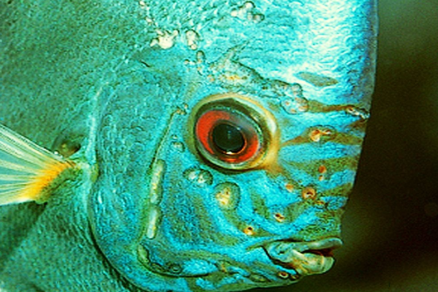
Identification
Can be characterised by:
- Holes/pits on the head or lateral line.
- Appears first white growths which last usually a few days from these pits.
- Necrosis around the the pits.
- Often in older fishes particularly cichlids (Amesberger‐Freitag et al., 2019; Morrison et al., 2007; Paull and Matthews, 2001).
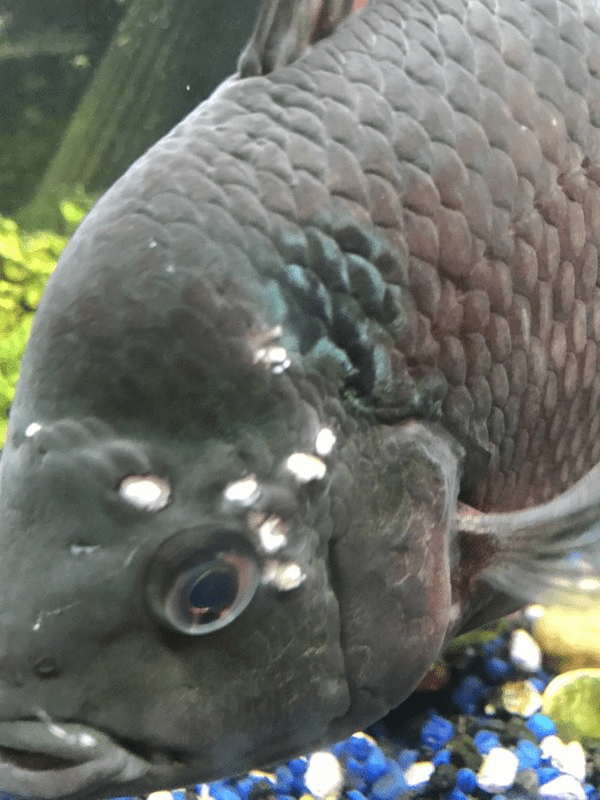
It is definitely worth noting those white growths, some have confused it with being caused by fungi, bacteria or other protozoans. Some unreliable resources have thought it’s a totally new disease (Canal Neuromast Inflammation Syndrome, which isn’t a real disease) but if you actually observe it is the early stages of hole in the head.
Causes
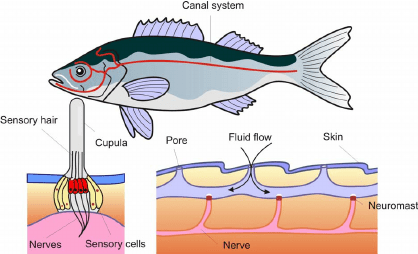
The disease involves erosion and necrosis of areas where neural pits are present, this causes tissue damage and necrosis of the surrounding tissues giving originally a pitted appearance but can spread further.
The actual causes are debatable and there are many ways to handle it:
- Hexamita and related pathogens such as Spironucleus (Paull and Matthews, 2001), pathogens have been isolated from these lesions.
- Stray charge, not sure if this has any scientific backing but it is worth just crossing out as it’s quite easy to do so.
- Activated carbon (Amesberger‐Freitag et al., 2019), largely associated with any could have powders rather then the sponges. While it seems shown in a marine sturgeon fish (Acanthurus bahianus) which generally are associated with a different pathogenic cause and the mode of action isn’t well known there is some correlation (Stamper et al., 2011). I wonder if it’s associated with actually attaching to the pits or causing some abrasion but I don’t know how it would work.
- Nutrition (Amesberger‐Freitag et al., 2019; Paull and Matthews, 2001)
- Age and other stressors (Amesberger‐Freitag et al., 2019; Morrison et al., 2007)
Treatment
My personal opinion is to actually cross off as many causes as possible, nutrition and water quality should be assessed, is the diet providing everything the fish needs. While I do think some diets are good for rapid growth for long term health they might not be as useful. Stray charges can be grounded and it has actually solved the issue for me in the past, but any faulty electrics are worth checking for. Activated carbon is largely not needed long term in an aquarium unless removing tannins or medication, it is useful for filtration of rainwater though.
When it comes to actually treating Hexamita many have found Octozin previously sold by Waterlife but now NT labs effective containing dimetridazole. It is directed to add into the water but there is discussion online to be used orally with food particularly on persistent infections, as it is now in a liquid it should be quite easy for the fish to take up and easy to avoid underdosing. It is always best and advised to treat as recommended on the bottle. In the US or countries where legal to be obtained without a prescription metronidazole be used (Whaley & Francis-Floyd, 1991), this is also an antibiotic so will target a very broad group of organisms and shouldn’t be used without considerable thought.
Prognosis
At the end of the day this disease can be tricky to treat, it is often not fatal. It can lead to more permanent scars and the fish if it is not severe can heal. It can also be lethal if left. So it is definitely worth treating but it doesn’t progress as rapidly as say white spot/ich (Ichthyophthirius multifiliis) so not quite as lethal.
References
Amesberger‐Freitag, A., Tichy, A., El‐Matbouli, M., & Lewisch, E. (2019). Hole‐in‐the‐head disease in discus fish, Symphysodon (Heckel, 1840): Is it a consequence of a dietary Ca/P imbalance?. Journal of Fish Diseases, 42(8), 1133-1142.
Morrison, C. M., O’Neil, D., & Wright Jr, J. R. (2007). Histopathology of “hole-in-the-head” disease in the Nile tilapia, Oreochromis niloticus. Aquaculture, 273(4), 427-433.
Paull, G. C., & Matthews, R. A. (2001). Spironucleus vortens, a possible cause of hole-in-the-head disease in cichlids. Diseases of Aquatic Organisms, 45(3), 197-202.
Stamper, M. A., Kittell, M. M., Patel, E. E., & Corwin, A. L. (2011). Effects of full‐stream carbon filtration on the development of head and lateral line erosion syndrome (HLLES) in ocean surgeon. Journal of Aquatic Animal Health, 23(3), 111-116.
Whaley, J., & Francis-Floyd, R. A Comparison of Metronidazole Treatments for Hexamitiasis in Angelfish IAAAM 1991.
 The Scientific Fishkeeper